GB 50923-2013 PDF English
US$505.00 · In stock · Download in 9 seconds
GB 50923-2013: Technical code for concrete-filled steel tube arch bridges
Delivery: 9 seconds. True-PDF full-copy in English & invoice will be downloaded + auto-delivered via email. See step-by-step procedure
Status: Valid
GB 50923-2013: Technical code for concrete-filled steel tube arch bridges
Delivery: 9 seconds. True-PDF full-copy in English & invoice will be downloaded + auto-delivered via email. See step-by-step procedure
Status: Valid
| Standard ID | USD | BUY PDF | Delivery | Standard Title (Description) | Status |
| GB 50923-2013 | 505 | Add to Cart | Auto, 9 seconds. | Technical code for concrete-filled steel tube arch bridges | Valid |
Similar standards
GB 50923-2013: Technical code for concrete-filled steel tube arch bridges
---This is an excerpt. Full copy of true-PDF in English version (including equations, symbols, images, flow-chart, tables, and figures etc.), auto-downloaded/delivered in 9 seconds, can be purchased online: https://www.ChineseStandard.net/PDF.aspx/GB50923-2013GB NATIONAL STANDARD OF THE PEOPLE’S REPUBLIC OF CHINA UDC P GB 50923-2013 Technical code for concrete-filled steel tube arch bridges Issued on: NOVEMBER 01, 2013 Implemented on: JUNE 01, 2014 Issued by. Ministry of Housing and Urban-Rural Development of PRC; General Administration of Quality Supervision, Inspection and Quarantine of the People's Republic of China.
Table of Contents
Foreword... 6 1 General provisions... 8 2 Terms and symbols... 8 2.1 Terms... 8 2.2 Symbols... 10 3 Materials... 16 3.1 Steel... 16 3.2 Concrete... 16 3.3 Concrete-filled steel tubes... 17 3.4 Other materials... 18 4 Basic requirements... 18 4.1 General requirements... 18 4.2 Actions... 20 4.3 Structural calculation... 22 5 Calculation of ultimate limit state in persistent situation... 23 5.1 General requirements... 23 5.2 Arch rib strength calculation... 24 5.3 Arch rib stability calculation... 30 5.4 Suspenders and tie cable calculation... 35 6 Calculation of serviceability limit states in persistent situation... 36 7 Structure and detailing... 37 7.1 Structure forms... 37 7.2 Main arch... 38 7.3 Arch seat and spandrel columns... 42 7.4 Suspender and tie... 42 7.5 Deck system... 43 8 Fabrication of steel tube arch rib... 43 8.1 Fabrication of steel tube... 43 8.2 Assembling of steel tube arch rib... 44 Technical code for concrete-filled steel tube arch bridges1 General provisions
1.0.1 This Code is formulated to meet the needs of bridge construction and ensure that the design, construction, maintenance of concrete-filled steel tube (CFST) arch bridges meet the requirements of safety, reliability, durability, advanced technology, economic rationality. 1.0.2 This Code applies to the design, construction, maintenance of concrete-filled steel tube (CFST) arch bridges, particularly urban and highway bridges. 1.0.3 In addition to complying with this Code, the design, construction, maintenance of concrete-filled steel tube (CFST) arch bridges shall also comply with the provisions of relevant current national standards.2 Terms and symbols
2.1 Terms 2.1.1 Concrete-filled steel tube (CFST) arch bridge A bridge whose primary load-bearing structure is an arch rib, which is formed by circular concrete-filled steel tubes as the basic unit. 2.1.2 CFST arch rib An arch rib whose primary load-bearing unit is concrete-filled steel tubes. 2.1.3 Steel tube arch rib An arch rib whose steel tube is not filled with concrete. 2.1.4 Concrete in tube Concrete poured inside a steel tube, also known as core concrete. 2.1.5 CFST member A member in which concrete is poured inside a steel tube, with the load shared by the steel tube and the concrete.3 Materials
3.1 Steel 3.1.1 The steel tubes in the concrete-filled steel tube arch ribs should be carbon structural steel or low-alloy high-strength structural steel of quality grade B or higher. Their quality requirements shall comply with the current national standards "Carbon structural steels" GB/T 700 or "High strength low alloy structural steels" GB/T 1591. 3.1.2 The steel tubes may be rolled welded tubes or seamless steel tubes. When the rolling requirements are met, straight seam welded tubes should be used. 3.1.3 The main strength indicators of the steel shall be adopted according to Table 3.1.3. 3.1.4 The physical properties of steel may be adopted according to Table 3.1.4. 3.2 Concrete 3.2.1 The concrete grade within the concrete-filled steel tube arch rib shall not be lower than C30, which should be C40 ~ C60. 3.2.2 The standard value of the axial compressive strength fck, the design value of the axial compressive strength fcd, the standard value of the axial tensile strength ftk, the design value of the axial tensile strength ftd, the elastic modulus Ec of the concrete shall be adopted according to Table 3.2.2.The concrete's shear deformation modulus Gc may be 40% of the elastic modulus Ec in Table 3.2.2; the concrete Poisson's ratio µc may be 0.2. 3.3 Concrete-filled steel tubes 3.3.1 The following material combinations may be used to match the steel tube and the concrete within the tube. 1 Q235 steel for concrete of strength grades C30 ~ C40. 2 Q345 steel for concrete of strength grades C40 ~ C60. 3 Q390 steel for concrete of strength grades C60 or above. 3.3.2 The wall thickness of the steel tube in concrete-filled steel tube members shall not be less than 8 mm. The ratio -- of the outer diameter D of the steel tube to the wall thickness t -- should be 35 × (235/fy) ~ 100 × (235/fy). The standard value fy of steel strength shall comply with the provisions of Table 3.1.3 of this Code. 3.3.3 The design value of the confinement or hooping coefficient ξ0 for concrete-filled steel tubes should not be less than 0.60; the cross-sectional steel content ρc should be 0.04 ~ 0.20.The ξ0 and ρc shall be calculated according to the following formulas. Where. ξ0 - Design value of the confinement or hooping coefficient for concrete-filled steel tubes; ρc - The cross-sectional steel content of concrete-filled steel tubes; As - The cross-sectional area of the steel tube (mm2); Ac - The cross-sectional area of the concrete in the steel tube (mm2); fs - The design value of the tensile, compressive, flexural strength of the steel plate (N/mm2); fcd - The design value of the axial compressive strength of the concrete (N/mm²). 3.4 Other materials 3.4.1 High-strength steel wire for suspenders and tie cables should be Φ5 mm or Φ7 mm hot-dip galvanized steel wire. The standard strength should not be less than 1670 N/mm2; the performance requirements shall comply with the current national standard "Hot-dip zinc or zinc-aluminium coated steel wires for bridge cables" GB/T 17101. 3.4.2 Steel strands for suspenders and tie cables should be high-strength, low-relaxation prestressed galvanized or other protective steel strands. The standard strength should not be less than 1860 N/mm2; the performance requirements shall comply with the current national standard "Steel strand for prestressed concrete" GB/T 5224. 3.4.3 Steel used for anchors and connectors for suspenders and tie cables shall be high- quality carbon structural steel or alloy structural steel; the performance requirements shall comply with the relevant current national standards. Protective materials used for suspenders and tie cables shall not contain components that are corrosive to steel.4 Basic requirements
4.1 General requirements 4.1.1 This Code adopts a limit state design method based on probability theory; the designs are performed according to the design expressions of partial coefficients. 4.1.2 CFST arch bridges shall be designed according to the following two limit states. 1 Bearing capacity ultimate state. It corresponds to a state in which the CFST arch or its components have reached their maximum bearing capacity, or have undergone deformation or displacement that is unsuitable for continued bearing. 2 Serviceability limit state. It corresponds to a state in which the CFST arch or its components have reached a certain limit of normal use or durability. 4.1.3 CFST arch bridges shall be designed, according to the bearing capacity ultimate state for persistent situations and the serviceability limit state for persistent situations. 4.1.4 The seismic design of CFST arch bridges shall comply with the provisions of the current industry standards "Code for seismic design of urban bridges" CJJ 166 or "Guidelines for seismic design of highway bridges" JTG/T B02-01. 4.1.5 The bearing capacity, deformation, stability of the connections between steel structures and steel components in concrete-filled steel tube arch bridges, including the steel tube arch structure during the construction phase before the concrete in the tube reaches the design strength, shall be designed and calculated as for bridge steel structures; meanwhile it shall comply with the provisions of relevant current national standards. 4.1.6 The design of concrete-filled steel tube arch bridges shall determine the guiding construction plan, main construction steps, quality requirements, allowable unbalanced loads during construction, based on the topography, geology, transportation conditions, and other construction conditions. It shall also define the sequence of structural system conversion and the measures to be taken. 4.1.7 The design of concrete-filled steel tube arch bridges shall include calculations for the main construction phases. Calculations during the construction phase shall include the following. 1 Calculations of stress, deformation, stability of arch rib components during transportation and installation. 2 Calculations of ancillary structures related to arch rib formation. 3 Calculations of stress, deformation, stability of the arch rib itself during formation. 4 Calculations of stress, deformation, stability of the bridge structure during completion. 4.1.8 Construction calculations shall take into account actual loads that may occur during construction, including erection equipment and materials, construction personnel, deck loads, wind forces, temperature fluctuations, and other temporary construction loads. The structural elastic stability characteristic value during the construction phase shall be no less than 4.0. 4.1.9 The CFST arch ribs, cross braces, columns, deck girders shall be designed to meet inspection and maintenance requirements during use. 4.1.10 The steel structure of CFST arch bridges shall be designed for corrosion protection, based on the atmospheric corrosion environment at the bridge site, with a maintenance-free period of no less than 15 years. The anti-corrosion system should be designed based on the environment and different parts of the bridge. The steel surface rust removal grade, surface cleanliness, surface roughness requirements for different anti-corrosion systems shall comply with the current industry standard "Technical conditions for anti-corrosion coating of highway bridge steel structure" JT/T 722. 4.1.11 The durability requirements for waterproofing, drainage, and other structures of CFST arch bridges shall comply with the relevant national standards. 4.1.12 Before construction of concrete-filled steel tube arch bridges, it shall develop specific construction and safety technical plans for each key process. 4.1.13 Construction monitoring and control shall be conducted for large-span concrete- filled steel tube arch bridges. The arch axis, internal forces, suspender, tie cable tension, steel tube stress shall meet design requirements. 4.2 Actions 4.2.1 The load classification, effect combination, load calculation for concrete-filled steel tube arch bridges shall not only comply with the provisions of this Code but also, depending on the nature of the project, comply with the current industry standards "Code for design of the municipal bridge" CJJ 11 or "General specifications for design of highway bridges and culverts" JTG D60. 4.2.2 The vehicle load impact coefficient µ0 of the concrete-filled steel tube arch rib can be calculated using the following formula. Where. f0 - The first-order vertical frequency of the concrete-filled steel tube arch bridge (Hz). 4.2.3 The deformation of a concrete-filled steel tube arch caused by temperature changes, or the resulting secondary internal forces, shall be calculated and determined (EI)sc1 - Gross design bending stiffness of the CFST section (N·mm2).5 Calculation of ultimate limit state in persistent situation
5.1 General requirements 5.1.1 CFST arch bridges shall undergo strength and stability verification of structures and components, according to the requirements of the ultimate limit state bearing capacity. 5.1.2 When calculating the ultimate limit state bearing capacity for persistent situations, the safety grade of CFST arch bridges shall be classified, based on their importance, the severity of the potential consequences of structural damage, the nature of the project. This classification shall comply with the provisions of the current industry standards "Code for design of the municipal bridge" CJJ 11 and "General specifications for design of highway bridges and culverts" JTG D60. 5.1.3 The ultimate limit state bearing capacity of concrete-filled steel tube (CFST) structures and components shall be calculated according to the following formula. Where. γ0 - Bridge structural importance coefficient, which shall be 1.1, 1.0, 0.9 for structures or components with safety levels 1, 2, 3, respectively. The structural importance coefficient is not considered in bridge seismic design. S - Combined design value of load effects, which shall comply with the current industry standards "General specifications for design of highway bridges and culverts" JTG D60 or "Code for design of the municipal bridge" CJJ 11, with vehicle loads included in the impact coefficient. R - Design value of component bearing capacity; R(•) - Bearing capacity function of component; fd - Design value of material strength; ad - Design value of geometric parameter. 5.1.4 Strength calculations for concrete-filled steel tube (CFST) arch ribs shall include all arch rib components; stability calculations shall include all components and the arch ......Source: Above contents are excerpted from the full-copy PDF -- translated/reviewed by: www.ChineseStandard.net / Wayne Zheng et al.


Tips & Frequently Asked Questions:
Question 1: How long will the true-PDF of English version of GB 50923-2013 be delivered?
Answer: The full copy PDF of English version of GB 50923-2013 can be downloaded in 9 seconds, and it will also be emailed to you in 9 seconds (double mechanisms to ensure the delivery reliably), with PDF-invoice.Question 2: Can I share the purchased PDF of GB 50923-2013_English with my colleagues?
Answer: Yes. The purchased PDF of GB 50923-2013_English will be deemed to be sold to your employer/organization who actually paid for it, including your colleagues and your employer's intranet.Question 3: Does the price include tax/VAT?
Answer: Yes. Our tax invoice, downloaded/delivered in 9 seconds, includes all tax/VAT and complies with 100+ countries' tax regulations (tax exempted in 100+ countries) -- See Avoidance of Double Taxation Agreements (DTAs): List of DTAs signed between Singapore and 100+ countriesQuestion 4: Do you accept my currency other than USD?
Answer: Yes. www.ChineseStandard.us -- GB 50923-2013 -- Click this link and select your country/currency to pay, the exact amount in your currency will be printed on the invoice. Full PDF will also be downloaded/emailed in 9 seconds.How to buy and download a true PDF of English version of GB 50923-2013?
A step-by-step guide to download PDF of GB 50923-2013_English
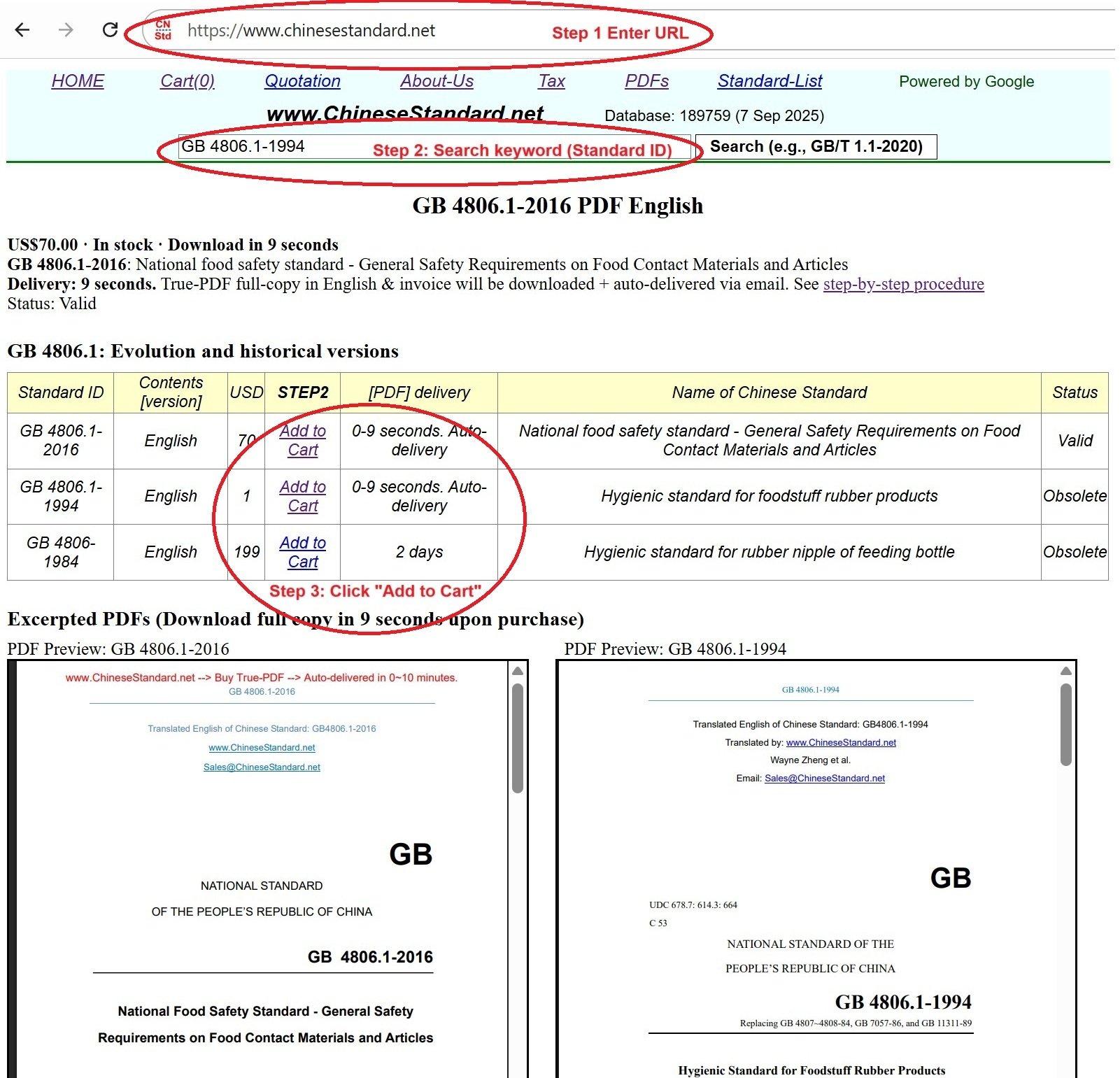
Step 1: Visit website https://www.ChineseStandard.net (Pay in USD), or https://www.ChineseStandard.us (Pay in any currencies such as Euro, KRW, JPY, AUD).Step 2: Search keyword "GB 50923-2013".
Step 3: Click "Add to Cart". If multiple PDFs are required, repeat steps 2 and 3 to add up to 12 PDFs to cart.
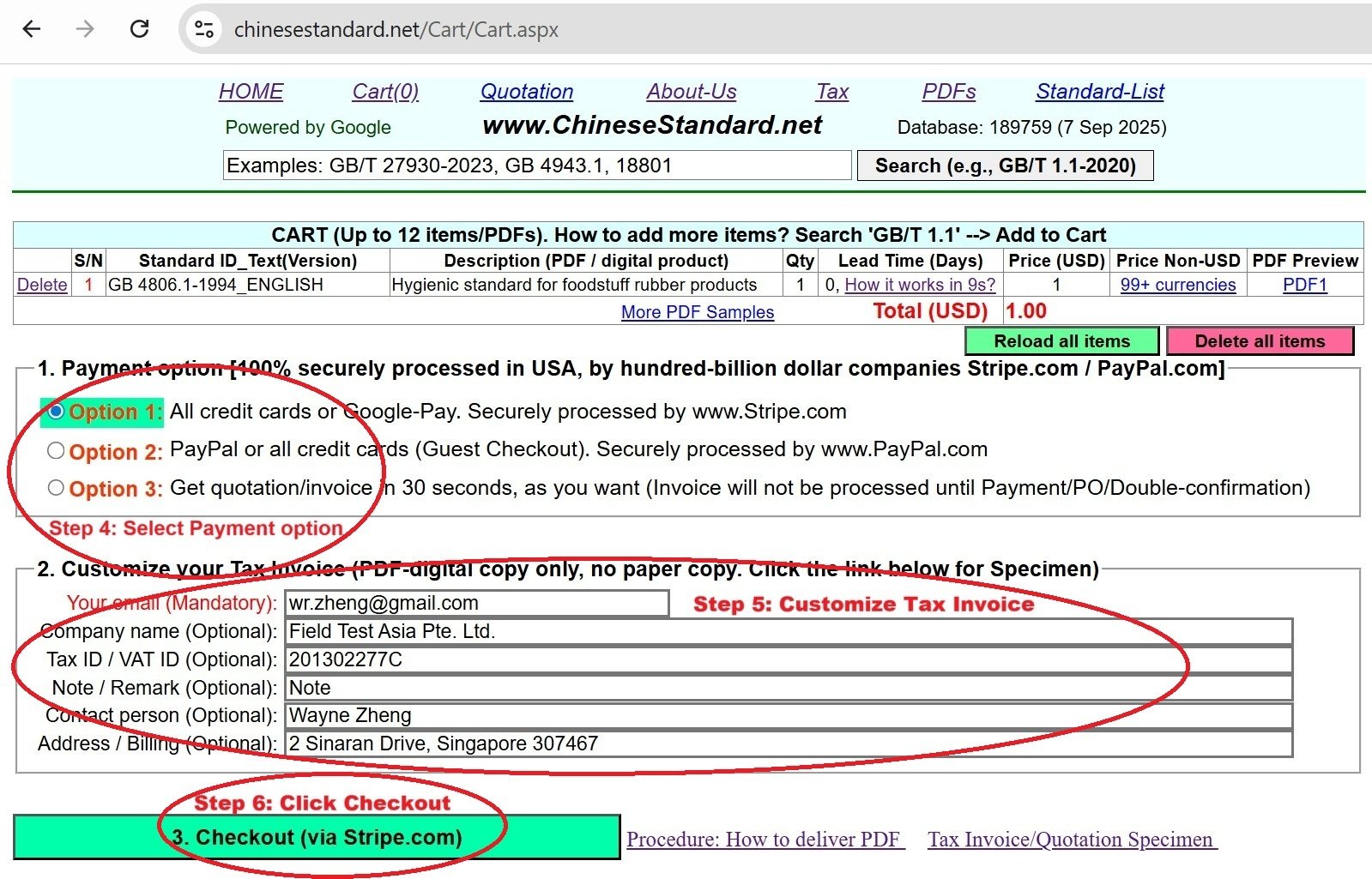
Step 4: Select payment option (Via payment agents Stripe or PayPal).
Step 5: Customize Tax Invoice -- Fill up your email etc.
Step 6: Click "Checkout".
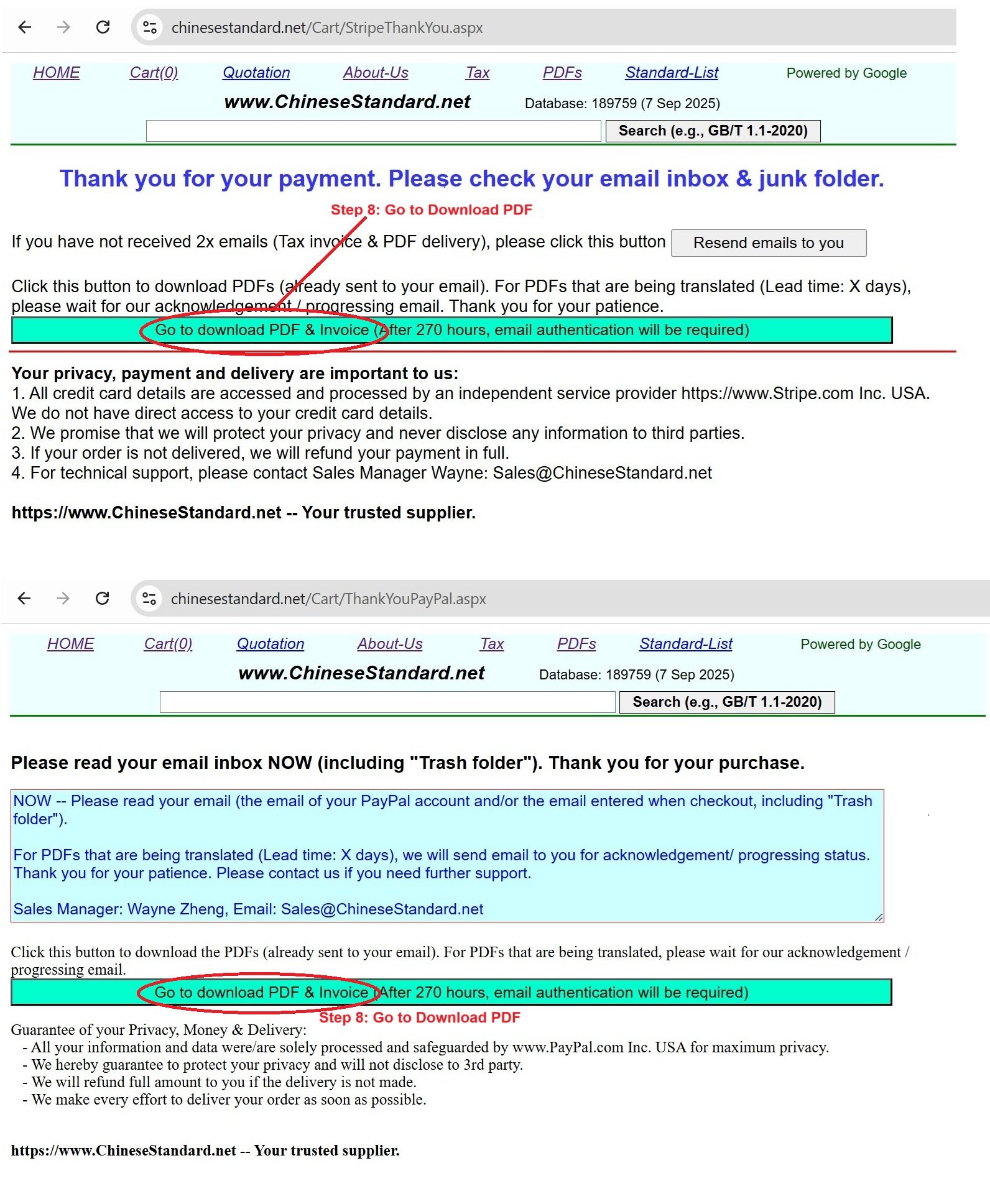
Step 7: Make payment by credit card, PayPal, Google Pay etc. After the payment is completed and in 9 seconds, you will receive 2 emails attached with the purchased PDFs and PDF-invoice, respectively.
Step 8: Optional -- Go to download PDF.
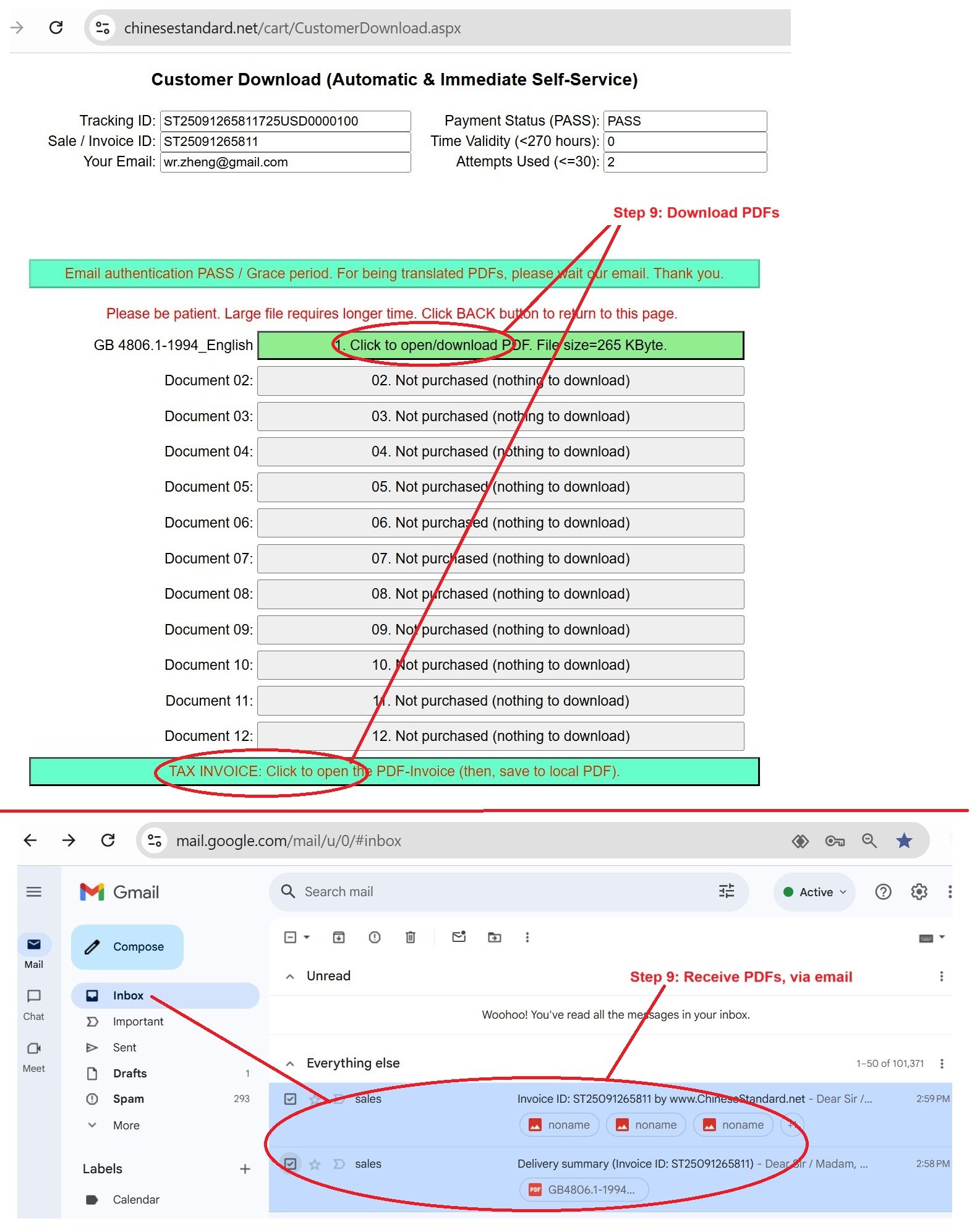
Step 9: Optional -- Click Open/Download PDF to download PDFs and invoice.
See screenshots for above steps: Steps 1~3 Steps 4~6 Step 7 Step 8 Step 9