Home   Cart   Quotation   Policy   About-Us
www.ChineseStandard.net
SEARCH

GB 4715-2024 English PDF

US$839.00 ยท In stock
Delivery: <= 6 days. True-PDF full-copy in English will be manually translated and delivered via email.
GB 4715-2024: Point-type smoke detectors using scattered light, transmitted light or ionization
Status: Valid

GB 4715: Historical versions

Standard IDUSDBUY PDFLead-DaysStandard Title (Description)Status
GB 4715-2024839 Add to Cart 6 days Point-type smoke detectors using scattered light, transmitted light or ionization Valid
GB 4715-2005879 Add to Cart 6 days Smoke detectors -- Point detectors using scattered light, transmitted light or ionization Valid
GB 4715-1993RFQ ASK 6 days Technical requirements and test methods for point type smoke fire detectors Obsolete

Similar standards

GB 12791   GB 14287.1   GB 14287.3   GB 4716   GB 4717   

Basic data

Standard ID: GB 4715-2024 (GB4715-2024)
Description (Translated English): Point-type smoke detectors using scattered light, transmitted light or ionization
Sector / Industry: National Standard
Classification of Chinese Standard: C81
Classification of International Standard: 13.220.20
Word Count Estimation: 42,433
Date of Issue: 2024-04-29
Date of Implementation: 2025-05-01
Older Standard (superseded by this standard): GB 4715-2005
Issuing agency(ies): State Administration for Market Regulation, China National Standardization Administration

GB 4715-2024: Point-type smoke detectors using scattered light, transmitted light or ionization


---This is a DRAFT version for illustration, not a final translation. Full copy of true-PDF in English version (including equations, symbols, images, flow-chart, tables, and figures etc.) will be manually/carefully translated upon your order.
ICS 13:220:20 CCSC81 National Standards of People's Republic of China Replaces GB 4715-2005 Point type smoke detector Released on 2024-04-29 2025-05-01 Implementation State Administration for Market Regulation The National Standardization Administration issued
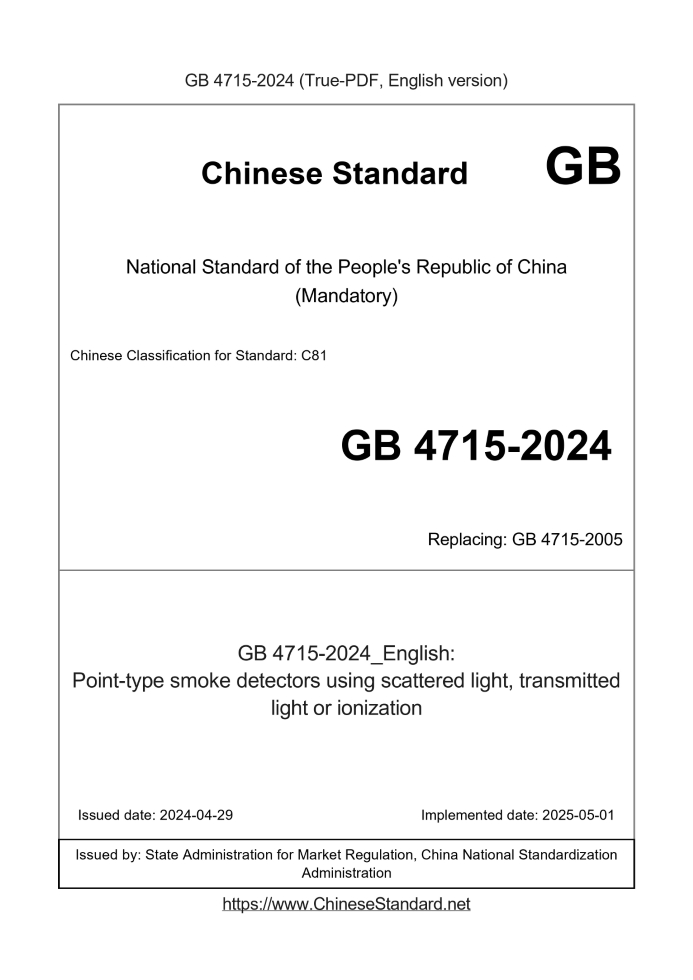
Table of Contents

Preface III 1 Scope 1 2 Normative references 1 3 Terms and Definitions 1 4 Categories 1 5 Requirements 1 5:1 General Requirements 1 5:2 Packaging and Appearance 2 5:3 Performance of main components (devices) 2 5:4 Control software requirements 3 5:5 Smoke response repeatability 3 5:6 Smoke response direction 4 5:7 Conformance 4 5:8 Power supply parameter fluctuation performance 4 5:9 Anti-airflow interference performance 4 5:10 Anti-interference performance of ambient light (applicable to photoelectric detectors) 4 5:11 Electromagnetic compatibility performance 5 5:12 Climate and environment tolerance 5 5:13 Mechanical environmental resistance 6 5:14 Fire sensitivity 7 5:15 Sensing component contamination alarm function (applicable to photoelectric detectors) 7 5:16 Composite Detection 7 6 Test methods 7 6:1 General Principles 7 6:2 Smoke response repeatability test 9 6:3 Smoke response orientation test 9 6:4 Conformance test 10 6:5 Power supply parameter fluctuation performance test 10 6:6 Test for resistance to ambient light interference (applicable to optoelectronic samples) 10 6:7 Anti-airflow interference performance test 11 6:8 High temperature (operation) test 11 6:9 Low temperature (operation) test 12 6:10 Cyclic damp heat (operation) test 12 6:11 Steady-state heat and humidity (durability) test 12 6:12 Sulfur dioxide (SO2) corrosion (durability) test 13 6:13 Impact (operation) test 13 6:14 Collision test 13 6:15 Vibration (sinusoidal) (operating) test 14 6:16 Vibration (sinusoidal) (endurance) test 14 6:17 Radio frequency electromagnetic field radiation immunity test 14 6:18 Radio frequency field induced conducted disturbance immunity test 15 6:19 Electrostatic discharge immunity test 15 6:20 Electrical fast transient pulse group immunity test 15 6:21 Surge (impact) immunity test 16 6:22 Fire sensitivity test 16 6:23 Sensing component pollution alarm function test (applicable to photoelectric samples) 16 7 Inspection Rules 17 7:1 Factory Inspection 17 7:2 Type inspection 17 8 Sign 17 8:1 General Principles17 8:2 Product Labelling 18 8:3 Quality inspection mark 18 Appendix A (Normative) Threshold Test Smoke Box 19 Appendix B (Normative) Test smoke 24 Appendix C (Normative) Flashing Device 25 Appendix D (Normative) Collision Test Equipment 26 Appendix E (Normative) Combustion Laboratory 28 Appendix F (Normative) Test fire SH1---wood pyrolysis smoldering fire 29 Appendix G (Normative) Test fire SH2---Cotton rope smoldering fire 30 Appendix H (Normative) Test fire SH3---Polyurethane plastic fire 31 Appendix I (Normative) Test fire SH4---n-heptane fire 32 Appendix J (Normative) Dust environment simulation test device 33

Foreword

This document is in accordance with the provisions of GB/T 1:1-2020 "Guidelines for standardization work Part 1: Structure and drafting rules for standardization documents" Drafting: This document replaces GB 4715-2005 "Point-type smoke detectors": Compared with GB 4715-2005, except for structural adjustments and editorial In addition to the modifications, the main technical changes are as follows: a) Added the classification of point-type photoelectric smoke detectors (see 4:2); b) Added terminal requirements (see 5:3:3); c) Changed the range requirements for the response threshold of point-type photoelectric smoke detectors (see 5:7, 4:2 of the:2005 edition); d) Deleted the slow developing fire response performance (see 3:8 of the:2005 edition); e) Change the constant humidity and heat (operation) test to the alternating humidity and heat (operation) test (see 5:12, 4:10 of the:2005 edition); f) Added requirements for the contamination alarm function of the sensing components of point-type photoelectric smoke detectors (see 5:15); g) The light source type of the flash device has been changed (see Appendix C, Appendix C of the:2005 edition): Please note that some of the contents of this document may involve patents: The issuing organization of this document does not assume the responsibility for identifying patents: This document is proposed and coordinated by the Ministry of Emergency Management of the People's Republic of China: The previous versions of this document and the documents it replaces are as follows: ---First issued as GB 4715-1984 in 1984, first revised in:1993, second revised in:2005; ---This is the third revision: Point type smoke detector

1 Scope

This document specifies the classification, requirements, inspection rules and markings of point type smoke detectors and describes the corresponding test methods: This document applies to the design, manufacture and inspection of point-type smoke detectors used in industrial and civil buildings:

2 Normative references

The contents of the following documents constitute the essential clauses of this document through normative references in this document: For referenced documents without a date, only the version corresponding to that date applies to this document; for referenced documents without a date, the latest version (including all amendments) applies to This document: GB 4716 Point-type heat-sensing fire detector GB/T 9969 General principles for instructions for use of industrial products GB 15631 Special fire detectors GB/T 16838 Environmental test methods and severity levels for fire protection electronic products GB/T 17626:2 Electromagnetic compatibility test and measurement technology Electrostatic discharge immunity test GB/T 17626:3 Electromagnetic compatibility test and measurement technology Radio frequency electromagnetic field radiation immunity test GB/T 17626:4 Electromagnetic compatibility test and measurement technology Electrical fast transient pulse group immunity test GB/T 17626:5 Electromagnetic compatibility test and measurement technology Surge (impact) immunity test GB/T 17626:6 Electromagnetic compatibility test and measurement technology - Immunity to conducted disturbances induced by radio frequency fields ISO 12103-1:2016 Pollutants for filter evaluation in road vehicles Part 1: Arizona test dust

3 Terms and definitions

There are no terms or definitions that require definition in this document:

4 Categories

4:1 According to the working principle, it can be divided into: a) Point-type photoelectric smoke detectors; b) Point type ionization smoke detector: 4:2 Point-type photoelectric smoke detectors can be divided into the following types according to their response threshold: a) Type A: Response threshold is adjustable; b) Type B: The response threshold is not adjustable:

5 Requirements

5:1 General requirements Point type smoke detectors (hereinafter referred to as detectors) shall meet the relevant requirements of this chapter and be tested in accordance with the provisions of Chapter 6 to confirm
......
Image     

Tips & Frequently Asked Questions:

Question 1: How long will the true-PDF of GB 4715-2024_English be delivered?

Answer: Upon your order, we will start to translate GB 4715-2024_English as soon as possible, and keep you informed of the progress. The lead time is typically 4 ~ 6 working days. The lengthier the document the longer the lead time.

Question 2: Can I share the purchased PDF of GB 4715-2024_English with my colleagues?

Answer: Yes. The purchased PDF of GB 4715-2024_English will be deemed to be sold to your employer/organization who actually pays for it, including your colleagues and your employer's intranet.

Question 3: Does the price include tax/VAT?

Answer: Yes. Our tax invoice, downloaded/delivered in 9 seconds, includes all tax/VAT and complies with 100+ countries' tax regulations (tax exempted in 100+ countries) -- See Avoidance of Double Taxation Agreements (DTAs): List of DTAs signed between Singapore and 100+ countries

Question 4: Do you accept my currency other than USD?

Answer: Yes. If you need your currency to be printed on the invoice, please write an email to Sales@ChineseStandard.net. In 2 working-hours, we will create a special link for you to pay in any currencies. Otherwise, follow the normal steps: Add to Cart -- Checkout -- Select your currency to pay.

Question 5: Should I purchase the latest version GB 4715-2024?

Answer: Yes. Unless special scenarios such as technical constraints or academic study, you should always prioritize to purchase the latest version GB 4715-2024 even if the enforcement date is in future. Complying with the latest version means that, by default, it also complies with all the earlier versions, technically.


Refund Policy     Privacy Policy     Terms of Service