GB 31604.38-2016 PDF English
| Standard ID | USD | BUY PDF | Delivery | Standard Title (Description) | Status |
| GB 31604.38-2016 | 70 | Add to Cart | Auto, 9 seconds. | National food safety standard - Food contact materials and articles - Determination of arsenic and migration | Valid |
Similar standards
GB 31604.38-2016: National food safety standard - Food contact materials and articles - Determination of arsenic and migration
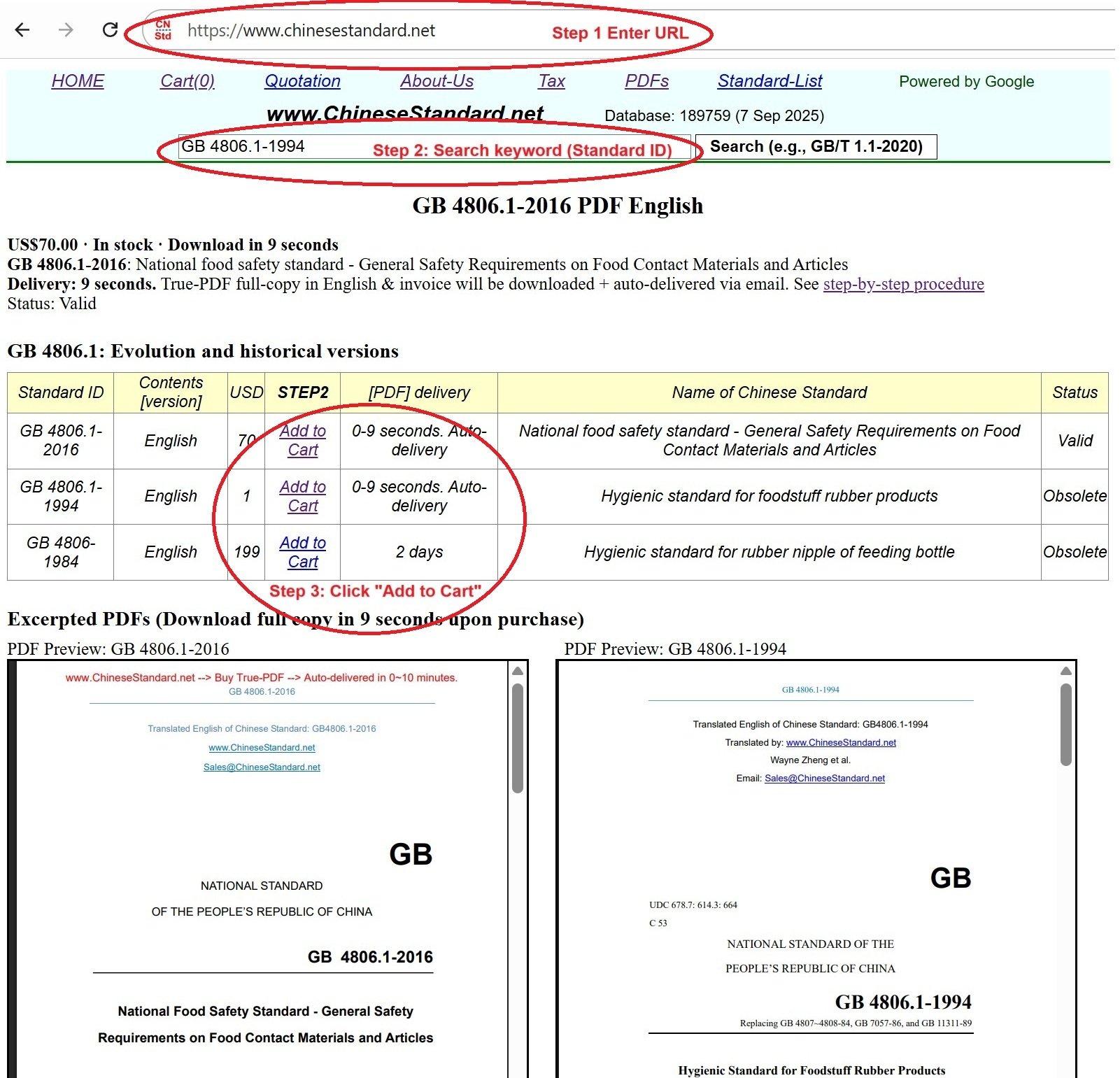
---This is an excerpt. Full copy of true-PDF in English version (including equations, symbols, images, flow-chart, tables, and figures etc.), auto-downloaded/delivered in 9 seconds, can be purchased online: https://www.ChineseStandard.net/PDF.aspx/GB31604.38-2016
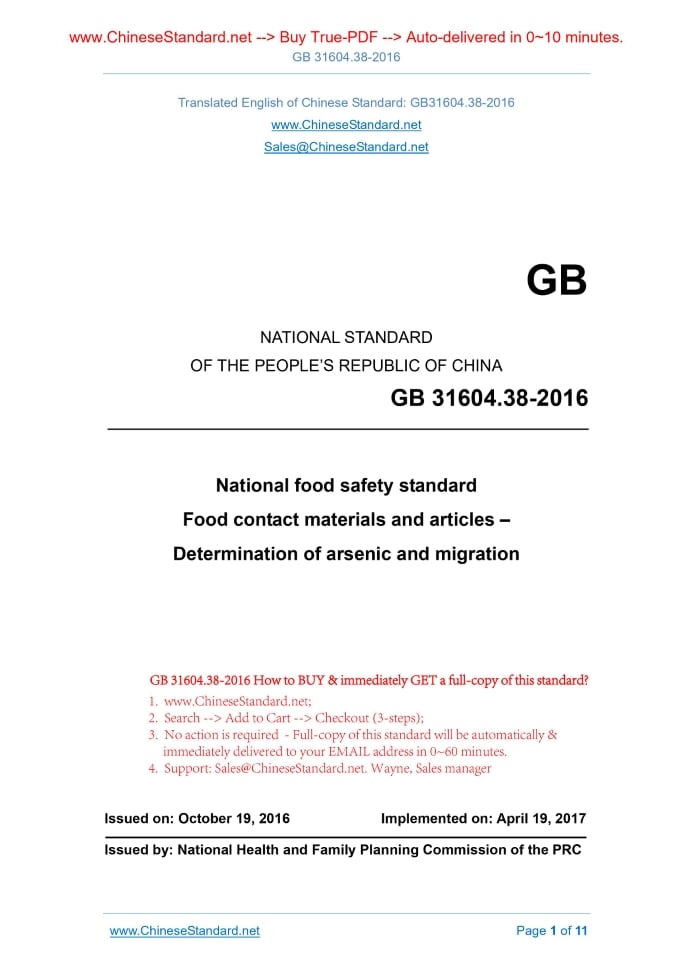
GB NATIONAL STANDARD National food safety standard Food contact materials and articles – Determination of arsenic and migration Issued on. OCTOBER 19, 2016 Implemented on. APRIL 19, 2017 Issued by. National Health and Family Planning Commission of the PRC
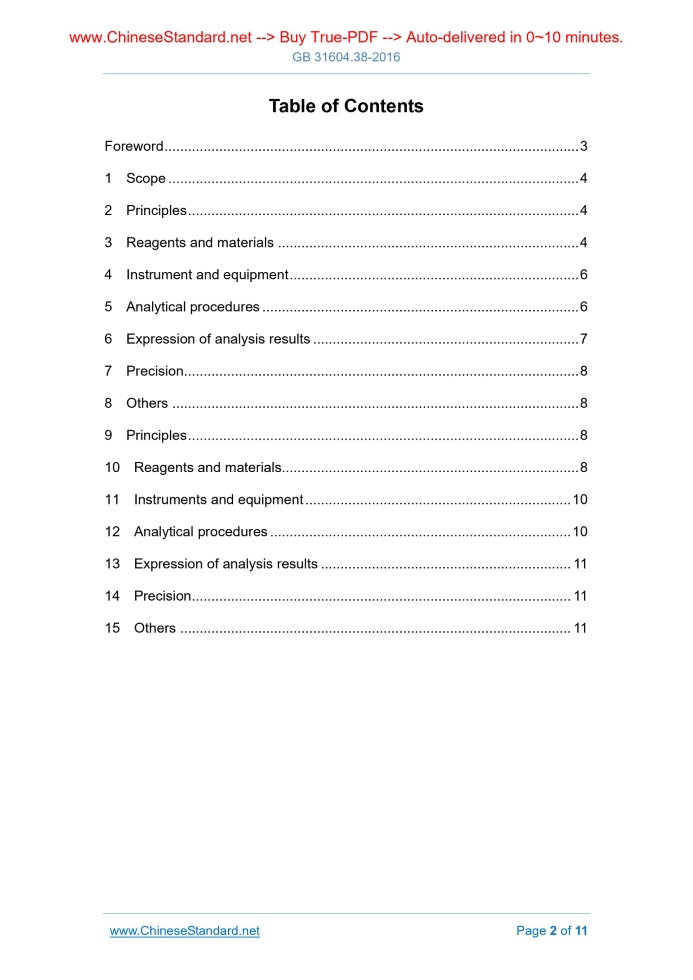
Table of Contents
Foreword... 3 1 Scope... 4 2 Principles... 4 3 Reagents and materials... 4 4 Instrument and equipment... 6 5 Analytical procedures... 6 6 Expression of analysis results... 7 7 Precision... 8 8 Others... 8 9 Principles... 8 10 Reagents and materials... 8 11 Instruments and equipment... 10 12 Analytical procedures... 10 13 Expression of analysis results... 11 14 Precision... 11 15 Others... 11Foreword
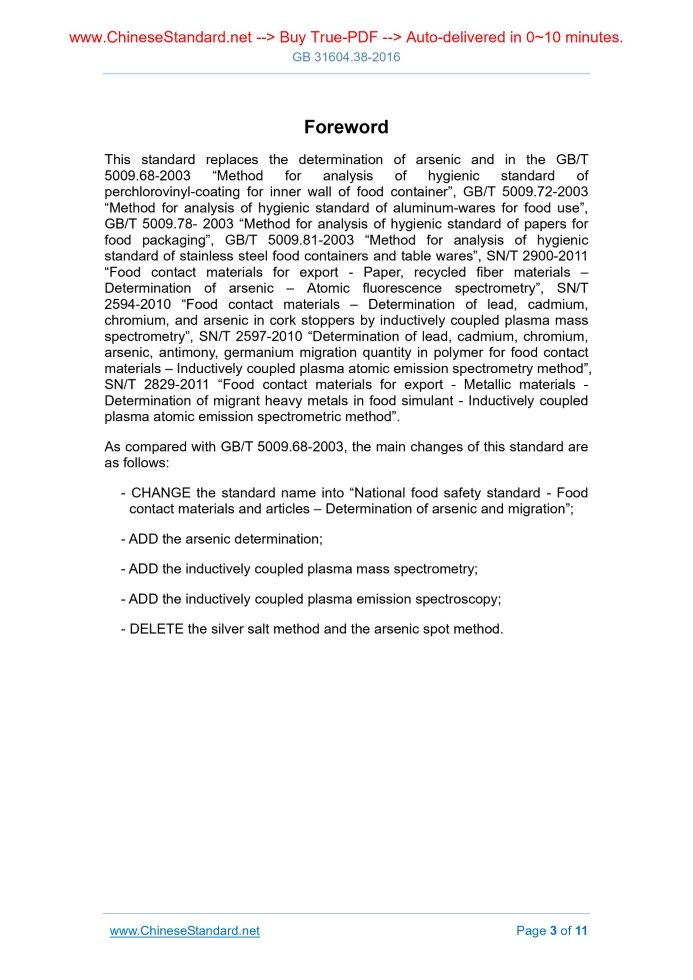
This standard replaces the determination of arsenic and in the GB/T 5009.68-2003 “Method for analysis of hygienic standard of perchlorovinyl-coating for inner wall of food container”, GB/T 5009.72-2003 “Method for analysis of hygienic standard of aluminum-wares for food use”, GB/T 5009.78- 2003 “Method for analysis of hygienic standard of papers for food packaging”, GB/T 5009.81-2003 “Method for analysis of hygienic standard of stainless steel food containers and table wares”, SN/T 2900-2011 “Food contact materials for export - Paper, recycled fiber materials – Determination of arsenic – Atomic fluorescence spectrometry”, SN/T 2594-2010 “Food contact materials – Determination of lead, cadmium, chromium, and arsenic in cork stoppers by inductively coupled plasma mass spectrometry”, SN/T 2597-2010 “Determination of lead, cadmium, chromium, arsenic, antimony, germanium migration quantity in polymer for food contact materials – Inductively coupled plasma atomic emission spectrometry method”, SN/T 2829-2011 “Food contact materials for export - Metallic materials - Determination of migrant heavy metals in food simulant - Inductively coupled plasma atomic emission spectrometric method”. As compared with GB/T 5009.68-2003, the main changes of this standard are as follows. - CHANGE the standard name into “National food safety standard - Food contact materials and articles – Determination of arsenic and migration”; - ADD the arsenic determination; - ADD the inductively coupled plasma mass spectrometry; - ADD the inductively coupled plasma emission spectroscopy; - DELETE the silver salt method and the arsenic spot method. National food safety standard Food contact materials and articles – Determination of arsenic and migration1 Scope
This standard specifies the hydride atomic fluorescence spectrometry, inductively coupled plasma mass spectrometry, and inductively coupled plasma emission spectroscopy for the determination of arsenic migration of the food contact materials and articles after soaked in the food simulants as well as the determination of arsenic in the paper articles and cork stoppers. This standard applies to determination of the arsenic migration in the food contact materials and articles as well as the determination of arsenic in the paper articles and cork stoppers. Part 1.Determination of arsenic Method 1.Hydride atomic fluorescence spectrometry2 Principles
Paper products and cork stoppers are crushed AND then subjected to dry ash digestion, thiourea is added to the digestion solution to pre-reduce the pentavalent arsenic to trivalent arsenic, which reacts with the reduction hydrogen to produce the arsenic hydride; the arsenic hydride is carried by the argon into the quartz atomizer AND decomposed into atomic arsenic, which generates the atomic fluorescence under the excitation light of the arsenic hollow cathode lamp. The fluorescence intensity is proportional to the arsenic concentration in the measured solution, AND it is quantified through comparison with the standard series.3 Reagents and materials
Unless otherwise specified, the reagents used in this method are of analytical pure AND the water is the level II water as specified in GB/T 6682. 3.1 Reagents 3.1.1 Potassium hydroxide (KOH). 3.1.2 Potassium borohydride (KBH4). 3.1.8 Magnesium oxide (MgO). 3.2 Reagent preparation 3.2.1 Potassium hydroxide solution (5 g/L). WEIGH 5 g of potassium hydroxide; USE water to dilute it to 1000 mL; MIX it uniformly. 3.2.2 Potassium borohydride alkaline solution (10 g/L). WEIGH 10 g of potassium borohydride; USE potassium hydroxide solution (5 g/L) to dissolve it; 3.2.3 Pre-reducing agent solution. WEIGH 5.0 g of thiourea; ADD about 80 mL of water to dissolve it; ADD 5.0 g of ascorbic acid; after it is completely dissolved, USE water to dilute it to 100 mL; MIX it uniformly; AND this solution shall be prepared before use. 3.4 Standard solution preparation 3.4.1 Arsenic standard stock solution (1000 mg/L). USE the standard solution certified by the state AND awarded with the standard substance certificate, or PREPARE it in accordance with the requirements of GB/T 602. 3.4.2 Arsenic standard intermediate (1.00 mg/L). accurately PIPETTE 10.0 mL of arsenic standard stock solution into a 100 mL volumetric flask; ADD the hydrochloric acid solution (5 + 95) to the mark;4 Instrument and equipment
4.1 Atomic fluorescence photometer. with arsenic hollow cathode lamp. 4.2 Muffle furnace. 4.3 Analytical balance. sensitivity of 1 mg.5 Analytical procedures
5.1 Pretreatment of sample TAKE appropriate amount of sample; CRUSH it and MIX it uniformly. WEIGH 1 g ~ 3 g of sample (accurate to 0.001 g); PLACE it in a crucible with cover; ADD 10 mL of magnesium nitrate solution (150 g/L); 5.2 Determination 5.2.1 Instrument test conditions ADJUST the performance of the instrument to the best condition, AND the instrument reference conditions are as follows. photomultiplier tube voltage. 400 V; arsenic hollow cathode lamp current. 35 mA; atomizer. temperature 820 °C ~ 850 °C; height. 8 mm; argon flow rate. carrier gas 400m L/min. 5.2.3 Sample determination TAKE 20 mL of the sample digestion solution into a 25 mL colorimetric tube; ADD 5 mL of pre-reducing agent solution; MIX it uniformly; PLACE it for 30 min; MAKE determination on the instrument; QUANTIFY it by comparison with the standard series; and meanwhile MAKE the blank test.6 Expression of analysis results
The arsenic content in the sample is calculated in accordance with the formula7 Precision
The absolute difference between the two independent determinations obtained under repeatability shall not exceed 20% of the arithmetic mean.8 Others
When calculated using the sample amount of 0.5 g and the constant volume of 25 mL, the method detection limit is 0.05 mg/kg AND the limit of quantification is 0.15 mg/kg.9 Principles
The food simulant is used to soak the portion of the food contact materials and products which are expected to contact with the food part, thiourea is added to the soaking solution to pre-reduce the pentavalent arsenic to trivalent arsenic, which reacts with the reduction hydrogen to produce the arsenic hydride;10 Reagents and materials
Unless otherwise specified, the reagents used in this method are of analytical pure AND the water is the level II water as specified in GB/T 6682. 10.1 Reagents 10.2 Reagent preparation 10.2.1 Potassium hydroxide solution (5 g/L). WEIGH 5 g of potassium hydroxide; USE water to dilute it to 1000 mL; MIX it uniformly. 10.2.2 Potassium borohydride alkaline solution (10 g/L). WEIGH 10 g of potassium borohydride; USE potassium hydroxide solution (5 g/L) to dissolve it; MAKE its volume reach to 1000 mL; AND this solution shall be prepared before use. 10.4 Standard solution preparation 10.4.1 Arsenic standard stock solution (1000 mg/L). USE the standard solution certified by the state AND awarded with the standard substance certificate, or PREPARE it in accordance with the requirements of GB/T 602. 10.4.2 Arsenic standard intermediate (1.00 mg/L). accurately PIPETTE 10.0 mL of arsenic standard stock solution into a 100 mL volumetric flask; ADD the hydrochloric acid solution (5 + 95) to the mark; MIX it uniformly. And then accurately PIPETTE 1.00 mL of this arsenic standard solution into a 100 mL volumetric flask; ADD hydrochloric acid solution (5 + 95) to the mark; MIX it uniformly. ......Source: Above contents are excerpted from the full-copy PDF -- translated/reviewed by: www.ChineseStandard.net / Wayne Zheng et al.