GB 29987: Historical versions
| Standard ID | USD | BUY PDF | Lead-Days | Standard Title (Description) | Status |
| GB 29987-2014 | RFQ |
ASK
|
8 days
|
National Food Safety Standard -- Food Additives -- Gum Base and its Composition
| Obsolete |
| GB 29987-2013 | 679 |
Add to Cart
|
5 days
|
Food additive -- SBR
| Obsolete |
Basic data
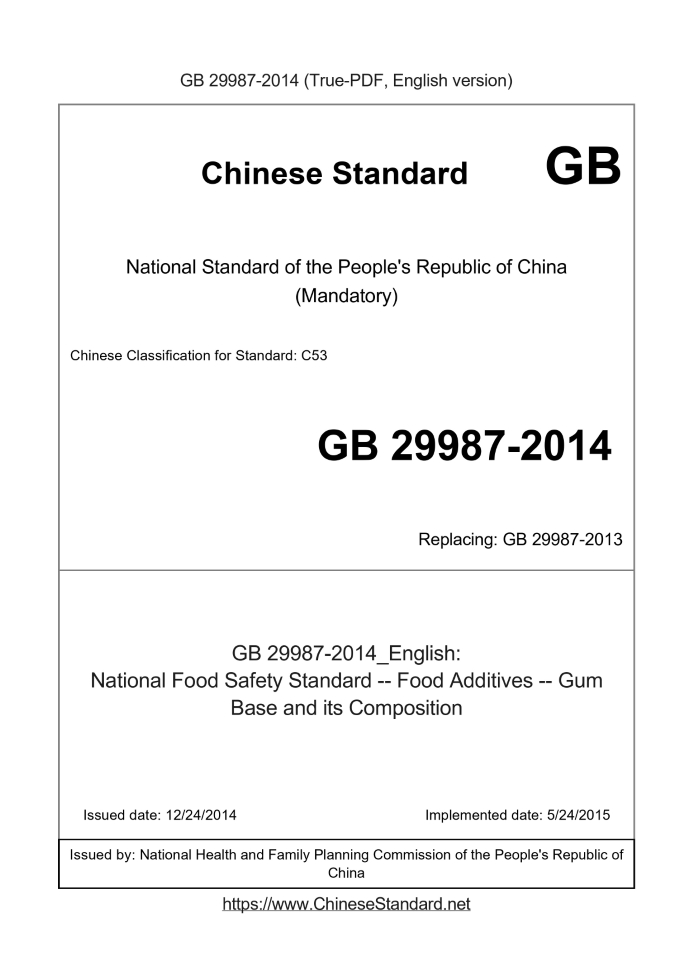
Standard ID: GB 29987-2014 (GB29987-2014)
Description (Translated English): National Food Safety Standard -- Food Additives -- Gum Base and its Composition
Sector / Industry: National Standard
Classification of Chinese Standard: C53
Classification of International Standard: 67.020
Word Count Estimation: 50,572
Date of Issue: 12/24/2014
Date of Implementation: 5/24/2015
Older Standard (superseded by this standard): GB 29987-2013
Regulation (derived from): Health Planning Commission Bulletin 2014 No. 21
Issuing agency(ies): National Health and Family Planning Commission of the People's Republic of China
Summary: This Standard is applicable to the gum base and gum base ingredients.
GB 29987-2014: National Food Safety Standard -- Food Additives -- Gum Base and its Composition
---This is a DRAFT version for illustration, not a final translation. Full copy of true-PDF in English version (including equations, symbols, images, flow-chart, tables, and figures etc.) will be manually/carefully translated upon your order.
(National food safety standard.Food Additives.Gum and its ingredients)
National Standards of People's Republic of China
National standards for food safety
Food additive gum base and its ingredients
Released on.2014-12-24
2015-05-24 implementation
People's Republic of China
National Health and Family Planning Commission released
Foreword
C.1 Butadiene-Styrene 75/25, 50/50 Rubber (SBR) Substitutes GB 29987-2013 "Foodstuffs
Safe national standard food additives styrene butadiene rubber ".
National standards for food safety
Food additive gum base and its ingredients
1 Scope
This standard applies to gum base and gum base.
2 terms and definitions
2.1 gum base (also known as gelatin base or gum base in the base material)
To rubber, resin, wax and other substances made by the use of materials for the production of gum base candy.
2.2 gum base ingredients
Used in the rubber base of natural rubber, synthetic rubber, resin, wax, emulsifier, softener, antioxidants, preservatives, fillers and other food Tim
Additive and cocoa powder and hydrogenated vegetable oil.
3 basic requirements
3.1 glue base should be selected in Appendix A listed in the base material made with.
3.2 The quality specifications of natural rubber, synthetic rubber, resin and wax shall be in accordance with the corresponding provisions of Appendix B to Appendix E respectively.
3.3 The quality specifications of the emulsifier and softener in the gum base shall comply with the corresponding provisions of Appendix F or the corresponding national standards for food safety
carried out.
3.4 The quality of antioxidants, preservatives and fillers in the gum base shall be in accordance with the national standards for the corresponding food safety.
4 rubber technology requirements
4.1 sensory requirements
Shall comply with the provisions of Table 1.
Table 1 sensory requirements
Requires inspection method
Should not have smell, should not have corruption and mildew phenomenon, should not have normal vision can be
See the external impurities
Take the appropriate amount of the test sample in a colorless transparent container or white porcelain dish, placed in the Ming
Bright, observe the shape, color, and smell the smell at room temperature
4.2 physical and chemical indicators
Shall comply with the provisions of Table 2.
Table 2 Physical and chemical indicators
Project indicator detection method
Total arsenic (in As)/(mg/kg) ≤ 1.5 GB/T 5009.11
Lead (Pb)/(mg/kg) ≤ 1.5 GB 5009.12
5 logo
5.1 The gum base table shall be marked with natural rubber, synthetic rubber, resin, wax, emulsifier, softener, antioxidant, preservative and filler
Category name, no specific name.
5.2 In addition to the ingredients table, the identification of gum base and gum base ingredients shall be carried out in accordance with the requirements of GB 29924; the gum base may not mark "food additives"
Words.
Appendix A
List of ingredients allowed for use
The gum base shall be formulated with the substances listed in Table A.1. The amount of each component in accordance with the relevant provisions of the implementation, not required by the production needs
Appropriate use.
Table A.1 list of ingredients allowed for use
Chinese name/category English name
A1 natural rubber naturalgum
1 balata gum massarandubabalata
2 Dayton Dayton jelutong
3 to open the European rubber lechecaspi (sorva)
4 Gorgon palm tree chiquibul
5 sugar gum gum chicle
6 natural rubber (latex solid) naturalrubber (latexsolids)
A2 synthetic rubber syntheticrubber
1 butadiene-styrene 75/25,50/50 rubber (butadiene rubber) butadiene-styrenerubber75/25,50/50 (SBR)
2 polybutylene polybutylene
3 polyethylene polyethylene
4 polyisobutylene polyisobutylene
5 isobutylene-isoprene copolymer (butyl rubber) isobutylene-isoprenecopolymer (butylrubber)
A3 resin
1 part dimer rosin (including rosin, wood rosin, tall rosin) Gan
Oil ester
glycerolesterofpartialydimerizedrosin (gum, wood,
taloil
2 partially hydrogenated rosin (including rosin, wood rosin, tall rosin) Gan
Oil ester
glycerolesterofpartialyhydrogenatedrosin (gum,
wood, taloil)
3 partially hydrogenated rosin (including rosin, wood rosin, tall rosin)
Tetraol ester
pentaerythritolesterofpartialyhydrogenatedrosin
(gum, wood, taloil)
4 partially hydrogenated rosin (including rosin, wood rosin, tall rosin) methyl esterofpartialyhydrogenatedrosin (gum,
wood, taloil)
5 vinyl acetate-vinyl laurate vinylacetate-vinyllauratecopolymer
6 synthetic resin (including terpene resin) syntheticresin (syntheticterpeneresin)
7 polyvinyl acetate polyvinylacetate (PVA)
8 Agative rosin (including wood rosin, tall rosin) Glycerol esterofpolymerizedrosin (gum, wood, taloil)
9 Rosin Glyceryl Ester glycerolesterofwoodrosin
10 rosin (including rosin, wood rosin, tall rosin) pentaerythritolesterofrosin (gum, wood, taloil)
11 rosin glycerol ester glycerolesterofgumrosin
12 tall rosin glycerol ester glycerolesteroftaloilrosin
A4 wax wax
1 carnauba wax carnaubawax
2 beeswax beeswax
3 Polyethylene wax homopolymer Polyethylene-waxhomopolymer
4 paraffin paraffin
5 petroleum paraffin (Fischer-Tropsch) paraffinwax, synthetic (Fischer-Tropsch)
6 microcrystalline paraffin microcrystalinewax
7 candelilla candle candelilawax
Table A.1 (continued)
Chinese name/category English name
A5 emulsifier, softener
1 propylene glycol propyleneglycol
2 single, double glycerol fatty acid ester mono-anddiglyceridesoffattyacids
3 glycerol (glycerol) glycerine (glycerol)
4 pectin pectins
5 alginic acid, sodium alginate (also known as sodium alginate), alginic acid alginicacid, sodiumalginate, ammonium alginate
6 phospholipid phospholipid
7 gelatin gelatin
8 triacetin triacetin
9 acetylated mono-, diglycerin fatty acid ester acetylatedmono-anddiglyceride (aceticandfattyacid
estersofglycerol)
10 stearic acid, calcium stearate, magnesium stearate, sodium stearate, stearin
Potassium
stearicacidanditscalcium, magnesium, sodium
potassimsalts
11 sucrose fatty acid ester sucroseestersoffattyacid
12 hydrogenated vegetable oil hydrogenvegetableoils
13 cocoa cocoapowder
A6 antioxidant, preservative antioxidant, preservative
1 benzoic acid, sodium benzoate
2 butyl hydroxy anisole (BHA) butylatedhydroxyanisole
3 Dibutylhydroxytoluene (BHT) butylatedhydroxytoluene
4 propyl gallate (PG) propylgalate
5 sorbicacid sorbicacid, potassiumsorbate
6 Vitamin E (dl-α-tocopherol, d-α-tocopherol, mixed with tocopherol
Shrinkage)
vitamine E (dl-α-tocopherol, d-α-tocopherol, mixedto-
copherolconcentrate
7 bamboo leaf antioxidant antioxidantofbambooleaves
A7 filler filingagent
Talc talc
2 calcium hydrogenphosphate (dicalciumorthophosphate)
3 calcium carbonate (including light and heavy calcium carbonate) calciumcarbonate (light, heavy)
4 magnesium carbonate magnesiumcarbonate
Appendix B
Rubber-based ingredients are allowed to use natural rubber
B.1 Balata gum
B.1.1 traits
Natural plant - derived condensate. Due to moisture content and refining process of different heat treatment, color from white to brown. Generally insoluble
In water and cold ethanol, partially soluble in hot ethanol, soluble in oil.
B.1.2 Physical and chemical indicators
Shall comply with the provisions of Table B.1.
Table B.1 Physical and chemical indicators
Item Index Test Method
Lead (Pb)/(mg/kg) ≤ 3 GB 5009.12
Total arsenic (in As)/(mg/kg) ≤ 3 GB/T 5009.11
Total mercury (Hg)/(mg/kg) ≤ 0.5 GB/T 5009.17
Cadmium (Cd)/(mg/kg) ≤ 1 GB/T 5009.15
B.2 Dayton Dayton glue
B.2.1 traits
Natural plant-derived coagulum, block resin, composed of resin part and gum part.
B.2.2 Physical and chemical indicators
Shall comply with the provisions of Table B.1.
B.3 to open the European glue
B.3.1 traits
The main ingredients are celeryin acetate and polyisoprene. Appearance was gray, cut after the snow was white solid, tasteless
Odorless
B.3.2 Physical and chemical indicators
Shall comply with the provisions of Table B.1.
B.4 Gorgon gum
B.4.1 traits
Mainly by the resin part and the gum part. Appearance was gray, cut after the snow was white solid.
B.4.2 Physical and chemical indicators
Shall comply with the provisions of Table B.1.
B.5 Glucose gum
B.5.1 traits
At room temperature for the elastic and plasticity of the gum-like material, after heating for the syrup-like viscous body. Do not dissolve in water, soluble in most organic
Solvent.
B.5.2 Physical and chemical indicators
Shall comply with the provisions of Table B.1.
B.6 Natural rubber (latex solid)
B.6.1 traits
White toughness flaky or massive colloid, not easy to oxidation. At room temperature there is a higher flexibility, slightly plastic, low temperature crystallization hardening. Have better
Of the alkali resistance, but not strong acid. Do not dissolve in water, lower ketones and alcohols, in non-polar solvents (such as chloroform, carbon tetrachloride, etc.) can swell.
B.6.2 Physical and chemical indicators
Shall comply with the requirements in Table B.2.
Table B.2 Physical and chemical indicators
Item Index Test Method
Nitrogen (Kjeldahl) /% ≤ 0.65 GB/T 8088
Lead (Pb)/(mg/kg) ≤ 3 GB 5009.12
Total arsenic (in As)/(mg/kg) ≤ 3 GB/T 5009.11
Total mercury (Hg)/(mg/kg) ≤ 0.5 GB/T 5009.17
Cadmium (Cd)/(mg/kg) ≤ 1 GB/T 5009.15
Appendix C.
Rubber-based ingredients are allowed to use synthetic rubber
C.1 Butadiene-styrene 75/25, 50/50 Rubber (styrene-butadiene rubber)
C.1.1 production process
Made of butadiene and styrene synthetic rubber, divided into two grades, the proportion of butadiene and styrene were 75/25 and
50/50.
C.1.2 traits
Usually light yellow with tough flakes or lumps, but also for the latex substances, with a slight rubber taste.
C.1.3 Structural formula
C.1.4 Physical and chemical indicators
Shall comply with the provisions of Table C.1.
Table C.1 Physical and chemical indicators
project
index
SBR50/50 SBR75/25
Testing method
Bound styrene /% 45.0 ~ 50.0 22.0 ~ 26.0 GB/T 8658
Styrene residue/(mg/kg) ≤ 30 20 Appendix I I.2
Hexane residue/(mg/kg) ≤ 100 I.3
1,3-butadiene/(mg/kg) ≤ 0.5 I.4
Benzoquinone/(mg/kg) ≤ 20 I.5
Lead (Pb)/(mg/kg) ≤ 3 GB 5009.12
Total arsenic (in As)/(mg/kg) ≤ 3 GB/T 5009.11
Total mercury (Hg)/(mg/kg) ≤ 3 GB/T 5009.17
Cadmium (Cd)/(mg/kg) ≤ 1 GB/T 5009.15
Lithium (Li) /% ≤ 0.0075 I.6
C.2 polybutene
C.2.1 Production process
Polymerized polymer made from butene.
C.2.2 traits
Colorless to light yellow viscous liquid, tasteless or with a slight special odor. Soluble in benzene, almost insoluble in water, acetone or ethanol.
C.2.3 Molecular formula
(C4H8) n.
C.2.4 Physical and chemical indicators
Shall comply with the provisions of Table C.2.
Table C.2 Physical and chemical indicators
Item Index Test Method
Chloride (in terms of Cl) /% ≤ 0.014 I.7
Low molecular weight polymer /% ≤ 0.40 I.8
Residue on ignition /% ≤ 0.05 GB/T 7531
Heavy metals (Pb)/(mg/kg) ≤ 10 GB/T 5009.74
Total arsenic (in As)/(mg/kg) ≤ 3 GB/T 5009.11
C.3 Polyethylene
C.3.1 Production process
A polymer-inert polymer obtained by direct polymerization of ethylene under high temperature and high pressure.
C.3.2 traits
White, translucent, partially crystalline and partially amorphous. Soluble in hot benzene, insoluble in water, at low temperatures to maintain a certain soft
Softness.
C.3.3 Molecular formula
(C2H4) n.
C.3.4 Relative molecular mass
2000 ~ 21000.
C.3.5 Physical and chemical indicators
Shall comply with the requirements of Table C.3.
Table C.3 Physical and chemical indicators
Item Index Test Method
Volatile matter /% ≤ 0.5 I.9
Lead (Pb)/(mg/kg) ≤ 3 GB 5009.12
Total arsenic (in As)/(mg/kg) ≤ 3 GB/T 5009.11
Total mercury (Hg)/(mg/kg) ≤ 0.5 GB/T 5009.17
Cadmium (Cd)/(mg/kg) ≤ 1 GB/T 5009.15
C.4 polyisobutylene
C.4.1 Production process
From isobutylene and a small amount of n-butene copolymerization.
C.4.2 traits
Light color (colorless to light yellow), soluble in diisobutylene and benzene, but not soluble in water, alcohol.
C.4.3 Molecular formula
(C4H8) n.
C.4.4 Relative molecular mass
≥37000.
C.4.5 Physical and chemical indicators
Shall comply with the provisions of Table C.4.
Table C.4 Physical and Chemical Indicators
Item Index Test Method
Volatile matter /% ≤ 0.3 I.9
Isobutene/(mg/kg) ≤ 30 I.4
Lead (Pb)/(mg/kg) ≤ 3 GB 5009.12
Total arsenic (in As)/(mg/kg) ≤ 3 GB/T 5009.11
Total mercury (Hg)/(mg/kg) ≤ 0.5 GB/T 5009.17
Cadmium (Cd)/(mg/kg) ≤ 1 GB/T 5009.15
C.5 isobutylene-isoprene copolymer (butyl rubber)
C.5.1 Production process
Isobutylene-isoprene copolymer is a synthetic copolymer, usually from isobutylene and isoprene in methyl chloride solution, using chlorinated
Aluminum as a catalyst copolymerization.
C.5.2 traits
White or light solid or semi-solid, with butyl rubber-specific odor, insoluble in ethanol and acetone.
C.5.3 Physical and chemical indicators
Shall comply with the provisions of Table C.5.
Table C.5 Physical and chemical indicators
Item Index Test Method
Volatile matter /% ≤ 1 I.9
Isobutene/(mg/kg) ≤ 30 I.4
Isoprene/(mg/kg) ≤ 15 I.4
Total Unsaturation/(mol%) ≤ 3 I.10
Lead (Pb)/(mg/kg) ≤ 3 GB 5009.12
Total arsenic (in As)/(mg/kg) ≤ 3 GB/T 5009.11
Total mercury (Hg)/(mg/kg) ≤ 0.5 GB/T 5009.17
Cadmium (Cd)/(mg/kg) ≤ 1 GB/T 5009.15
Appendix D
The gum base is allowed to use the resin
D.1 Partial dimer rosin (including rosin, wood rosin, tall rosin) Glyceride
D.1.1 Production process
To partially dimer rosin (rosin, wood rosin, tall rosin) resin as raw material, by glycerol esterification reaction, steam purification.
D.1.2 traits
Light amber hard resin, soluble in acetone, insoluble in water.
D.1.3 Physical and chemical indicators
Shall comply with the requirements of Table D.1.
Table D.1 Physical and chemical indicators
Item Index Test Method
Acid value (in KOH)/(mg/g) 3 to 8 GB/T 8146 Determination of acid value
Softening point/° C ≥ 103 (Universal method) GB/T 8146 Determination of softening point
Lead (Pb)/(mg/kg) ≤ 1 GB 5009.12
Total arsenic (in As)/(mg/kg) ≤ 2 GB/T 5009.11
Total mercury (Hg)/(mg/kg) ≤ 1 GB/T 5009.17
Cadmium (Cd)/(mg/kg) ≤ 1 GB/T 5009.15
D.2 partially hydrogenated rosin (including rosin, wood rosin, tall rosin) glyceride
Shall comply with the requirements of GB 10287.
D.3 partially hydrogenated rosin (including rosin, wood rosin, tall rosin) pentaerythritol ester
D.3.1 Production process
To partially hydrogenated rosin (including rosin, wood rosin, tall rosin) resin as raw material, the pentaerythritol esterification reaction, steam purification from.
D.3.2 traits
Light amber hard resin, soluble in acetone, insoluble in water and ethanol.
D.3.3 Physical and chemical indicators
Shall comply with the requirements of Table D.2.
Table D.2 Physical and chemical indicators
Item Index Test Method
Acid value (in KOH)/(mg/g) 6 to 18 GB/T 8146 Determination of acid value
Softening point/° C ≥ 94 (ball method) GB/T 8146 Determination of softening point (Universal method)
Lead (Pb)/(mg/kg) ≤ 1 GB 5009.12
Total arsenic (in As)/(mg/kg) ≤ 2 GB/T 5009.11
Total mercury (Hg)/(mg/kg) ≤ 1 GB/T 5009.17
Cadmium (Cd)/(mg/kg) ≤ 1 GB/T 5009.15
D.4 partially hydrogenated rosin (including rosin, wood rosin, tall rosin) methyl ester
D.4.1 Production process
To partially hydrogenated rosin (including rosin, wood rosin, tall rosin) resin as raw material, esterification by methyl ester, steam purification.
D.4.2 traits
Light amber liquid resin, soluble in acetone, insoluble in water and ethanol.
D.4.3 Physical and chemical indicators
Shall comply with the requirements of Table D.3.
Table D.3 Physical and chemical indicators
Item Index Test Method
Acid value (in KOH)/(mg/g) 4 to 8 GB/T 8146 Determination of acid value
Refractive index/(20 ° C) 1.517 to 1.520 GB/T 14454.4
Lead (Pb)/(mg/kg) ≤ 1 GB 5009.12
Total arsenic (in As)/(mg/kg) ≤ 2 GB/T 5009.11
Total mercury (Hg)/(mg/kg) ≤ 1 GB/T 5009.17
Cadmium (Cd)/(mg/kg) ≤ 1 GB/T 5009.15
D.5 vinyl acetate - vinyl laurate copolymer
D.5.1 Production process
From vinyl acetate and ethylene laurate by a certain percentage of copolymerization.
D.5.2 traits
Colorless to yellow solid, odorless, tasteless.
D.5.3 Molecular formula
(C4H6O2) n (C14H26O2) m.
D.5.4 Structural formula
D.5.5 Physical and chemical indicators
Shall comply with the requirements in Table D.4.
Table D.4 Physical and chemical indicators
Item Index Test Method
Dry reduction /% ≤ 1 GB 5009.3
Free acetic acid /% ≤ 0.05 I.11
Residual Vinyl Acetate Monomer/(mg/kg) ≤ 5 I.12
Lead (Pb)/(mg/kg) ≤ 3 GB 5009.12
Total arsenic (in As)/(mg/kg) ≤ 1 GB/T 5009.11
Total mercury (Hg)/(mg/kg) ≤ 0.5 GB/T 5009.17
Cadmium (Cd)/(mg/kg) ≤ 1 GB/T 5009.15
D.6 Synthetic resin (including terpene resin)
D.6.1 Production process
Synthetic terpene resin consisting of light yellow to yellow thermoplastic polymer solid resin, mainly turpentine extracted from turpentine or alpha-pin
Ene, beta-pinene and/or dipentene polymer.
D.6.2 traits
Light yellow brittle solid, soluble in benzene and vegetable oils, insoluble in water, ethanol and acetone.
D.6.3 Physical and chemical indicators
Shall comply with the requirements in Table D.5.
Table D.5 Physical and chemical indicators
Item Index Test Method
Acid value (in KOH)/(mg/g) ≤ 5 GB/T 8146 Determination of acid value
Solvent Residue/(mg/kg) ≤ 100 I.13
Saponification value/(mgKOH/g) ≤ 5 I.14
Lead (Pb)/(mg/kg) ≤ 3 GB 5009.12
Total arsenic (in As)/(mg/kg) ≤ 3 GB/T 5009.11
Total mercury (Hg)/(mg/kg) ≤ 1 GB/T 5009.17
Cadmium (Cd)/(mg/kg) ≤ 1 GB/T 5009.15
D.7 Polyvinyl acetate
D.7.1 Production process
A solid resin made from vinyl acetate monomer.
D.7.2 traits
Transparent, water white to light yellow, granular, sheet and so on. Soluble in acetone, insoluble in water.
D.7.3 Molecular formula
(C4H6O2) n.
D.7.4 Structural formula
D.7.5 Relative molecular mass
≥.2000.
D.7.6 Physical and chemical indicators
Shall comply with the requirements of Table D.6.
Table D.6 Physical and chemical indicators
Item Index Test Method
Dry reduction /% ≤ 1 GB 5009.3
Free acetic acid /% ≤ 0.05 I.15
Table D.6 (continued)
Item Index Test Method
Residual Vinyl Acetate Monomer/(mg/kg) ≤ 5 I.12
Lead (Pb)/(mg/kg) ≤ 3 GB 5009.12
Total arsenic (in As)/(mg/kg) ≤ 3 GB/T 5009.11
Total mercury (Hg)/(mg/kg) ≤ 0.5 GB/T 5009.17
Cadmium (Cd)/(mg/kg) ≤ 1 GB/T 5009.15
D.8 Polymerized rosin (including wood rosin, tall rosin) Glyceride
D.8.1 Production process
With rosin (including wood rosin, rosin rosin) as raw materials, glycerol esterification reaction, steam purification from.
D.8.2 traits
Light amber or lighter hard resin, soluble in acetone, insoluble in water and ethanol.
D.8.3 Physical and chemical indicators
Shall comply with the requirements in Table D.7.
Table D.7 Physical and chemical indicators
Item Index Test Method
Acid value (in KOH)/(mg/g) 3 to 9 GB/T 8146 Determination of acid value
Softening point/° C ≥ 80 (Global method) GB/T 8146 Determination of softening point (Universal method)
Lead (Pb)/(mg/kg) ≤ 1 GB 5009.12
Total arsenic (in As)/(mg/kg) ≤ 2 GB/T 5009.11
Total mercury (Hg)/(mg/kg) ≤ 1 GB/T 5009.17
Cadmium (Cd)/(mg/kg) ≤ 1 GB/T 5009.15
D.9 Wood Rosin Glyceride
D.9.1 Production process
To light wood rosin as raw materials, glycero......
Tips & Frequently Asked Questions:
Question 1: How long will the true-PDF of GB 29987-2014_English be delivered?
Answer: Upon your order, we will start to translate GB 29987-2014_English as soon as possible, and keep you informed of the progress. The lead time is typically 5 ~ 8 working days. The lengthier the document the longer the lead time.
Question 2: Can I share the purchased PDF of GB 29987-2014_English with my colleagues?
Answer: Yes. The purchased PDF of GB 29987-2014_English will be deemed to be sold to your employer/organization who actually pays for it, including your colleagues and your employer's intranet.
Question 3: Does the price include tax/VAT?
Answer: Yes. Our tax invoice, downloaded/delivered in 9 seconds, includes all tax/VAT and complies with 100+ countries' tax regulations (tax exempted in 100+ countries) -- See Avoidance of Double Taxation Agreements (DTAs):
List of DTAs signed between Singapore and 100+ countriesQuestion 4: Do you accept my currency other than USD?
Answer: Yes. If you need your currency to be printed on the invoice, please write an email to Sales@ChineseStandard.net. In 2 working-hours, we will create a special link for you to pay in any currencies. Otherwise, follow the normal steps: Add to Cart -- Checkout -- Select your currency to pay.
Question 5: Should I purchase the latest version GB 29987-2014?
Answer: Yes. Unless special scenarios such as technical constraints or academic study, you should always prioritize to purchase the latest version GB 29987-2014 even if the enforcement date is in future. Complying with the latest version means that, by default, it also complies with all the earlier versions, technically.