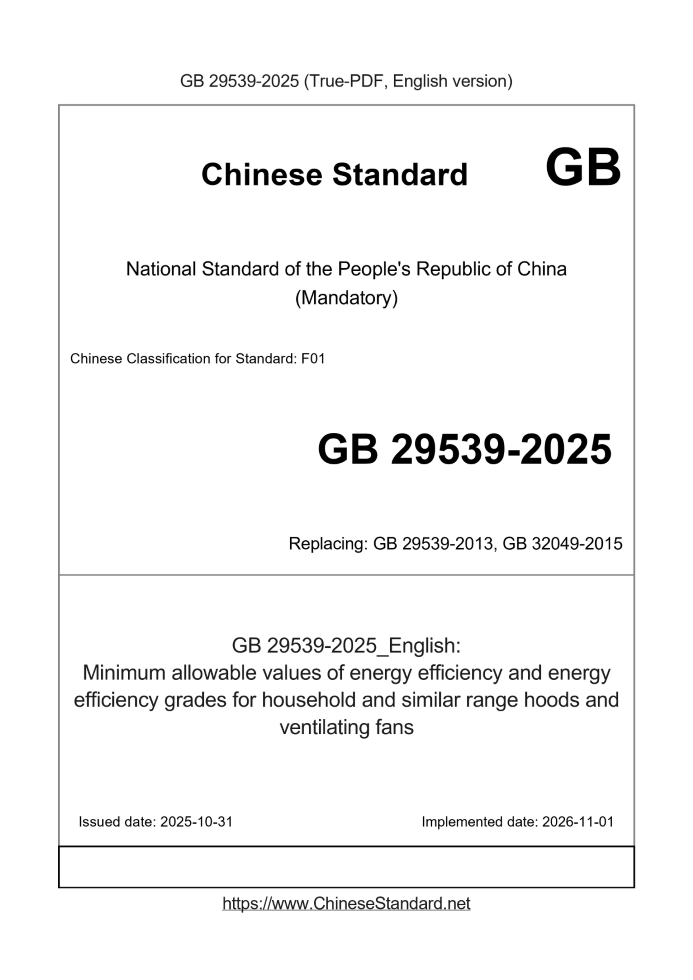
GB 29539: Historical versions
| Standard ID | USD | BUY PDF | Lead-Days | Standard Title (Description) | Status |
| GB 29539-2025 | RFQ |
ASK
|
3 days
|
Minimum allowable values of energy efficiency and energy efficiency grades for household and similar range hoods and ventilating fans
| |
| GB 29539-2013 | 125 |
Add to Cart
|
Auto, < 3 mins
|
Minimum allowable values of energy efficiency and energy efficiency grades for range hoods
| Valid |
Basic data
Standard ID: GB 29539-2025 (GB29539-2025)
Description (Translated English): Minimum allowable values of energy efficiency and energy efficiency grades for household and similar range hoods and ventilating fans
Sector / Industry: National Standard
Classification of Chinese Standard: F01
Classification of International Standard: 27.010
Date of Issue: 2025-10-31
Date of Implementation: 2026-11-01
Older Standard (superseded by this standard): GB 29539-2013, GB 32049-2015
GB 29539-2013: Minimum allowable values of energy efficiency and energy efficiency grades for range hoods
---This is a DRAFT version for illustration, not a final translation. Full copy of true-PDF in English version (including equations, symbols, images, flow-chart, tables, and figures etc.) will be manually/carefully translated upon your order.
Minimum allowable values of energy efficiency and energy efficiency grades for range hoods
ICS 27.010
F01
National Standards of People's Republic of China
Smoke fumes functional efficiency limited value
And energy efficiency rating
Issued on. 2013-06-09
2013-10-01 implementation
Administration of Quality Supervision, Inspection and Quarantine of People's Republic of China
Standardization Administration of China released
Foreword
The standard Chapter 4, Chapter 5 are mandatory, the rest are recommended.
This standard was drafted in accordance with GB/T 1.1-2009 given rules.
This standard was proposed by the National Development and Reform Commission Resource Conservation and Environmental Protection.
This standard by the National Standardization Technical Committee for Energy and Management (SAC/TC20) centralized.
This standard drafting units. China National Institute of Standardization, Weikai Detection Technology Co., Ltd. Hangzhou boss Electric Co., Ltd., Guangdong Midea
Kitchen appliances Manufacturing Co., Ltd., Guangdong Long Auto Electric Manufacturing Co., BSH Electrical Appliances (Jiangsu) Co., Ltd., Qingdao Haier washing
Machine Co., Ltd., Guangdong combo Electric Co., Ltd., Chinese Academy of household appliances, Ningbo, too kitchenware Ltd., Zhongshan Vantage shares
Ltd., Guangdong Macro Gas Appliance Co., Ltd., Zhejiang Shuaikang Electric Co., Ltd., Sakura (China) Co., Ltd., Guangzhou
East Million and the new Electric Co., Ltd., Zhejiang German, Italian and kitchen utensils Co., Ltd. Guang Ning Tianhua purification technology, Chengdu Eastern Technology Development
Exhibition Co., Ltd., Sichuan opening force Kitchenware Co., Ltd., Jiangsu light kitchen and toilet Solar Technology Co., Ltd.
The main drafters of this standard. Cheng Jianhong, Wang Pan, Yu Guocheng, late Xuejun, Lai Chi star, Li Yan, Pan Jie, Zhang Li, Cai Xingming, Du Xin, Yunxia,
Yi Hongbin, Shao Yan, Maojie Jun, Zhang Jingzong to flat, Huang Guan Germany, Zhong Xinhua, Liu Honghua, co-Yin Qian, Li Ping, Wang Xiaobin.
Smoke fumes functional efficiency limited value
And energy efficiency rating
1 Scope
This standard specifies the hood of the energy efficiency rating, energy efficiency limit value and energy conservation evaluation values, test methods and inspection rules.
This standard applies to household cooking appliance mounted on the upper stoves, stove or similar purposes, rated voltage not exceeding 250V efflux formula
grease pump.
2 Normative references
The following documents for the application of this document is essential. For dated references, only the dated version suitable for use herein
Member. For undated references, the latest edition (including any amendments) applies to this document.
GB/T 2828.1 Sampling procedures for inspection - Part 1. by acceptance quality limit (AQL) retrieval batch inspection sampling plan
GB/T 2829 periodic inspection Sampling procedures and tables (suitable for process stability test)
GB/T 17713-2011 hood
3 Terms and Definitions
GB/T 17713-2011 define the following terms and definitions apply to this document.
3.1
Smoke fumes functional efficiency limited value minimumalowablevaluesofenergyefficiencyforrangehoods
Under the test conditions specified in hood minimum allowable value of energy efficiency.
3.2
Hood evaluating values of energy evaluatingvaluesofenergyconservationforrangehoods
Under the test conditions specified minimum allowable energy efficiency hood value of energy efficiency.
3.3
Standby mode standbymode
Hood is connected to the power supply, provides only restart information or status display (including the clock) function, without any major
State functions.
Note. The restart function is through the remote control, internal sensor or time clock, etc. so that the appliance is switched to the main function of providing a functional model.
3.4
Shutdown mode offmode
Hood is connected to the power supply, but does not provide any kind of standby mode state functions and the main functions.
NOTE. Only shutdown, status indicators (light emitting diode) is also considered to be in shutdown mode.
3.5
Standby power standbypower
Hood in the standby mode active power in watts (W).
3.6
Off power offpower
Hood in shutdown mode active power in watts (W).
4 energy efficiency rating
Energy efficiency hood at full pressure efficiency, standby power, power off, reduce the degree of normality odor, grease discharge limits for classification. Its energy efficiency
Is divided into five grades (see Table 1), including an energy-efficient. Energy efficiency rating value of each product shall comply with the requirements in Table 1.
Table 1 Functional smoke fumes efficiency rating
Energy efficiency rating total pressure efficiency standby power off to reduce the power of the normal odor
1 ≥23%
2 ≥21%
≤2.0W ≤1.0W ≥95%
3 ≥19%
4 ≥17%
5 ≥15%
≤3.0W ≤1.5W ≥90%
5 energy efficiency limit
Energy efficiency hood limit value 1 table-level energy efficiency rating of 5.
6 energy conservation evaluation values
Energy-saving evaluation value hood Table 1 energy efficiency rating of two.
7 Test methods
Experimental conditions and methods hood according to GB/T 17713-2011 and the corresponding requirements in Appendix A for testing.
8 Inspection Rules
8.1 factory inspection
8.1.1 Test program with reference to GB/T 2828.1 and GB/T 2829, determined by the quality inspection departments of their manufacturer.
8.1.2 Upon examination identified energy efficiency limit value fails to meet the requirements of Chapter 5 of the products do not allow the factory.
8.2 Type inspection
8.2.1 one of the following occurs, it should be energy efficiency limit test.
a) new product trial;
b) changes in product design, workmanship or materials used significantly affect its performance;
c) after a lapse of more than one year of reproduction;
d) factory inspection results are quite different and the last type inspection;
e) quality and technical supervision department inspection requirements.
8.2.2 type test sample, every 3 pumping units, of which two trials, one spare. Two test results are in line with the requirements of this standard, the
Batch of qualified; if the two do not meet the requirements of this standard, the batch to be ineligible. If there is a sample value of energy efficiency does not meet this standard
Requirements, respond spare samples for testing, such as test results meet the requirements, it is judged to be acceptable; If the test result is still not meet the requirements, it is determined
Ineligible.
Appendix A
(Normative)
Test methods for standby and off power hoods
A.1 short-time power measurement
This test method is only applicable to the selected mode and power stability of the situation. If the measured power within 5min variation of less than 5%
Believes that power has stabilized, in this case can be read instrument displays power values directly.
The test hood is connected to the measuring instrument, and selecting a measurement mode. In the hood over at least 5min to reach the power
Stable, measured by measuring power consumption, time should not be less than 5min. Power value change during the measurement is less than 5% (from the maximum observed
Worth to power), power has been considered stable and 5min power value recorded directly from the end of the measuring instrument.
A.2 average power law
This test method is applicable to the selected mode or measurement unstable power situation. However, this method is also applicable to all modes stable situation
condition. This method uses a user-selected time period, the average power or accumulated energy readings.
The test hood is connected to the measuring instrument, select the measurement mode is to monitor power consumption. Average power following the "average power
Law "or the" cumulative energy method "to determine.
Average power method. the user selected period of time meter records a true average power for the selected period of time of not less than 5min.
Cumulative energy method. measuring instrument can cumulative energy consumption of user-selected time period, the selected period of time of not less than 5min. Cumulative time
Lap record should be such that the total is greater than the value of the energy and time meter (including power meter and time meter) resolution 200 times. With tired
Accumulated energy value divided by the measurement time to obtain the average power.
Example 1. If a time resolution of the instrument is 1s, which is required as a minimum cumulative 200s.
Example 2. If a resolution of the instrument of power 0.1mW · h, which is required as a minimum cumulative 20mW · h.
If more than one power cycle (such as minutes or hours) changes, the average power or accumulated energy measurements are selected
Inter segment should be one or more complete cycles in order to obtain a representative average.
3102-
Rights Proprietary Rights Reserved
ISBN. 155 066 · 1-47366
......
Tips & Frequently Asked Questions:
Question 1: How long will the true-PDF of GB 29539-2025_English be delivered?
Answer: Upon your order, we will start to translate GB 29539-2025_English as soon as possible, and keep you informed of the progress. The lead time is typically 1 ~ 3 working days. The lengthier the document the longer the lead time.
Question 2: Can I share the purchased PDF of GB 29539-2025_English with my colleagues?
Answer: Yes. The purchased PDF of GB 29539-2025_English will be deemed to be sold to your employer/organization who actually pays for it, including your colleagues and your employer's intranet.
Question 3: Does the price include tax/VAT?
Answer: Yes. Our tax invoice, downloaded/delivered in 9 seconds, includes all tax/VAT and complies with 100+ countries' tax regulations (tax exempted in 100+ countries) -- See Avoidance of Double Taxation Agreements (DTAs):
List of DTAs signed between Singapore and 100+ countriesQuestion 4: Do you accept my currency other than USD?
Answer: Yes. If you need your currency to be printed on the invoice, please write an email to Sales@ChineseStandard.net. In 2 working-hours, we will create a special link for you to pay in any currencies. Otherwise, follow the normal steps: Add to Cart -- Checkout -- Select your currency to pay.
Question 5: Should I purchase the latest version GB 29539-2025?
Answer: Yes. Unless special scenarios such as technical constraints or academic study, you should always prioritize to purchase the latest version GB 29539-2025 even if the enforcement date is in future. Complying with the latest version means that, by default, it also complies with all the earlier versions, technically.