US$279.00 · In stock
Delivery: <= 3 days. True-PDF full-copy in English will be manually translated and delivered via email.
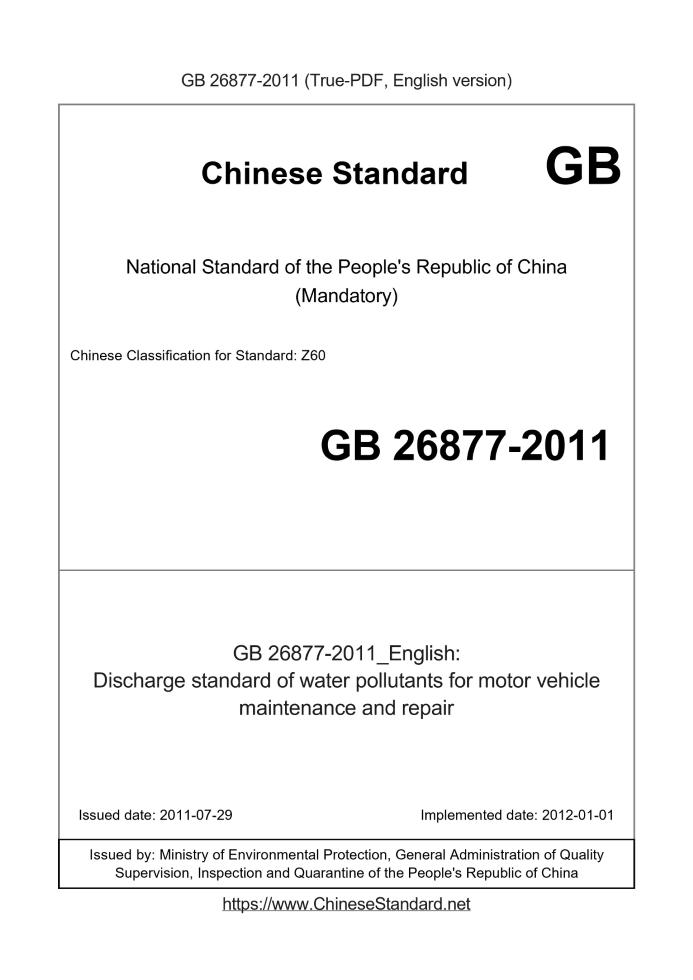
GB 26877-2011: Discharge standard of water pollutants for motor vehicle maintenance and repair
Status: Valid
| Standard ID | USD | BUY PDF | Lead-Days | Standard Title (Description) | Status |
| GB 26877-2011 | 279 |
Add to Cart
|
3 days
|
Discharge standard of water pollutants for motor vehicle maintenance and repair
| Valid |
Basic data
Standard ID: GB 26877-2011 (GB26877-2011)
Description (Translated English): Discharge standard of water pollutants for motor vehicle maintenance and repair
Sector / Industry: National Standard
Classification of Chinese Standard: Z60
Classification of International Standard: 13.060.30
Word Count Estimation: 12,142
Date of Issue: 2011-07-29
Date of Implementation: 2012-01-01
Quoted Standard: GB/T 6920-1986; GB/T 7494-1987; GB/T 11893-1989; GB/T 11894-1989; GB/T 11901-1989; GB/T 11914-1989; GB/T 16488-1996; GB/T 16739.1-2004; HJ/T 195-2005; HJ/T 199-2005; HJ/T 399-2007; HJ 505-2009; HJ 535-2009; HJ 536-2009; HJ 537-2009; " auto pollution monitoring and management approach " SEPA Order No. 28; " Environmental monitoring and Management Measures " State Environmental Protection Administration Order No. 39
Regulation (derived from): Department of Environmental Protection Notice No. 57 of 2011
Issuing agency(ies): Ministry of Environmental Protection, General Administration of Quality Supervision, Inspection and Quarantine of the People's Republic of China
Summary: This Chinese standard specifies the auto repair business water pollutant discharge limits, monitoring, and monitoring requirements, and standards for the implementation and supervision of relevant regulations. This standard applies to existing Class I and II car repair business water pollutant discharge management. This standard applies to Class I and II car repair business construction project environmental impact assessment, environmental protection facilities design, environmental acceptance and commissioning completed water pollutant emissions management. This standard applies to legally permissible emission behavior. The location and the newly established sources of existing pollution sources in special protected areas management, according to"The People's Republic of China Air Pollution Prevention Law", "PRC Water Pollution Prevention Law, "Marine Environmental Protection Law, "China people's Republic of solid Waste Pollution prevention Law", "PRC environmental Impact Assessment Law"and other laws, regulations and rules of the relevant regulations. This standard specifies a water pollutant emission control requirements apply to companies directly or indirectly, to its discharge water pollutants outside the legal boundaries of behavior.
GB 26877-2011: Discharge standard of water pollutants for motor vehicle maintenance and repair
---This is a DRAFT version for illustration, not a final translation. Full copy of true-PDF in English version (including equations, symbols, images, flow-chart, tables, and figures etc.) will be manually/carefully translated upon your order.
Discharge standard of water pollutants for motor vehicle maintenance and repair
ICS 13.060.30
Z 60
National Standards of People's Republic of China
Water pollutant discharge standard for automobile maintenance industry
Discharge standard of water pollutants for
Motor vehicle maintenance and repair
Released on.2011-07-29
2012-01-01 implementation
Ministry of Environmental Protection
The General Administration of Quality Supervision, Inspection and Quarantine issued
Content
Preface II
1 Scope..1
2 Normative references..1
3 Terms and definitions. 2
4 Water pollutant emission control requirements..2
5 Water pollutant monitoring requirements.5
6 Implementation and supervision.5
Foreword
To implement the "Environmental Protection Law of the People's Republic of China", "Water Pollution Prevention and Control Law of the People's Republic of China",
Laws and regulations such as the implementation of the scientific development concept to strengthen environmental protection, and the State Council on the preparation of national main functional areas
Planning Opinions, protect the environment, prevent pollution, strengthen the control and management of water pollutant discharge in the automobile maintenance industry, and formulate
This standard.
This standard specifies the limits, monitoring and monitoring requirements for water pollutant discharge in automobile maintenance enterprises. To promote regional economy and the ring
Coordinated development, promote the adjustment of economic structure and the transformation of economic growth mode, and guide the process and pollution control of automobile maintenance industry
The development direction of technology, this standard specifies the special emission limits for water pollutants.
The pollutant discharge concentrations in this standard are all mass concentrations.
Automobile maintenance enterprises emit atmospheric pollutants (including odorous pollutants), and environmental noise is applied to corresponding national pollutant discharges.
Standards, the identification, treatment and disposal of solid wastes are subject to national solid waste pollution control standards.
This standard is the first release.
From the date of implementation of this standard, the water pollutant discharge control of automobile maintenance enterprises shall be implemented in accordance with the provisions of this standard and shall not be executed.
Relevant provisions in the "Sewage Integrated Emission Standards" (GB 8978-1996).
Local provincial people's governments may formulate local pollutant discharge standards for pollutants not specified in this standard;
The pollutants items that have been stipulated in this standard may be formulated with local pollutant discharge standards that are stricter than this standard.
This standard was formulated by the Science and Technology Standards Department of the Ministry of Environmental Protection.
This standard is mainly drafted by. Beijing Environmental Protection Research Institute, Environmental Protection Institute of the Ministry of Environmental Protection, Beijing
Automobile Maintenance Industry Association.
This standard was approved by the Ministry of Environmental Protection on July 18,.2011.
This standard has been implemented since January 1,.2012.
This standard is explained by the Ministry of Environmental Protection.
Water pollutant discharge standard for automobile maintenance industry
1 Scope of application
This standard stipulates the limits, monitoring and monitoring requirements for water pollutants in automobile maintenance enterprises, as well as the implementation and supervision of standards.
Governor and other relevant regulations.
This standard applies to the management of water pollutants in existing Class I and Class II automobile maintenance enterprises.
This standard is applicable to the environmental impact assessment and environmental protection facilities for the construction projects of Class I and Class II automobile maintenance enterprises.
Environmental protection acceptance of completed and completed labor and management of water pollutant discharge after production.
This standard applies to the discharge of pollutants permitted by law. Site selection and special protection areas for newly established pollution sources
The management of pollution sources shall be in accordance with the Law of the People's Republic of China on the Prevention and Control of Air Pollution and the Law of the People's Republic of China on Prevention and Control of Water Pollution
Law of the People's Republic of China on Marine Environmental Protection, Law of the People's Republic of China on the Prevention and Control of Environmental Pollution by Solid Waste, Chinese
The relevant provisions of laws, regulations and rules, such as the Environmental Impact Assessment Law of the Republic of China.
The water pollutant emission control requirements specified in this standard are applicable to enterprises directly or indirectly discharging water pollution outside their legal boundaries.
The behavior of the dye.
2 Normative references
The contents of this standard refer to the following documents or their terms.
GB/T 6920-1986 Determination of water pH value - Glass electrode method
Water quality -- Anionic surfactants - Determination of methylene blue spectrophotometric method
GB/T 11893-1989 Determination of total phosphorus in water - Ammonium molybdate spectrophotometric method
GB/T 11894-1989 Determination of total nitrogen in water - Alkaline potassium persulfate digestion - UV spectrophotometric method
GB/T 11901-1989 Determination of suspended solids by weight method
GB/T 11914-1989 Determination of chemical oxygen demand in water - Dichromate method
Water quality -- Determination of petroleum and animal and vegetable oils - Infrared photometric method
GB/T 16739.1-2004 Opening conditions for automobile maintenance industry Part 1 Automobile maintenance enterprises
HJ/T 195-2005 Determination of ammonia nitrogen in water quality
HJ/T.199-2005 Determination of total nitrogen in water -- Gas phase molecular absorption spectroscopy
HJ/T 399-2007 Determination of chemical oxygen demand in water quality - Rapid digestion spectrophotometric method
HJ 505-2009 Water quality five-day biochemical oxygen demand (BOD5) determination dilution and inoculation method
HJ 535-2009 Determination of ammonia nitrogen in water quality - Nexus reagent spectrophotometric method
HJ 536-2009 Determination of ammonia nitrogen in water quality - Salicylic acid spectrophotometric method
HJ 537-2009 Determination of ammonia nitrogen in water quality - Distillation - Neutralometric titration
Measures for the Automatic Monitoring and Control of Pollution Sources (Order No. 28 of the State Environmental Protection Administration)
Measures for the Administration of Environmental Monitoring (Order No. 39 of the State Environmental Protection Administration)
3 Terms and definitions
The following terms and definitions apply to this standard.
3.1 Automobile repair company
Refers to companies engaged in automobile repair, maintenance and maintenance services. The vehicle maintenance enterprise in this standard refers to GB/T
16739.1-2004 Required Class 1 and 2 vehicle maintenance enterprises, excluding oil tankers, chemical trucks, etc.
A company that repairs dangerous goods vehicles.
3.2 Small car
Refers to passenger vehicles with a total body length of no more than 6m and cargo vehicles with a maximum design total mass of not more than 3500kg.
3.3 Large and medium-sized buses
Refers to passenger vehicles with a total body length of more than 6m.
3.4 Large trucks
Refers to the vehicle parts of trailers, trailers and special vehicles with a maximum design total mass of more than 3,500 kg.
3.5 Existing companies
Refers to the automobile maintenance enterprise that has completed the commissioning of the production or environmental impact assessment documents before the date of implementation of this standard.
3.6 New Enterprise
Refers to the construction of new, rebuilt and expanded auto repair industry approved by the environmental impact assessment document from the date of implementation of this standard.
project.
3.7 Direct discharge
Refers to the behavior of pollutant discharge units directly discharging water pollutants into the environment.
3.8 Indirect emissions
Refers to the behavior of sewage units discharging water pollutants to public sewage treatment systems.
3.9 Public sewage treatment system
Refers to the collection of wastewater through sewage pipelines, providing wastewater treatment services to more than two sewage disposal units and drainage
Enterprises or institutions that meet the relevant emission standards, including urban sewage treatment plants of various sizes and types, and regions (including
All kinds of industrial parks, development zones, industrial gathering places, etc.) wastewater treatment plants, etc., the degree of wastewater treatment should reach two or two
the above.
3.10 Displacement
Refers to the amount of wastewater discharged by a production facility or enterprise outside the legal boundaries of the enterprise, including direct or indirect relationship with production.
Various types of effluent wastewater (such as domestic sewage, cooling wastewater, plant boilers and power station drainage).
3.11 Unit base displacement
Refers to the upper limit of the wastewater discharge for each vehicle as specified in the approved water pollutant discharge concentration.
4 Water pollutant emission control requirements
4.1 From January 1,.2012 to December 31,.2012, existing companies implement the water pollutant discharge limits specified in Table 1.
Table 1 Limits of water pollutant discharge concentration of existing enterprises
Unit. mg/L (except pH)
Limit
Serial number pollutant project
Direct emission indirect emissions
Pollutant emission monitoring location
1 pH 6~9 6~9
2 Suspended solids (SS) 30 100
3 Chemical oxygen demand (COD) 100 300
4 5th Biochemical Oxygen Demand (BOD5) 30 150
5 Petroleum 5 10
6 Anionic Surfactant (LAS) 5 10
7 ammonia nitrogen 15 25
8 total nitrogen 25 30
9 total phosphorus 1 3
Corporate wastewater discharge
4.2 As of January 1,.2013, existing companies implement the water pollutant discharge limits specified in Table 2.
4.3 From January 1,.2012, the newly-built enterprise shall implement the water pollutant discharge limit specified in Table 2.
Table 2 Limits of water pollutant emission concentration of newly-built enterprises
Unit. mg/L (except pH)
Limit
Serial number pollutant project
Direct emission indirect emissions
Pollutant emission monitoring location
1 pH 6~9 6~9
2 suspended solids (SS) 20 100
3 Chemical Oxygen Demand (COD) 60 300
4 5th Biochemical Oxygen Demand (BOD5) 20 150
5 Petroleum 3 10
6 Anionic Surfactant (LAS) 3 10
7 ammonia nitrogen 10 25
8 total nitrogen 20 30
9 total phosphorus 0.5 3
Corporate wastewater discharge
4.4 According to the requirements of environmental protection work, the density of land development has been high, the environmental carrying capacity has begun to weaken, or the environment
Areas with small capacity, fragile ecological environment, and prone to serious water pollution problems, which require special protection measures,
The company should strictly control the pollutant discharge behavior of enterprises, and the enterprises in the above regions shall implement the special discharge limits of water pollutants specified in Table 3.
value.
The geographical scope and time for the implementation of special discharge limits for water pollutants shall be administered by the environmental protection administrative department of the State Council or the provincial level.
The people's government regulations.
Table 3 Special limits for water pollutants
Unit. mg/L (except pH)
Limit number pollutant item
Direct emission indirect emissions
Pollutant emission monitoring location
1 pH 6~9 6~9
2 Suspended solids (SS) 10 20
3 Chemical oxygen demand (COD) 50 60
4 5th Biochemical Oxygen Demand (BOD5) 10 20
5 petroleum class 1 3
6 Anionic Surfactant (LAS) 1 3
7 ammonia nitrogen 5 10
8 total nitrogen 15 20
9 total phosphorus 0.5 0.5
Corporate wastewater discharge
4.5 The baseline drainage of existing enterprises and newly built enterprises is implemented in accordance with Table 4.
Table 4 Unit base displacement
Unit. m3/car
Serial number limit pollutant discharge monitoring position
1 small passenger car 0.014
2 minivans 0.05
3 large and medium passenger cars 0.06
4 large trucks 0.07
Displacement measurement position and pollution
The emission monitoring position is the same
4.6 The concentration limit of water pollutant discharge is applicable to the case where the actual displacement is not higher than the reference displacement. If the actual displacement exceeds
For the baseline displacement, the measured water pollutant concentration shall be converted into the water pollutant base discharge discharge concentration according to formula (1), and
The water concentration of water pollutants is used as the basis for determining whether the emission is up to standard. The maintenance quantity and displacement statistics period is
One working day.
Base = ρρ ×∑ iiQ
(1)
In the formula.
Emission concentration of base ρ-water pollutants under baseline drainage, mg/L;
Total Q - total drainage, m3/d;
iY - the number of cars repairing a certain type of vehicle, /d;
Base iQ - the base displacement for maintenance of a certain type of car, m3/vehicle;
Real ρ - measured water pollutant concentration, mg/L.
If the ratio to ∑ is less than 1, the measured concentration of water pollutants is used as the basis for determining whether the discharge meets the standard.
according to.
Total Q base iiQY
5 Water pollutant monitoring requirements
5.1 Sampling of wastewater discharged by enterprises shall be carried out according to the type of pollutants to be monitored and at the monitoring location of the specified pollutant discharge.
If there is a wastewater treatment facility, it should be monitored after the treatment facility. A permanent drain outlet sign shall be provided at the pollutant discharge monitoring location.
5..2 Requirements for the installation of automatic monitoring equipment for pollutant discharge in newly-built enterprises and existing enterprises, in accordance with relevant laws and
The provisions of the Monitoring and Management Measures are implemented.
5.3 Frequency, sampling time and other requirements for monitoring the discharge of pollutants from enterprises, according to relevant national pollution source monitoring technologies
The implementation of the regulations.
5.4 The verification of the output of the enterprise products shall be based on the statutory statements.
5.5 The enterprise must monitor and save the sewage discharge in accordance with the relevant laws and the Measures for the Administration of Environmental Monitoring.
Original monitoring record.
5.6 The method standards listed in Table 5 are used to determine the concentration of pollutants discharged from enterprises.
Table 5 Standards for determination of water pollutant concentration
No. Pollutant project analysis method standard name standard number
1 pH Water quality Determination of pH value Glass electrode method GB/T 6920-1986
2 Determination of suspended solids suspended solids - Gravimetric method GB/T 11901-1989
Water quality - Determination of chemical oxygen demand - Dichromate method GB/T 11914-1989
3 Chemical oxygen demand
Water quality chemical oxygen demand determination - Rapid digestion spectrophotometric method HJ/T 399-2007
4 5th Biochemical Oxygen Demand Water Quality Biochemical Oxygen Demand (BOD5) Determination Dilution and inoculation method HJ 505-2009
5 Petroleum water quality - Determination of petroleum and animal and vegetable oils - Infrared photometric method GB/T 16488-1996
6 Anionic surfactants - Determination of anionic surfactants - Determination of methylene blue spectrophotometric method GB/T 7494-1989
Water quality - Determination of ammonia nitrogen - Gas phase molecular absorption spectroscopy HJ/T 195-2005
Determination of ammonia nitrogen in water quality - Nachite reagent spectrophotometric method HJ 535-2009
Water quality - Determination of ammonia nitrogen - Salicylic acid spectrophotometric method HJ 536-2009
7 ammonia nitrogen
Determination of ammonia nitrogen in water quality - Distillation - Neutralometric titration method HJ 537-2009
Water quality - Determination of total nitrogen - Alkaline potassium persulfate digestion - UV spectrophotometric method GB 11894-1989
8 total nitrogen
Water quality - Determination of total nitrogen - Gas phase molecular absorption spectroscopy HJ/T.199-2005
9 Total phosphorus phosphorus - Determination of total phosphorus - Ammonium molybdate spectrophotometric method GB 11893-1989
6 Implementation and supervision
6.1 This standard is supervised and implemented by the environmental protection administrative department of the people's government at or above the county level.
6.2 Under any circumstance, the enterprise shall comply with the pollutant emission control requirements of this standard and take necessary measures to ensure pollution prevention.
The facilities are operating normally. When the environmental protection departments at all levels conduct supervised inspections of the facilities, they can immediately sample or monitor the knots on site.
As a basis for determining whether the discharge behavior meets emission standards and implements relevant environmental protection management measures. Found in the row
In the case of abnormal changes in water quantity, the actual product output and displacement of the enterprise shall be verified, and water shall be converted according to the provisions of this standard.
Pollutant baseline displacement discharge concentration.
......
Tips & Frequently Asked Questions:
Question 1: How long will the true-PDF of GB 26877-2011_English be delivered?
Answer: Upon your order, we will start to translate GB 26877-2011_English as soon as possible, and keep you informed of the progress. The lead time is typically 1 ~ 3 working days. The lengthier the document the longer the lead time.
Question 2: Can I share the purchased PDF of GB 26877-2011_English with my colleagues?
Answer: Yes. The purchased PDF of GB 26877-2011_English will be deemed to be sold to your employer/organization who actually pays for it, including your colleagues and your employer's intranet.
Question 3: Does the price include tax/VAT?
Answer: Yes. Our tax invoice, downloaded/delivered in 9 seconds, includes all tax/VAT and complies with 100+ countries' tax regulations (tax exempted in 100+ countries) -- See Avoidance of Double Taxation Agreements (DTAs):
List of DTAs signed between Singapore and 100+ countriesQuestion 4: Do you accept my currency other than USD?
Answer: Yes. If you need your currency to be printed on the invoice, please write an email to Sales@ChineseStandard.net. In 2 working-hours, we will create a special link for you to pay in any currencies. Otherwise, follow the normal steps: Add to Cart -- Checkout -- Select your currency to pay.