US$349.00 · In stock
Delivery: <= 3 days. True-PDF full-copy in English will be manually translated and delivered via email.
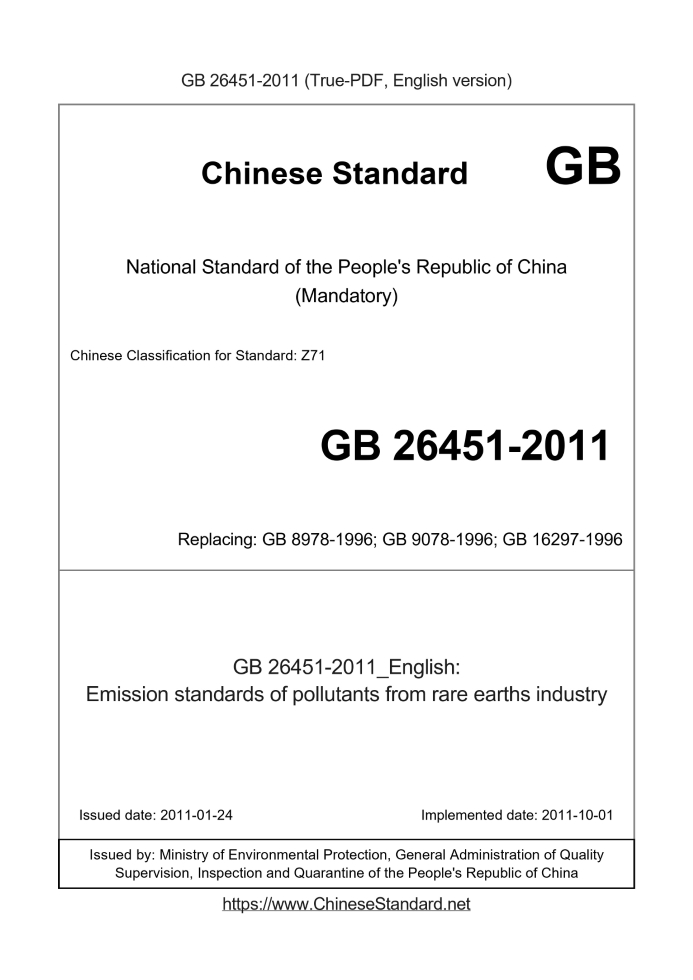
GB 26451-2011: Emission standards of pollutants from rare earths industry
Status: Valid
| Standard ID | USD | BUY PDF | Lead-Days | Standard Title (Description) | Status |
| GB 26451-2011 | 349 |
Add to Cart
|
3 days
|
Emission standards of pollutants from rare earths industry
| Valid |
Basic data
Standard ID: GB 26451-2011 (GB26451-2011)
Description (Translated English): Emission standards of pollutants from rare earths industry
Sector / Industry: National Standard
Classification of Chinese Standard: Z71
Classification of International Standard: 13.030.01
Word Count Estimation: 15,114
Date of Issue: 2011-01-24
Date of Implementation: 2011-10-01
Older Standard (superseded by this standard): GB 8978-1996; GB 9078-1996; GB 16297-1996
Regulation (derived from): Department of Environmental Protection Notice 2011 No. 5 Announcement of Newly Approved National Standards No. 6 of 2011
Issuing agency(ies): Ministry of Environmental Protection, General Administration of Quality Supervision, Inspection and Quarantine of the People's Republic of China
GB 26451-2011: Emission standards of pollutants from rare earths industry
---This is a DRAFT version for illustration, not a final translation. Full copy of true-PDF in English version (including equations, symbols, images, flow-chart, tables, and figures etc.) will be manually/carefully translated upon your order.
Emission standards of pollutants from rare earths industry
National Standards of People's Republic of China
Rare earth industrial pollutant discharge standard
Emission standard of pollutants for rare earths industry
Published on.2011-01-24
2011-10-01 Implementation
Ministry of Environmental Protection
State Administration of Quality Supervision, Inspection and Quarantine
release
Ministry of Environmental Protection
announcement
No. 5 of.2011
To implement the "Environmental Protection Law of the People's Republic of China", "Water Pollution Prevention and Control Law of the People's Republic of China"
Pollution Prevention and Control Law, to prevent pollution, protect and improve the ecological environment, and protect human health, and now approve the "Rare Earth Industry Pollutant Emission Standards"
It is the national pollutant discharge standard and is jointly issued by the Ministry of Environmental Protection and the General Administration of Quality Supervision, Inspection and Quarantine.
The standard name and number are as follows.
According to relevant laws, the standard has the effect of enforcement.
The standard has been implemented since October 1,.2011.
Special announcement.
(This announcement was signed by Zhang Jianwei of the General Administration of Quality Supervision, Inspection and Quarantine of the People's Republic of China)
January 24,.2011
Content
Foreword..iv
1 Scope..1
2 Normative references..1
3 Terms and definitions. 2
4 Pollutant emission control requirements 4
5 Pollutant Monitoring Requirements..9
6 Standard implementation and supervision 10
Iv
Foreword
To implement the "Environmental Protection Law of the People's Republic of China", "Water Pollution Prevention and Control Law of the People's Republic of China"
Dyeing Prevention and Control Law, the Marine Environmental Protection Law of the People's Republic of China, and the State Council's Decision on Implementing the Scientific Outlook on Development and Strengthening Environmental Protection
And other laws, regulations and the relevant requirements of the state to strengthen the prevention and control of heavy metal pollution, protect the environment, prevent pollution, and promote the production of rare earth industrial
The development of art and pollution control technologies, the development of this standard.
This standard specifies the limits, monitoring and monitoring requirements for water pollutants and atmospheric pollutants in rare earth industrial enterprises, and is applicable to rare earth industrial enterprises.
Water pollution and air pollution prevention and management. In order to promote the coordinated development of regional economy and environment, promote economic restructuring and economic growth.
The transformation of the formula guides the development direction of the rare earth industrial production process and pollution control technology. This standard specifies the special emission limits for water pollutants.
The pollutant discharge concentrations in this standard are all mass concentrations.
Rare-earth industrial enterprises emit odor pollutants, environmental noise and boiler emissions of atmospheric pollutants.
The identification, treatment and disposal of solid wastes are subject to national solid waste pollution control standards.
This standard is the first release.
From the date of implementation of this standard, the emission control of water pollutants and atmospheric pollutants of rare earth industrial enterprises shall be implemented in accordance with the provisions of this standard, no longer
Implementation of the "Integrated Wastewater Discharge Standard" (GB 8978-1996), "Integrated Emission Standards for Air Pollutants" (GB 16297-1996) and "Work
Relevant regulations in the Standard for Emission of Air Pollutants in Furnace and Kiln (GB 9078-1996).
Local provincial people's governments may formulate local pollutant discharge standards for pollutants not specified in this standard;
For the specified pollutants, local pollutant discharge standards that are stricter than this standard can be formulated.
This standard was formulated by the Science and Technology Standards Department of the Ministry of Environmental Protection.
This standard is mainly drafted by. China Enfei Engineering Technology Co., Ltd. (China Nonferrous Engineering Design and Research Institute), Ministry of Environmental Protection
Institute of Environmental Standards, Beijing Research Institute of Nonferrous Metals, Baotou Rare Earth Research Institute, Sichuan Rare Earth Industry Association, Inner Mongolia Baotou Steel Rare Earth High-Tech
Technology Co., Ltd., Baotou Huamei Rare Earth High-Tech Co., Ltd., Jiangxi Tungsten Group Co., Ltd., and Luoyang Rare Earth New Materials Co., Ltd.
Division, Inner Mongolia Autonomous Region Rare Earth Industry Association participated.
This standard was approved by the Ministry of Environmental Protection on January 18,.2011.
This standard has been implemented since October 1,.2011.
This standard is explained by the Ministry of Environmental Protection.
Rare earth industrial pollutant discharge standard
1 Scope of application
This standard specifies the limits, monitoring and monitoring requirements for water pollutants and atmospheric pollutants in rare earth industrial enterprises, as well as the implementation of standards.
Supervision and other relevant regulations.
This standard applies to the management of water pollutants and atmospheric pollutants in existing rare earth industrial enterprises, as well as the ring of rare earth industrial construction projects.
Environmental impact assessment, environmental protection facility design, completion environmental protection acceptance and management of water pollutants and atmospheric pollutants after commissioning.
This standard does not apply to rare earth material processing enterprises (or workshops, systems) and non-characteristic production processes and equipment attached to rare earth industrial enterprises.
Set.
This standard applies to the discharge of pollutants permitted by law. Sites for newly established pollution sources and tubes for existing pollution sources in special protection areas
Li, in accordance with the Law of the People's Republic of China on the Prevention and Control of Air Pollution, the Law of the People's Republic of China on the Prevention and Control of Water Pollution,
Environmental Protection Law, Law of the People's Republic of China on the Prevention and Control of Environmental Pollution by Solid Wastes, Law of the People's Republic of China on Prevention and Control of Radioactive Pollution,
The relevant provisions of laws, regulations and rules such as the Environmental Impact Assessment Law of the People's Republic of China shall be implemented.
The water pollutant emission control requirements specified in this standard are applicable to enterprises directly or indirectly discharging water pollutants outside their legal boundaries.
behavior.
2 Normative references
The contents of this standard refer to the following documents or their terms.
GB/T 6768 analytical method for trace uranium in water
GB/T 6920-1986 Determination of pH value of water-based glass electrode method
GB/T 7466-1987 Determination of total chromium in water
GB/T 7467-1987 Determination of hexavalent chromium in water - Diphenyl hydrazide spectrophotometric method
GB/T 7475-1987 Determination of copper, zinc, lead and cadmium - Atomic absorption spectrophotometric method
GB/T 7484-1987 Determination of fluoride in water quality - Ion selective electrode method
GB/T 7485-1987 Determination of total arsenic in water - Spectrophotometric method
GB/T 11224 Analytical method for strontium in water
GB/T 11743 γ-ray spectrum analysis method for radionuclides in soil
GB/T 11893-1989 Determination of total phosphorus in water - Ammonium molybdate spectrophotometric method
GB/T 11894-1989 Determination of total nitrogen in water - Alkaline potassium persulfate digestion - UV spectrophotometric method
GB/T 11901-1989 Determination of suspended solids by weight method
GB/T 15432-1995 Determination of total suspended particulate matter in ambient air
GB/T 16157-1996 Determination of particulate matter in fixed pollution source exhaust gas and sampling method of gaseous pollutants
Water quality -- Determination of petroleum and animal and vegetable oils - Infrared photometric method
GB/T 18871 Basic standards for ionizing radiation protection and radiation source safety
HJ/T 27-1999 Determination of hydrogen chloride in fixed source emissions - Mercury thiocyanate spectrophotometric method
HJ/T 30-1999 Determination of chlorine in fixed source exhaust gases - methyl orange spectrophotometric method
HJ/T 42-1999 Determination of nitrogen oxides from fixed source s
HJ/T 43-1999 Determination of nitrogen oxides from fixed source s
HJ/T 55 Technical Guidelines for the Monitoring of Unorganized Emissions of Air Pollutants
HJ/T 56-2000 Determination of sulphur dioxide in fixed source s
HJ/T 57-2000 Determination of sulfur dioxide in fixed source exhaust gases
HJ/T 67-2001 Determination of Fluoride in Fixed Atmospheric Sources Ion Selective Electrode Method
HJ/T 70-2001 Determination of chemical oxygen demand of high chlorine waste water
HJ/T 75 Technical Specifications for Continuous Monitoring of Flue Gas Emissions from Fixed Sources (Trial)
HJ/T 132-2003 Determination of chemical oxygen demand of high chloride wastewater - Potassium iodide potassium permanganate method
HJ/T 195-2005 Determination of ammonia nitrogen in water quality
HJ/T.199-2005 Determination of total nitrogen in water -- Gas phase molecular absorption spectroscopy
HJ 479-2009 Determination of ambient air oxynitride (nitrogen oxide and nitrogen dioxide)
HJ 480-2009 Determination of ambient air fluoride - Filter membrane sampling fluoride ion selective electrode method
HJ 481-2009 Determination of ambient air fluoride - Lime filter paper sampling fluoride ion selective electrode method
HJ 482-2009 Determination of sulphur dioxide in ambient air - Formaldehyde absorption - Para-elyl aniline spectrophotometric method
HJ 483-2009 Determination of sulphur dioxide in ambient air - Tetrachlorohydroxide absorption - Pararosaniline spectrophotometric method
HJ 487-2009 Determination of fluoride in water quality - Zirconium sulphonate
Water quality - Determination of fluoride - Fluorescence spectrophotometric method
HJ 535-2009 Determination of ammonia nitrogen in water quality - Nexus reagent spectrophotometric method
HJ 536-2009 Determination of ammonia nitrogen in water quality - Salicylic acid spectrophotometric method
HJ 537-2009 Determination of ammonia nitrogen in water quality - Distillation - Neutralometric titration
HJ 544-2009 Determination of sulfuric acid mist of fixed pollution sources - Ion chromatography (interim)
HJ 547-2009 Determination of chlorine in fixed source pollution - Iodometric method (provisional)
HJ 548-2009 Determination of Hydrogen Chloride from Fixed Pollution Sources - Silver Nitrate Capacity Method (Provisional)
HJ 549-2009 Determination of hydrogen chloride in air and exhaust gases - Chromatography (interim)
Measures for the Automatic Monitoring and Control of Pollution Sources (Order No. 28 of the State Environmental Protection Administration)
Measures for the Administration of Environmental Monitoring (Order No. 39 of the State Environmental Protection Administration)
3 Terms and definitions
The following terms and definitions apply to this standard.
3.1
Rare earth rare earths
The lanthanides of the atomic number from 57 to 71 in the periodic table, namely lanthanum (La), cerium (Ce), praseodymium (Pr), yttrium (Nd), yttrium (Pm),
钐 (Sm), 铕 (Eu), 钆 (Gd), 铽 (Tb), 镝 (Dy), 钬 (Ho), 铒 (Er), 铥 (Tm), 镱 (Yb), 镥 (Lu)
A general term for 17 elements of 钪(Sc) and 39 钇(Y) with an atomic number of 21, usually represented by the symbol RE, which is a chemical phase.
a set of elements.
3.2
Rare earths industry
Refers to the production of rare earth concentrates or rare earth enrichment, rare earth compounds, rare earth metals, rare earth alloys of any one or several products.
3.3
Rare earths mining
Refers to the process of extracting rare earth ore from the deposit by open pit mining or underground mining. This standard does not include the use of solution leaching directly
The process of obtaining an ionic rare earth leach liquor from leaching or heap leaching of a rare earth deposit.
3.4
Rare earths mineral processing
Refers to the separation of useful minerals from gangue or harmful substances according to the physicochemical properties of useful minerals and gangue in rare earth ore.
The process of earth concentrate and the process of chemically producing rare earth enrichment in rare earth leach liquor obtained from solution leaching.
3.5
Rare earths metallurgy
Using rare earth concentrates or rare earth-containing materials as raw materials, containing at least one step in the process of decomposition extraction, grouping, separation, metal and alloy preparation
The process of producing rare earth compounds, rare earth metals or rare earth alloys.
3.6
Decomposition and extraction
The process of producing a mixed rare earth compound by using a rare earth concentrate or a rare earth-containing material as a raw material, by calcination or decomposition by acid or alkali.
3.7
Rare earth group separation and purification
Separating and purifying by using mixed rare earth compounds as raw materials by solvent extraction, ion exchange, extraction chromatography, redox, crystal precipitation, etc.
Means to produce a single rare earth compound or rare earth enrichment (including rare earth chloride, rare earth nitrate, rare earth carbonate, rare earth phosphate, rare
Process of oxalate, rare earth hydroxide, rare earth oxide, etc.). This standard includes washing and calcining insoluble rare earth salt compounds.
The process of preparing rare earth oxides or other compounds.
3.8
Rare earth metal and alloy production process rare earths metal and its alloy preparation
Rare earth metals and rare earth alloys are prepared by electrolysis, metal thermal reduction or other methods using single or mixed rare earth compounds as raw materials
the process of.
3.9
Rare earth oxide
A generic term for a compound formed by the combination of a rare earth element and an oxygen element, usually represented by the symbol REO.
3.10
Rare earth ferrosilicon alloy
A silicon-containing iron alloy composed of a rare earth element and other elements such as calcium, manganese, aluminum, or the like.
3.11
Characteristic production process and device
Refers to the production process and equipment of rare earth mining, mineral processing and smelting, and the pollutant treatment processes and devices related to these processes.
3.12
Existing enterprise existing facility
Refers to the rare earth industrial enterprises and production facilities that have been approved for production or environmental impact assessment documents before the date of implementation of this standard.
3.13
New enterprise new facility
Refers to the construction, renovation and expansion of rare earth industrial construction projects approved by the environmental impact assessment document from the date of implementation of this standard.
3.14
Enterprise boundary
Refers to the legal boundary of rare earth industrial enterprises. If the boundary cannot be determined, it means the actual boundary.
3.15
Standard condition
It refers to the state when the temperature is 273.15 K and the pressure is 101 325 Pa. The limits of atmospheric pollutant emission concentrations specified in this standard are based on standards.
The dry gas in the state is the standard.
3.16
Effluent volume
Refers to the amount of wastewater discharged by a rare earth industrial production facility or enterprise outside the legal boundary of the enterprise, including direct or indirect relationship with production.
Various types of effluent wastewater (such as domestic sewage, cooling wastewater, plant boilers and power station drainage).
3.17
Exhaust volume
Refers to the amount of exhaust gas from the rare earth industrial production process and equipment discharged into the ambient air, including those directly or indirectly related to the production process and equipment.
Exhaust gas.
3.18
Benchmark effluent volume per unit product
Refers to the upper limit of the wastewater discharge amount of the production unit product specified for the approval of the discharge concentration of water pollutants.
3.19
Unit product basis exhaust volume banchmark exhaust volume per unit product
Refers to the upper limit of exhaust emissions of production unit products specified for the approval of atmospheric pollutant emission concentrations.
3.20
Exhaust height
Refers to the height from the ground level where the exhaust cylinder (or its main building construction) is located to the outlet of the exhaust.
3.21
Uranium and thorium dust
Refers to dust with natural strontium and uranium content greater than 1 。.
3.22
Direct discharge
Refers to the behavior of pollutant discharge units directly discharging water pollutants into the environment.
3.23
Indirect discharge
Refers to the behavior of sewage units discharging water pollutants to public sewage treatment systems.
3.24
Public wastewater treatment system
Refers to collecting waste water through sewage pipelines, providing wastewater treatment services for more than two sewage disposal units and draining can reach relevant rows
Enterprises or institutions required by the standards, including urban sewage treatment plants of various scales and types, areas (including various industrial parks, development zones,
Industrial gathering places, etc.) Wastewater treatment plants, etc., should have a wastewater treatment level of two or more.
4 Pollutant emission control requirements
4.1 Water pollutant emission control requirements
4.1.1 From January 1,.2012 to December 31,.2013, existing enterprises implement the water pollutant discharge limits specified in Table 1.
Table 1 Limits of water pollutant discharge concentration of existing enterprises and base product displacement of unit products
Unit. mg/L (except pH)
No. Pollutant Project Emission Limits Pollutant Emission Monitoring Location Direct Emissions Indirect Emissions
1 pH value 6~9 6~9
Corporate wastewater discharge
2 suspended matter 70 100
3 Fluoride (in F) 10 10
4 Petroleum 5 5
5 Chemical Oxygen Demand (COD) 80 100
6 total phosphorus 3 5
7 total nitrogen 50 70
8 ammonia nitrogen 25 50
9 total zinc 1.5 1.5
10 钍, total uranium 0.1
Workshop or production facility wastewater discharge
11 total cadmium 0.08
12 total lead 0.5
13 total arsenic 0.3
14 total chromium 1.0
15 hexavalent chromium 0.3
Unit product base
Quasi-discharge
Mineral processing (in terms of raw ore) m3/t 1.0
Displacement measurement position and pollutant discharge supervision
Control position is the same
Decomposition extraction (in terms of REO) m3/t 30
Extraction grouping, separation (in terms of REO) m3/t 35
M3/t 8 made of metal and alloy
4.1.2 As of January 1,.2014, existing enterprises will implement the water pollutant discharge limits specified in Table 2.
4.1.3 From October 1,.2011, the newly-built enterprise shall implemen......
Tips & Frequently Asked Questions:
Question 1: How long will the true-PDF of GB 26451-2011_English be delivered?
Answer: Upon your order, we will start to translate GB 26451-2011_English as soon as possible, and keep you informed of the progress. The lead time is typically 1 ~ 3 working days. The lengthier the document the longer the lead time.
Question 2: Can I share the purchased PDF of GB 26451-2011_English with my colleagues?
Answer: Yes. The purchased PDF of GB 26451-2011_English will be deemed to be sold to your employer/organization who actually pays for it, including your colleagues and your employer's intranet.
Question 3: Does the price include tax/VAT?
Answer: Yes. Our tax invoice, downloaded/delivered in 9 seconds, includes all tax/VAT and complies with 100+ countries' tax regulations (tax exempted in 100+ countries) -- See Avoidance of Double Taxation Agreements (DTAs):
List of DTAs signed between Singapore and 100+ countriesQuestion 4: Do you accept my currency other than USD?
Answer: Yes. If you need your currency to be printed on the invoice, please write an email to Sales@ChineseStandard.net. In 2 working-hours, we will create a special link for you to pay in any currencies. Otherwise, follow the normal steps: Add to Cart -- Checkout -- Select your currency to pay.