US$139.00 · In stock
Delivery: <= 3 days. True-PDF full-copy in English will be manually translated and delivered via email.
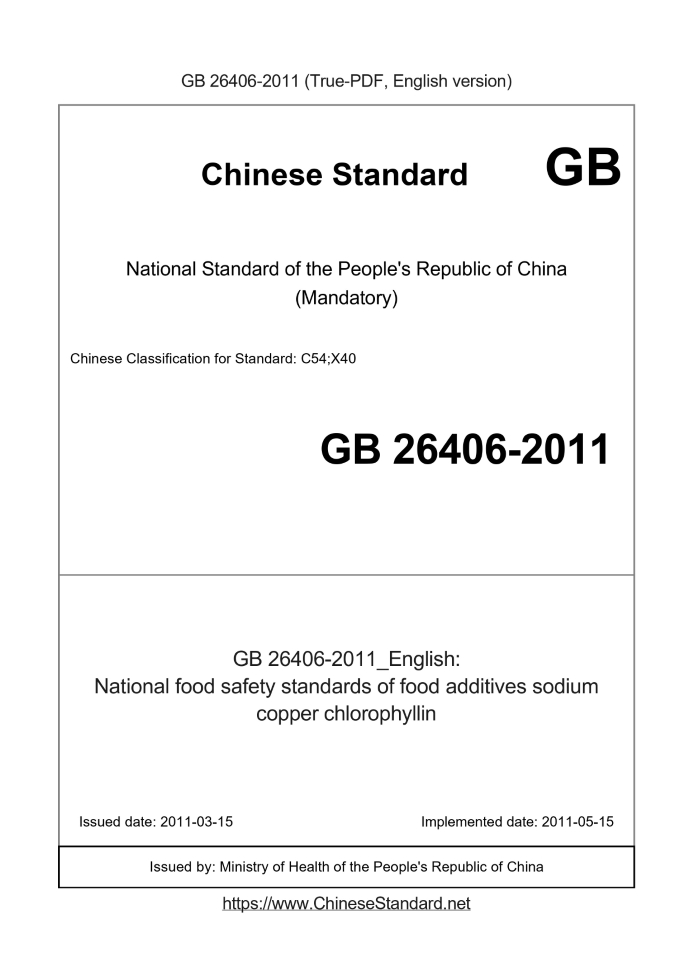
GB 26406-2011: National food safety standards of food additives sodium copper chlorophyllin
Status: Valid
| Standard ID | USD | BUY PDF | Lead-Days | Standard Title (Description) | Status |
| GB 26406-2011 | 139 |
Add to Cart
|
3 days
|
National food safety standards of food additives sodium copper chlorophyllin
| Valid |
Basic data
Standard ID: GB 26406-2011 (GB26406-2011)
Description (Translated English): National food safety standards of food additives sodium copper chlorophyllin
Sector / Industry: National Standard
Classification of Chinese Standard: C54;X40
Classification of International Standard: 67.220.20
Word Count Estimation: 6,668
Date of Issue: 2011-03-15
Date of Implementation: 2011-05-15
Regulation (derived from): Ministry of Health Bulletin No. 7 of 2011
Issuing agency(ies): Ministry of Health of the People's Republic of China
Summary: This Chinese standard applies to the mulberry silkworm sand as raw material, by saponification, copper and processed on behalf of other steps to obtain the powdered food additive sodium copper chlorophyll.
GB 26406-2011: National food safety standards of food additives sodium copper chlorophyllin
---This is a DRAFT version for illustration, not a final translation. Full copy of true-PDF in English version (including equations, symbols, images, flow-chart, tables, and figures etc.) will be manually/carefully translated upon your order.
National food safety standards of food additives sodium copper chlorophyllin
National Standards of People's Republic of China
National standards for food safety
Food Additives Chlorophyll Copper Salt
2011-03-15 release
2011-05-15 implementation
Issued by the Ministry of Health of the People's Republic of China
National standards for food safety
Food Additives Chlorophyll Copper Salt
1 Scope
This standard applies to the mulberry leaf, silkworm sand as raw material, the saponification, copper and other steps in the processing of powdered food additives chlorophyll copper salt.
2 molecular formula and relative molecular mass
2.1 Molecular formula
Copper tartrate. C34H31O6N4CuNa3
Copper chlorophyll disodium. C34H30O5N4CuNa2
2.2 Relative molecular mass
Copper tromate trisodium. 724.17 (according to.2007 International relative atomic mass)
Copper chlorophyll disodium. 684.16 (according to the.2007 international relative atomic mass)
3 technical requirements
3.1 sensory requirements. should be consistent with the provisions of Table 1.
Table 1 sensory requirements
The project requires a test method
Color ink green to black
Tissue state powder
Take appropriate sample in a clean, dry white porcelain dish
Natural light, observe the color and state
3.2 Physical and chemical indicators. should be consistent with the provisions of Table 2.
Table 2 Physical and chemical indicators
Item Index Test Method
pH 9.5 to 11.0 Appendix A, A.3
Absorbance [E1 m (405 nm ± 3 nm)] ≥ 568 Appendix A, A.4
Absorbance ratio 3.2 to 4.0 Appendix A, A.4
Total copper (Cu), w /% ≤ 8.0 Appendix A A.5
Free copper (Cu), w /% ≤ 0.025 Appendix A A.6
Dry reduction, w /% ≤ 5.0 GB 5009.3 direct drying method a
Total arsenic (in As)/(mg/kg) ≤ 2 GB/T 5009.11
Lead (Pb)/(mg/kg) ≤ 5 GB 5009.12
a Drying temperature and time are 105 ℃ and 2h respectively.
Appendix A
Testing method
A.1 General provisions
The reagents and water used in this standard, when not specified in other requirements, refer to the analysis of pure reagents and GB/T 6682-2008 in the provisions of the three
Water level. Standard titration solution used in the test, the standard solution for the determination of impurities, preparations and products, without any other requirements,
GB/T 601, GB/T 602, GB/T 603. The solution used in the test refers to water when it is not specified with the formulation of the solvent
Solution.
A.2 Identification test
A.2.1 Physical properties
Soluble in water, almost insoluble in low alcohol, insoluble in chloroform. The aqueous solution is clear and free from precipitation. In acidic cases (pH 6.5 or less) or calcium
When ions are present, there is precipitation.
A.2.2 Determination of absorption peak
Take A.4.3.1 absorbance determination of the sample solution, the sample solution in the 405nm ± 3nm and 630nm ± 3nm two wavelength range
Have the largest absorption peak.
A.2.3 Copper and sodium ion test
A sample of 1 g was weighed and placed in a crucible which had been burned to constant weight at 800 ° C ± 25 ° C and slowly heated until the sample was completely carbonized. Will be carbon
The sample was cooled and the residue was rinsed with 0.5 mL to 1 mL of sulfuric acid and heated to sulfuric acid vapor and heated at 800 & lt; 0 & gt; C
Burning residue in the furnace to constant weight. 10 mL of hydrochloric acid solution (1 3) was added to the residue, dissolved by heating on a water bath, and the water was added to the residue
10 mL, as the test solution, the following test.
a) Take the test solution as a flame test. Began to be green, after the yellow.
b) Take 5 mL of test solution, add 0.5 mL of 0.1% sodium diethyldithiocarbamate solution (1 g dissolved in 1000 mL
Water), resulting in brown red precipitate.
A.3 Determination of pH
A 1% sample solution (1 g of the sample was dissolved in 100 mL of water) was prepared and the pH was measured with an acidity meter.
A.4 Determination of absorbance and absorbance ratio
A.4.1 Reagents and materials
A.4.1.1 0.15mol/L disodium hydrogen phosphate solution. Weigh 53.7g disodium hydrogen phosphate (Na2HPO4 · 12H2O), add water to dissolve, dilute
And set to 1000mL.
A.4.1.2 0.15mol/L potassium dihydrogen phosphate solution. Weigh 20.4g potassium dihydrogen phosphate (KH2PO4), add water to dissolve, dilute and set to
1000mL.
A.4.1.3 Phosphate buffer (pH 7.5). 21 parts of 0.15 mol/L disodium hydrogen phosphate solution was mixed with 4 parts of 0.15 mol/L of dihydrogen phosphate
Potassium solution.
A.4.2 Instruments and equipment
Spectrophotometer.
A.4.3 Analysis steps
A.4.3.1 Preparation of sample solution
Accurately weighed 0.1g sample, accurate to 0.0002g, dissolved in water, into the 100mL volumetric flask to add water to the scale shake. take
1 mL of the above aqueous solution was diluted with phosphate buffer (pH 7.5) and set to 100 mL as a sample solution.
A.4.3.2 Determination
The sample solution was placed in a 1 cm cuvette with a phosphate buffer (pH 7.5) as a blank control, using a spectrophotometer at 405 nm ±
3nm and 630nm ± 3nm in the two wavelength range of the maximum absorption wavelength measured absorbance (absorbance should be controlled at 0.3 to 0.7
, Otherwise the sample solution should be adjusted concentration, and then re-measured absorbance).
A.4.4 Calculation of results
A.4.4.1 Concentration of sample solution is 1%, with 1cm cuvette, absorbance at the maximum absorption wavelength in the range of 405nm ± 3nm
Degrees according to formula (A.1), calculated as E1 m (405 nm ± 3 nm)
E1 m (405 nm ± 3 nm) = A1c1 ×
(A.1)
Where.
A1 --- actually measure the absorbance of the sample solution;
c1 --- the concentration of the test solution concentration (calculated according to the dry weight loss value of the measured sample, converted to the dry basis of the concentration), the unit is
G per milliliter (g/mL).
A.4.4.2 The absorbance ratio is calculated as w1 according to the formula (A.2)
w1 = E
1%
1 cm (405 nm ± 3 nm)
E1 m (630 nm ± 3 nm)
(A.2)
Where.
E1 m (405nm ± 3nm) --- sample concentration of 1%, with 1cm cuvette, in the range of 405nm ± 3nm maximum suction
The absorbance measured at the wavelength gain;
E1 m (630nm ± 3nm) --- sample concentration of 1%, with 1cm cuvette, in the range of 630nm ± 3nm maximum suction
The measured absorbance was measured with E1 m (405 nm ± 3 nm).
A.4.4.3 The experimental results are based on the arithmetic mean of the parallel determination results. Two independent determinations obtained under repeatability conditions
The absolute difference shall not exceed 2% of the arithmetic mean.
A.5 Total copper content
A.5.1 Sample handling
Accurately weighed 0.1g sample, accurate to 0.0002g, placed in the silicon dish, not more than 500 ℃ to the burning to carbon, with 1 drop ~ 2 drops
Sulfuric acid moist, again ashes. The ash was dissolved in 3 portions (5 mL each) with a hydrochloric acid solution with a mass fraction of 10% and filtered
100mL volumetric flask, after cooling the water volume to the mark, this is the sample solution.
A.5.2 Determination
In addition to the sample treatment, the other steps according to GB/T 5009.13 method of determination.
A.6 Free copper content
A.6.1 Sample handling
Accurately weighed 0.1g sample, add about 50mL of water dissolved, with 1mol/L hydrochloric acid to adjust the pH to 4.0, constant volume to 100mL, over
Filter, this is the sample solution.
A.6.2 Determination
In addition to the sample treatment, the other steps according to GB/T 5009.13 method of determination.
......
Tips & Frequently Asked Questions:
Question 1: How long will the true-PDF of GB 26406-2011_English be delivered?
Answer: Upon your order, we will start to translate GB 26406-2011_English as soon as possible, and keep you informed of the progress. The lead time is typically 1 ~ 3 working days. The lengthier the document the longer the lead time.
Question 2: Can I share the purchased PDF of GB 26406-2011_English with my colleagues?
Answer: Yes. The purchased PDF of GB 26406-2011_English will be deemed to be sold to your employer/organization who actually pays for it, including your colleagues and your employer's intranet.
Question 3: Does the price include tax/VAT?
Answer: Yes. Our tax invoice, downloaded/delivered in 9 seconds, includes all tax/VAT and complies with 100+ countries' tax regulations (tax exempted in 100+ countries) -- See Avoidance of Double Taxation Agreements (DTAs):
List of DTAs signed between Singapore and 100+ countriesQuestion 4: Do you accept my currency other than USD?
Answer: Yes. If you need your currency to be printed on the invoice, please write an email to Sales@ChineseStandard.net. In 2 working-hours, we will create a special link for you to pay in any currencies. Otherwise, follow the normal steps: Add to Cart -- Checkout -- Select your currency to pay.