GB/T 19342-2024 PDF English
GB/T 19342: Historical versions
| Standard ID | USD | BUY PDF | Delivery | Standard Title (Description) | Status |
| GB/T 19342-2024 | 275 | Add to Cart | Auto, 9 seconds. | Manual toothbrushes - General requirements and test methods | Valid |
| GB 19342-2013 | 1079 | Add to Cart | 5 days | Toothbrushes | Obsolete |
| GB 19342-2003 | 959 | Add to Cart | 4 days | Toothbrush | Obsolete |
Similar standards
GB/T 19342-2024: Manual toothbrushes - General requirements and test methods
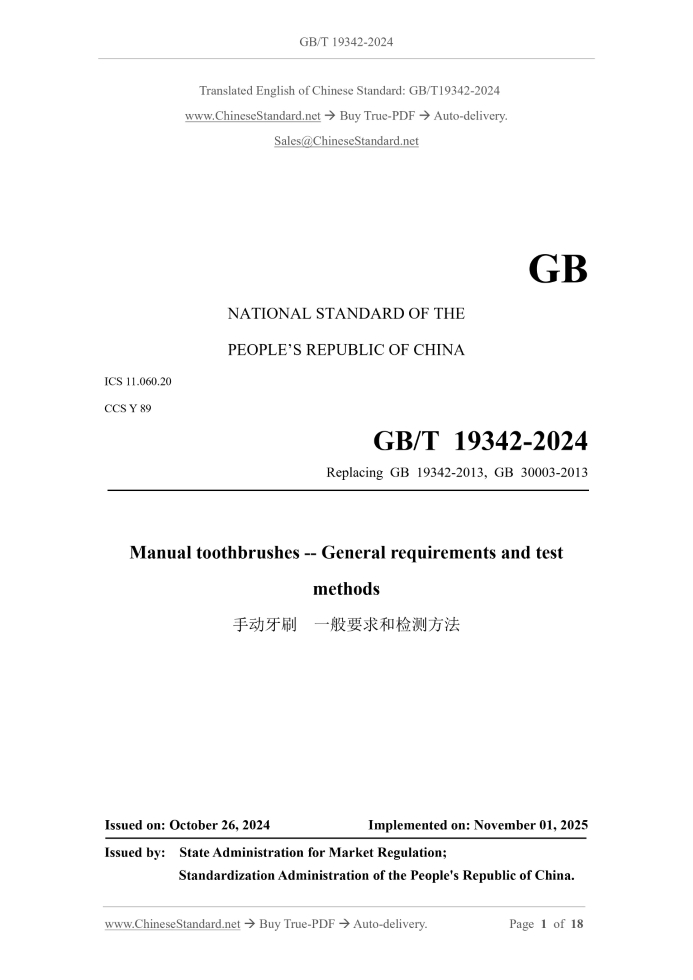
---This is an excerpt. Full copy of true-PDF in English version (including equations, symbols, images, flow-chart, tables, and figures etc.), auto-downloaded/delivered in 9 seconds, can be purchased online: https://www.ChineseStandard.net/PDF.aspx/GBT19342-2024GB NATIONAL STANDARD OF THE PEOPLE’S REPUBLIC OF CHINA ICS 11.060.20 CCS Y 89 Replacing GB 19342-2013, GB 30003-2013 Manual toothbrushes -- General requirements and test methods Issued on: OCTOBER 26, 2024 Implemented on: NOVEMBER 01, 2025 Issued by. State Administration for Market Regulation; Standardization Administration of the People's Republic of China.
Table of Contents
Foreword... 3 1 Scope... 5 2 Normative references... 5 3 Terms and definitions... 5 4 Requirements... 6 5 Test methods... 9 6 Inspection rules... 14 7 Marks, packaging, transportation and storage... 15 Annex A (normative) Determination of tuft deflection force... 17 Manual toothbrushes -- General requirements and test methods1 Scope
This document specifies the technical requirements, inspection rules, marking, packaging, transportation, and storage of manual toothbrushes (hereinafter referred to as "toothbrushes"). The corresponding test methods are described. This document applies to the production, inspection, and sale of manual toothbrushes for daily oral hygiene. This document does not apply to toothbrushes intended for use by children aged 14 and under.2 Normative references
The following referenced documents are indispensable for the application of this document. For dated references, only the edition cited applies. For undated references, the latest edition of the referenced document (including any amendments) applies. GB/T 191, Packaging and storage marks GB/T 2828.1, Sampling procedures for inspection by attributes -- Part 1.Sampling schemes indexed by acceptance quality limit (AQL) for lot-by-lot inspection GB/T 2829, Sampling procedures and tables for periodic inspection by attributes (apply to inspection of process stability) GB 39669, General technical requirements for safety of toothbrushes and oral implements3 Terms and definitions
For the purposes of this document, the terms and definitions defined in GB 39669 apply. 3.1 manual toothbrush A tool for cleaning the surface of teeth that does not use electricity to drive the cleaning function, but uses bristles. 3.2 tufting toothbrush A toothbrush in which all or part of the bristles are fixed to the brush head by means of metal sheets or heat fusion. 3.3 taper rate of filament The percentage of monofilaments with a pointed tip cone height of not less than 4 mm in the tapered filament brush bristles. 3.4 molded bristle The bristles that are molded into the brush head using an injection molding process and are used to clean teeth. NOTE. Excludes injection-molded components used for massage or other functions. 3.5 tuft deflection force; F The force that is generated by tufts resisting to bending. NOTE. The unit is Newton (N). 3.6 conventional bristle The bristles that have a solid circular cross-section along their length.4 Requirements
4.1 Sensory quality Sensory quality shall meet the requirements of Table 1. 4.2 Specifications and dimensions The specifications and dimensions shall conform to the requirements of Table 2.See 4.10 Detachable brush head secureness 4.10.1 Secureness of insertable detachable brush head The separation strength between the insertable detachable brush head and the brush handle shall not be less than 5 N. 4.10.2 Secureness of rotary detachable brush head The separation torque between the rotary detachable brush head and the brush handle shall not be less than 0.05 N·m.5 Test methods
5.1 Specimen conditioning and test environment Condition the samples in an environment with a temperature of (23±2)℃ and a relative humidity of (50±10)% for at least 4 h. Conduct the tests under these conditions (unless otherwise specified). 5.2 Sensory quality 5.2.1 Visually inspect the sample at a distance of 300 mm under natural light or a light source with a color temperature of 6500 K. 5.2.2 Use absorbent cotton fully soaked in 65% ethanol. Apply a force of 1 N~1.5 N and rub back and forth 100 times on each test area. Test areas include the brush head, handle, bristles, and decorative objects. The rubbing frequency is 2~3 times per second. Visually observe whether there is any color on the absorbent cotton. 5.2.3 Check for air bubbles in the brush handle by comparing them with a dust standard chart. 5.2.4 Use your sense of smell to determine if there is an unusual odor. 5.3 Specifications and dimensions The length, width, thickness, height, and total length of the toothbrush shall be measured using a measuring tool with a minimum graduation of no more than 0.02 mm (such as a steel ruler, vernier caliper, or outside micrometer). The diameter of a single filament shall be measured at the base using a measuring tool with a minimum graduation of no more than 0.001 mm (such as a measuring microscope). The maximum dimension of the bristles 4 mm below the top shall be measured using a measuring tool with a minimum graduation of no more than 0.001 mm (such as a measuring microscope). If a toothbrush has two or more bristle sizes, take one bristle of each size. 5.4 Tuft strength Tuft strength is assessed by tuft deflection force. The test is performed according to the method in Annex A. 5.5 Taper rate of filament Take 30 tapered monofilaments from the base of the bristles of a toothbrush. Measure the diameter of each monofilament at the base using a measuring tool with a minimum graduation of 0.001 mm (such as a tool measuring microscope). Simultaneously measure the diameter at a point 4 mm from the tip of the tapered filament on the corresponding bristle. Compare the diameter at this point with the diameter of the monofilament. If the diameter at this point is smaller than the diameter of the monofilament, the cone height of the monofilament is not less than 4 mm. Record the number of monofilaments with a cone height not less than 4 mm, and calculate the taper rate of filament using formula (1). Where, P - Taper rate of filament, %; n - Number of monofilaments with a cone height of not less than 4 mm, in units of strands. 5.6 Breaking strength of molded bristle 5.6.1 Test apparatus. A tensile testing machine with a minimum scale division of 0.1 N, equipped with a brush head clamp and a bristle clamp. 5.6.2 Test procedure. Connect the brush head to the lower jaw of the tensile testing machine using the brush head clamp (bristles upwards). Connect the bristle clamp to the upper jaw of the tensile testing machine. Select any 5 molded bristles from the same brush head and test them separately. Clamp the molded bristles 2 mm above the root with the bristle clamp. Start the tensile testing machine and allow it to rise at a constant speed of (90±10) mm/min. Read the tensile testing machine reading when the bristles break. Take the arithmetic mean of the results. NOTE. Avoid damaging the sample with the brush clip during testing to prevent affecting the test results. 5.7 Monofilament bending recovery rate 5.7.1 Test apparatus. A constant temperature water bath with a temperature control accuracy of ±2℃, a stopwatch, and a metal plate with through holes (see Figure 2). The diameter of the through holes in the metal plate and the corresponding diameter of the monofilaments are shown in Table 4.Annex A
(normative) Determination of tuft deflection force A.1 Test sampling Five tufting toothbrushes are selected. Those with a glue-filled structure have the glue- filled portion removed and are used as test samples. A.2 Test conditions Room temperature. (23±2)℃. A.3 Instruments and equipment A.3.1 The bristle tuft strength tester. its force measuring device structure diagram is shown in Figure A.1.It has a brush head clamp for effectively holding the toothbrush head and features adjustable bristle tuft planar position. The brush head clamp is mounted on a vertical column, the height of which is adjustable up and down along the column. The vertical column can reciprocate horizontally on the worktable. The grid is at least 50 mm long, 16 mm wide, and 5 mm deep. The grid bars are perpendicular to the vertical column's running direction. The distribution density is 1 bar/3 mm. Each bar has a diameter of (0.50±0.02) mm. The grid connects to the force measuring device for measuring the horizontal bristle tuft deflection force. The measurement accuracy is 0.01 N. Keys. 1 - Vertical column; 2 - Brush head clamp; 3 - Grating. Figure A.1 -- Structural diagram of the force measuring device ......Source: Above contents are excerpted from the full-copy PDF -- translated/reviewed by: www.ChineseStandard.net / Wayne Zheng et al.