GB 1903.74-2025 PDF English
| Standard ID | USD | BUY PDF | Delivery | Standard Title (Description) | Status |
| GB 1903.74-2025 | 110 | Add to Cart | Auto, 9 seconds. | National food safety standard - Nutrition fortifier - L-methionine | Valid |
Similar standards
GB 1903.74-2025: National food safety standard - Nutrition fortifier - L-methionine
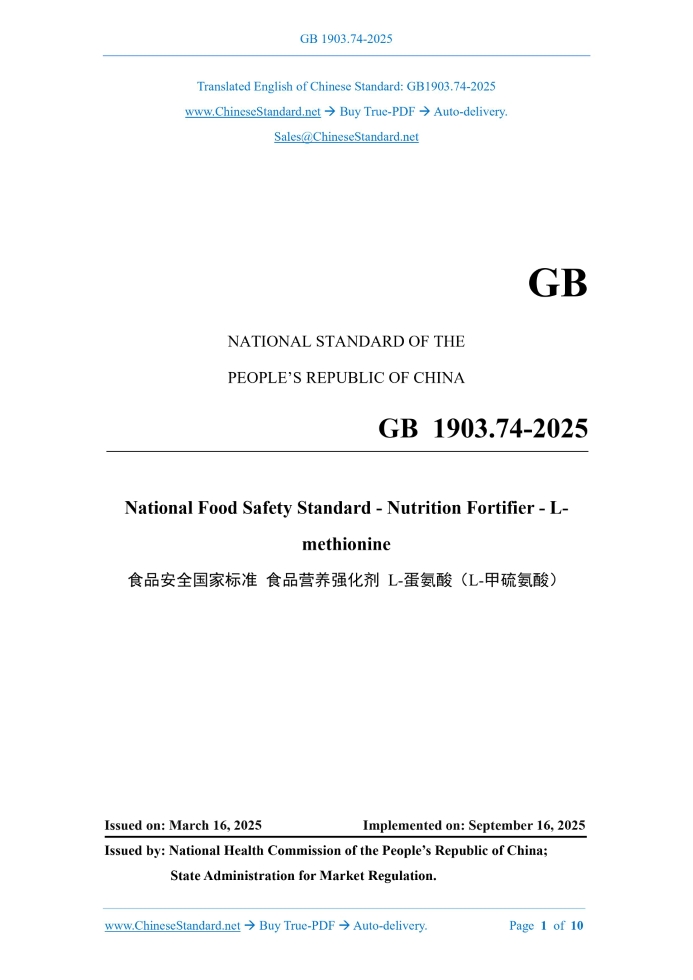
---This is an excerpt. Full copy of true-PDF in English version (including equations, symbols, images, flow-chart, tables, and figures etc.), auto-downloaded/delivered in 9 seconds, can be purchased online: https://www.ChineseStandard.net/PDF.aspx/GB1903.74-2025GB NATIONAL STANDARD OF THE PEOPLE’S REPUBLIC OF CHINA National Food Safety Standard - Nutrition Fortifier - L- methionine Issued on: MARCH 16, 2025 Implemented on: SEPTEMBER 16, 2025 Issued by. National Health Commission of the People’s Republic of China; State Administration for Market Regulation.
Table of Contents
1 Scope... 3 2 Chemical Name, Molecular Formula, Structural Formula and Relative Molecular Mass... 3 3 Technical Requirements... 3 Appendix A Inspection Method... 5 Appendix B Reference Infrared Spectrogram of L-methionine... 10 National Food Safety Standard - Nutrition Fortifier - L- methionine1 Scope
This Standard applies to the food nutrition fortifier L-methionine, which is obtained by fermentation, extraction and refinement with edible starch or sugariness as the main raw material; or by enzymatic resolution and refinement with DL-methionine as the raw material.2 Chemical Name, Molecular Formula, Structural Formula
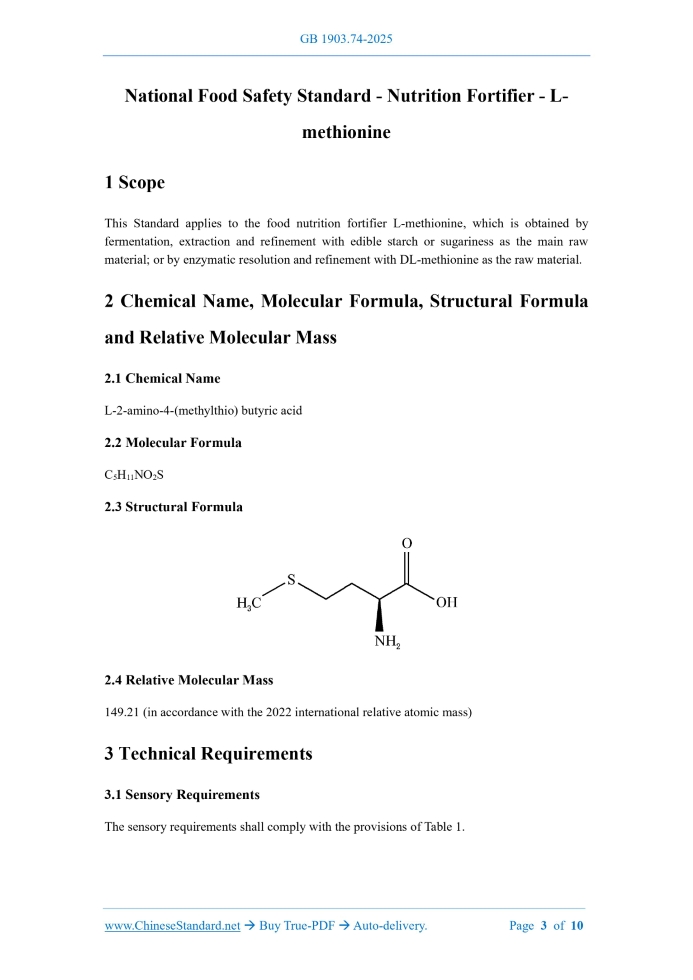
and Relative Molecular Mass 2.1 Chemical Name L-2-amino-4-(methylthio) butyric acid 2.2 Molecular Formula C5H11NO2S 2.3 Structural Formula 2.4 Relative Molecular Mass 149.21 (in accordance with the 2022 international relative atomic mass)3 Technical Requirements
3.1 Sensory Requirements The sensory requirements shall comply with the provisions of Table 1.Appendix A
Inspection Method A.1 Safety Tips Some of the reagents used in this test method are toxic or corrosive and require caution when operating. If they splash on the skin, immediately use water to rinse it. If the condition is serious, immediately seek medical treatment. When using volatile acids, use them in a fume hood. A.2 General Provisions The reagents and water used in this Standard, unless otherwise specified, refer to analytically pure reagents and Grade-3 water specified in GB/T 6682.The standard titration solutions used in the test, standard solutions, preparations and products used for impurity determination, unless otherwise specified, shall be respectively prepared in accordance with the provisions of GB/T 601, GB/T 602 and GB/T 603.Unless the solvent used is specified, the solutions used in the test refer to aqueous solutions. A.3 Identification Test Use the potassium bromide pellet technique, and in accordance with GB/T 6040, carry out the infrared spectrum test. The infrared spectrogram of the specimen shall be consistent with the reference spectrogram of L-methionine (see Appendix B). A.4 Determination of L-methionine Content (on a dry basis) A.4.1 Method summary The specimen is titrated with perchloric acid standard titration solution using formic acid as co- solvent and glacial acetic acid as solvent. In accordance with the volume of the perchloric acid standard titration solution consumed, calculate the L-methionine content. A.4.2 Reagents and materials A.4.2.1 Glacial acetic acid. A.4.2.2 Anhydrous formic acid. A.4.2.3 Perchloric acid standard titration solution. c(HClO4) = 0.1 mol/L. A.4.2.4 Crystal violet indicator solution. 5 g/L. A.4.3 Instruments and equipment A.4.3.1 Potentiometric titrator. A.7.2.1 High-temperature furnace. A.7.2.2 Porcelain crucible. A.7.2.3 Desiccator. A.7.2.4 Electronic balance. the division value is 0.0001 g. A.7.3 Analytical steps Weigh-take 2 g (accurate to 0.0001 g) of specimen, place it in a crucible that has been calcined at 800 C 25 C to a constant mass, slowly calcine, until it is completely carbonized, and cool it to room temperature. Add 1 mL ~ 2 mL of concentrated sulfuric acid to moisten it, heat at low temperature, until the sulfuric acid vapor is completely removed, and then, at 800 C 25 C, calcine to completely incinerate it. When the furnace temperature drops to about 200 C, take it out, move it into a desiccator, cool it for 30 minutes, and weigh it. Then, at 800 C 25 C, repeat the calcination, until a constant mass is reached. A.7.4 Result calculation The mass fraction of the ignition residue w2 is calculated in accordance with Formula (A.3). Where, m2---the mass of the constant-mass crucible, expressed in (g); m3---the mass of the crucible and the specimen before ignition, expressed in (g); m4---the mass of the crucible and residue after igniting to a constant mass, expressed in (g). The test result shall be based on the arithmetic mean of parallel determination results. The absolute difference between two independent determination results obtained under repeatability conditions must not exceed 10% of the arithmetic mean. A.8 Determination of Chloride (by Cl) A.8.1 Reagents and materials A.8.1.1 Nitric acid. A.8.1.2 Nitric acid solution (V + V). 1 + 9. A.8.1.3 Silver nitrate solution. 17 g/L. A.8.1.4 Chloride standard solution. in accordance with GB/T 602, prepare a stock solution with a mass concentration of 0.1 mg/mL. Before use, use water to dilute it to a level equivalent to ......Source: Above contents are excerpted from the full-copy PDF -- translated/reviewed by: www.ChineseStandard.net / Wayne Zheng et al.