GB 1886.330-2021 English PDF
Price & Delivery
US$80.00 · In stock · Download in 9 secondsGB 1886.330-2021: National food safety standard - Food additives - Ammonium dihydrogen phosphate
Delivery: 9 seconds. True-PDF full-copy in English & invoice will be downloaded + auto-delivered via email. See step-by-step procedure
Status: Valid
| Standard ID | USD | BUY PDF | Delivery | Standard Title (Description) | Status |
| GB 1886.330-2021 | 80 | Add to Cart | Auto, 9 seconds. | National food safety standard - Food additives - Ammonium dihydrogen phosphate | Valid |
Click to Preview this PDF
Similar standards
GB 1886.330-2021: National food safety standard - Food additives - Ammonium dihydrogen phosphate
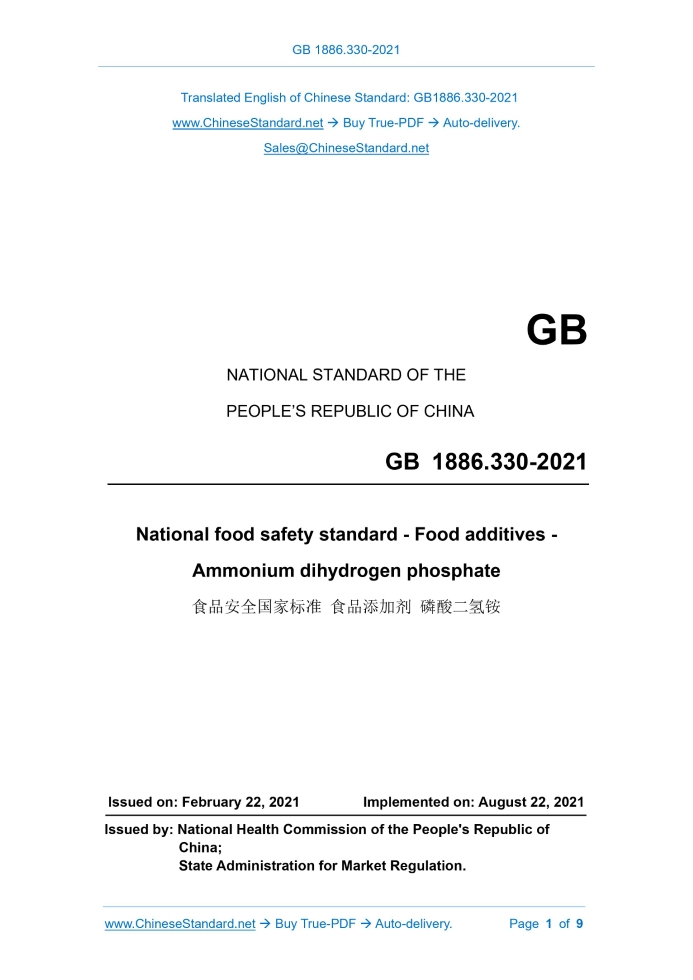
---This is an excerpt. Full copy of true-PDF in English version (including equations, symbols, images, flow-chart, tables, and figures etc.), auto-downloaded/delivered in 9 seconds, can be purchased online: https://www.ChineseStandard.net/PDF.aspx/GB1886.330-2021GB NATIONAL STANDARD OF THE PEOPLE’S REPUBLIC OF CHINA National food safety standard - Food additives - Ammonium dihydrogen phosphate ISSUED ON: FEBRUARY 22, 2021 IMPLEMENTED ON: AUGUST 22, 2021 Issued by: National Health Commission of the People's Republic of China; State Administration for Market Regulation.
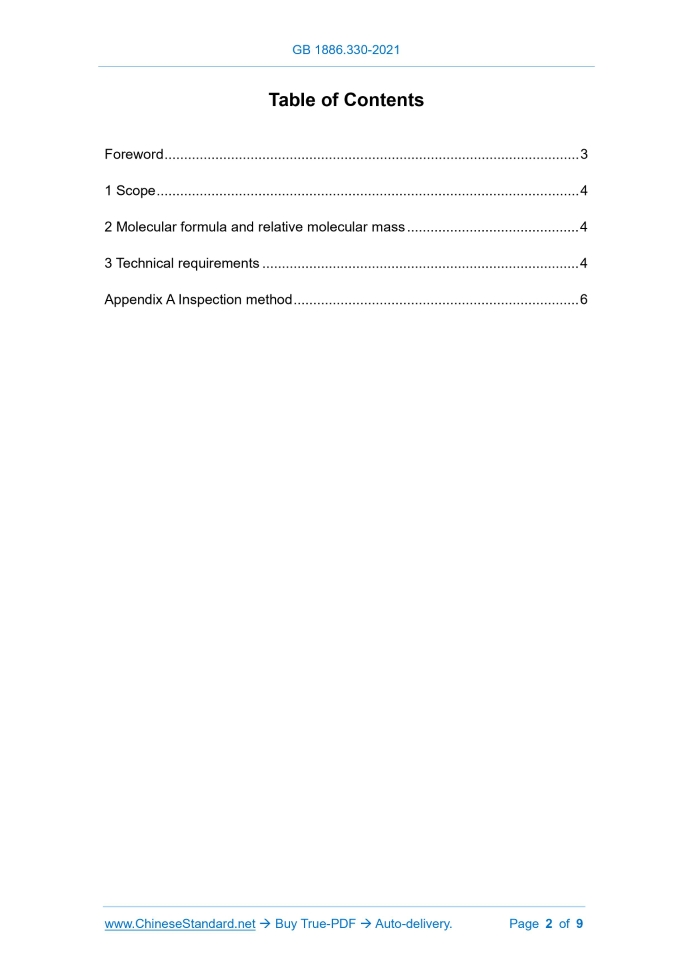
Table of Contents
Foreword ... 3 1 Scope ... 4 2 Molecular formula and relative molecular mass ... 4 3 Technical requirements ... 4 Appendix A Inspection method ... 6 National food safety standard - Food additives - Ammonium dihydrogen phosphate1 Scope
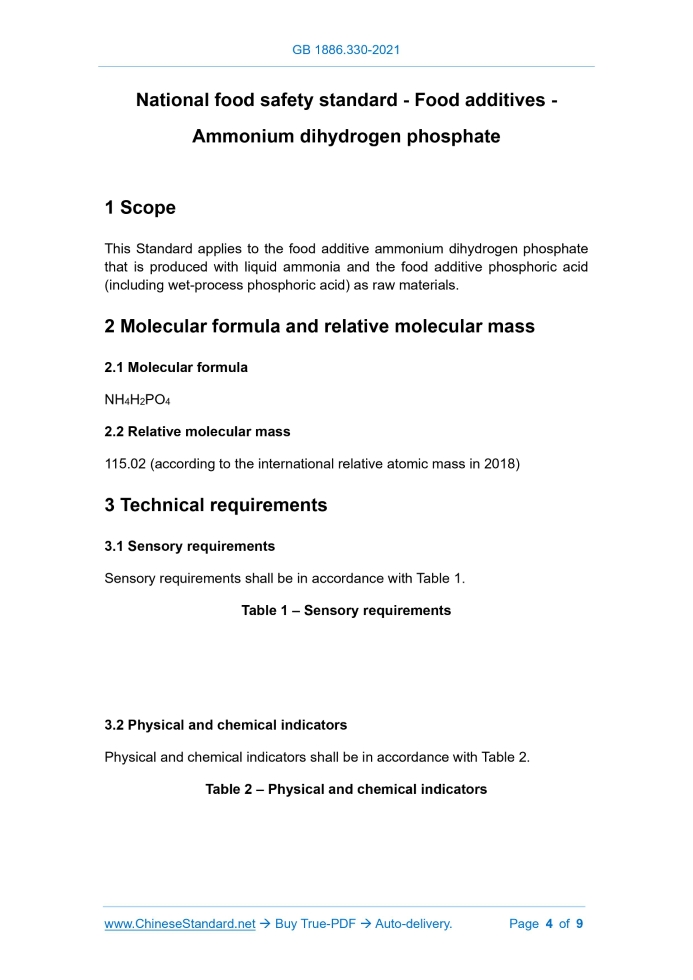
This Standard applies to the food additive ammonium dihydrogen phosphate that is produced with liquid ammonia and the food additive phosphoric acid (including wet-process phosphoric acid) as raw materials.2 Molecular formula and relative molecular mass
2.1 Molecular formula NH4H2PO4 2.2 Relative molecular mass 115.02 (according to the international relative atomic mass in 2018)3 Technical requirements
3.1 Sensory requirements Sensory requirements shall be in accordance with Table 1. Table 1 – Sensory requirements 3.2 Physical and chemical indicators Physical and chemical indicators shall be in accordance with Table 2. Table 2 – Physical and chemical indicatorsAppendix A
Inspection method WARNING: Some reagents which are used in the test method of this Standard are toxic or corrosive, so, be careful when operating! If necessary, perform it in a fume hood. If it splashes on the skin or eyes, use plenty of water to rinse immediately; if it is serious, seek medical attention immediately. A.1 General provisions The reagents and water that are used in this Standard, when no other requirements are specified, refer to analytical reagents and grade-III water which is specified in GB/T 6682. The standard titration solution, the standard solutions, preparations and products for impurity determination, which are used in the test, are all prepared in accordance with the provisions of GB/T 601, GB/T 602, and GB/T 603, when no other requirements are specified. The used solution, if not indicated which solvent is used, refers to aqueous solution. A.2 Identification test A.2.1 Reagents and materials A.2.1.1 Nitric acid solution: 1+8. A.2.1.2 Ammonia solution: 1+1. A.2.1.3 Sodium hydroxide solution: 40 g/L. A.2.1.4 Silver nitrate solution: 17 g/L. A.2.1.5 Litmus red test paper. A.2.2 Identification method A.2.2.1 Identification of phosphate ion Weigh 1.0 g of the sample; dissolve it in 20 mL of water; add silver nitrate solution, to produce a yellow precipitate. This precipitate is soluble in ammonia solution or nitric acid solution. A.2.2.2 Identification of ammonium ion Where: V1 – the volume of sodium hydroxide standard titration solution that is consumed by the titration sample solution, in milliliters (mL); V2 – the volume of sodium hydroxide standard titration solution that is consumed by the titration blank sample solution, in milliliters (mL); c – the concentration of the sodium hydroxide standard titration solution, in moles per liter (mol/L); M – the molar mass of ammonium dihydrogen phosphate (1/2NH4H2PO4), in grams per mole (g/moL) (M = 57.51); m – sample mass, in grams (g). 1 000 – conversion factor. The test result is based on the arithmetic mean of the parallel determination results. The absolute difference between two independent determination results that are obtained under repeatability conditions is not more than 0.3%. A.4 Determination of pH (10 g/L aqueous solution) A.4.1 Reagents and materials Carbon dioxide-free water. A.4.2 Instruments and apparatuses Acidity meter: resolution of 0.01 pH, equipped with glass electrode and saturated calomel electrode (or composite electrode). A.4.3 Analysis steps Weigh 1.00 g ± 0.01 g of the sample; place it in a 100 mL beaker; use carbon dioxide-free water to dissolve; transfer it into a 100 mL volumetric flask; use carbon dioxide-free water to dilute to the mark; shake well. Pour into a dry beaker; use a calibrated acidity meter to measure the pH of the sample solution. The test result is based on the arithmetic mean of the parallel determination results. The absolute difference between two independent determination results that are obtained under repeatability conditions is not more than 0.1. A.5 Determination of lead (Pb) ......Source: Above contents are excerpted from the full-copy PDF -- translated/reviewed by: www.ChineseStandard.net / Wayne Zheng et al.