GB 18383-2025 English PDF
Price & Delivery
US$275.00 · In stock · Download in 9 secondsGB 18383-2025: General technical requirements for products with filling materials
Delivery: 9 seconds. True-PDF full-copy in English & invoice will be downloaded + auto-delivered via email. See step-by-step procedure
Status: Valid
GB 18383: Historical versions
| Standard ID | USD | BUY PDF | Delivery | Standard Title (Description) | Status |
| GB 18383-2025 | 275 | Add to Cart | Auto, 9 seconds. | General technical requirements for products with filling materials | Valid |
| GB 18383-2007 | 85 | Add to Cart | Auto, 9 seconds. | General technical requirements for products with filling materials | Valid |
| GB 18383-2001 | 199 | Add to Cart | 2 days | General technical requirement for products with wadding fibre | Obsolete |
Click to Preview this PDF
Similar standards
GB 18383-2025: General technical requirements for products with filling materials
---This is an excerpt. Full copy of true-PDF in English version (including equations, symbols, images, flow-chart, tables, and figures etc.), auto-downloaded/delivered in 9 seconds, can be purchased online: https://www.ChineseStandard.net/PDF.aspx/GB18383-2025GB NATIONAL STANDARD OF THE PEOPLE'S REPUBLIC OF CHINA ICS 59.080.99 CCS W 59 Replacing GB 18383-2007 General technical requirements for products with filling materials Issued on: DECEMBER 2, 2025 Implemented on: JULY 1, 2026 Issued by. State Administration for Market Regulation; Standardization Administration of PRC.
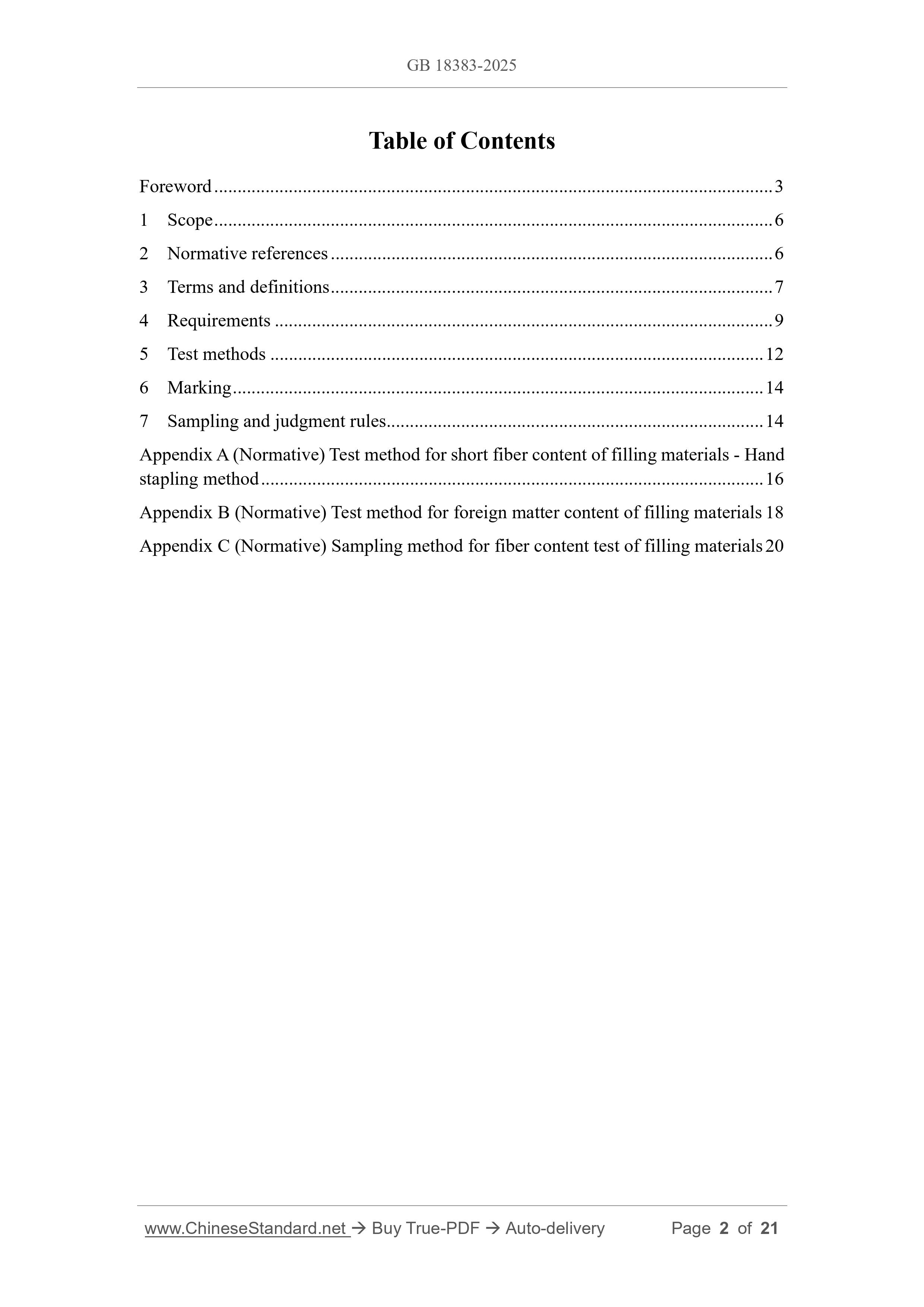
Table of Contents
Foreword... 3 1 Scope... 6 2 Normative references... 6 3 Terms and definitions... 7 4 Requirements... 9 5 Test methods... 12 6 Marking... 14 7 Sampling and judgment rules... 14 Appendix A (Normative) Test method for short fiber content of filling materials - Hand stapling method... 16 Appendix B (Normative) Test method for foreign matter content of filling materials 18 Appendix C (Normative) Sampling method for fiber content test of filling materials 20 General technical requirements for products with filling materials1 Scope
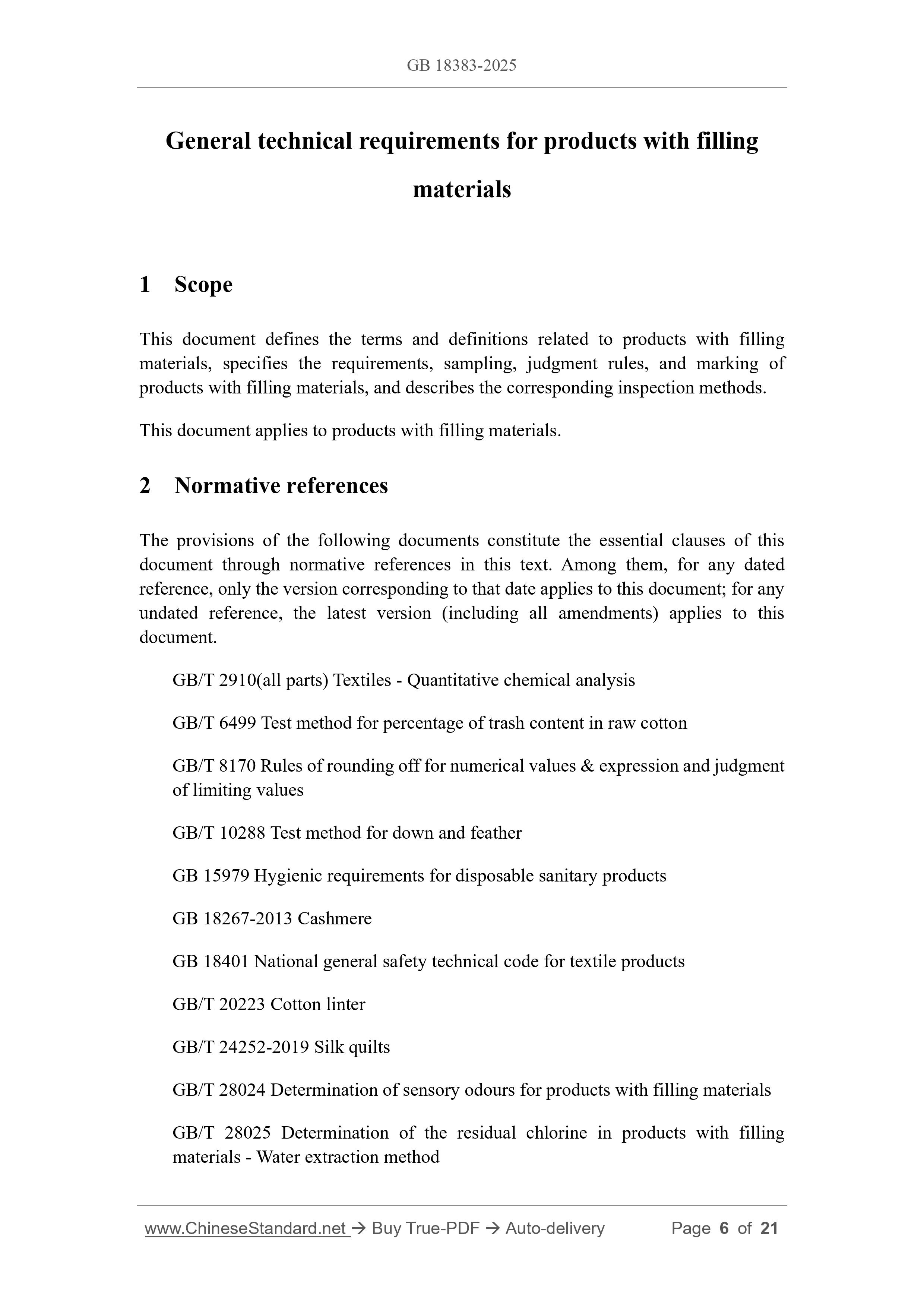
This document defines the terms and definitions related to products with filling materials, specifies the requirements, sampling, judgment rules, and marking of products with filling materials, and describes the corresponding inspection methods. This document applies to products with filling materials.2 Normative references
The provisions of the following documents constitute the essential clauses of this document through normative references in this text. Among them, for any dated reference, only the version corresponding to that date applies to this document; for any undated reference, the latest version (including all amendments) applies to this document. GB/T 2910(all parts) Textiles - Quantitative chemical analysis GB/T 6499 Test method for percentage of trash content in raw cotton GB/T 8170 Rules of rounding off for numerical values & expression and judgment of limiting values GB/T 10288 Test method for down and feather GB 15979 Hygienic requirements for disposable sanitary products GB 18267-2013 Cashmere GB 18401 National general safety technical code for textile products GB/T 20223 Cotton linter GB/T 24252-2019 Silk quilts GB/T 28024 Determination of sensory odours for products with filling materials GB/T 28025 Determination of the residual chlorine in products with filling materials - Water extraction method GB/T 43811 Test method for short fiber content of wadding fiber products FZ/T 01026 Textiles - Quantitative chemical analysis - Multinary fiber mixtures FZ/T 01057(all parts) Test method for identification of textile fibers FZ/T 01101 Textile test method - Fiber content - Quantitative physical analysis SN/T 3335 Rules for the inspection of microbiological specification on import and export textiles3 Terms and definitions
The following terms and definitions apply to this document. 3.1 filling materials A collective term for natural fibers, chemical fibers, and their mixtures used for filling and padding. 3.2 products with filling materials Products for which filling materials and their processed wadding sheets, felt pads, etc. are used as filling or padding materials. NOTE. Products with filling materials are divided into daily use products with filling materials and non- daily use products with filling materials. 3.3 daily use products with filling materials Products with filling materials that come into close contact with the human body in daily life. NOTE. Daily use products with filling materials mainly include clothing, footwear and hats products with filling materials, such as winter clothing, down clothing, cotton clothing, cotton shoes, and cotton hats; bedding products with filling materials, such as quilts, mattresses, pillows, and cushions; upholstered furniture products with filling materials, such as mattresses, sofas, and seating/lying cushions; and toy products with filling materials, such as plush toys. 3.4 non-daily use products with filling materials Products with filling materials other than those for daily use. NOTE. Non-daily use products with filling materials mainly include building insulation materials, agricultural insulation materials, transportation packaging materials, decorative materials, and building sound insulation materials, etc. 3.5 textile waste for medical purpose Various fiber products that have been discarded or abandoned by medical and health institutions. NOTE. Textile waste for medical purposes mainly includes obsolete or discarded medical dressings such as absorbent cotton and absorbent gauze, as well as clothing, products with filling materials, and other fibrous products worn by medical staff and patients. 3.6 foreign matter The collective term for non-flocculating fiber substances that are mixed into filling materials. 3.7 fibre waste Single fibers or bundles of fibers that fall off, are discarded, or are detached during the production and processing of fibers or fiber products. 3.8 fibre products waste Thread ends other than fiber waste, and offcuts from fabrics, wadding sheets and felt pads, which are generated during the processing and production of fiber products. 3.9 unused fibre products waste Waste generated during the production and processing of fibers and their products (such as spinning, weaving, printing and dyeing, and cutting), as well as clothing, household fiber products, industrial fiber products and other fiber products that are discarded or abandoned before use. NOTE. Waste materials include fiber waste and fiber products waste. 3.10 used fibre products waste Fiber products that are discarded or abandoned after use. NOTE. This includes clothing, household fiber products, industrial fiber products, and other fiber products that have been discarded or phased out after use. 3.11 mechanically recycled fibre Fibers that are made from fiber products, fiber waste, and fiber products waste through physical and mechanical processes. NOTE. Physical-mechanical processing refers to the process of using mechanical methods to cut, tear, and open fiber waste, fiber products, and their waste to obtain fibers. 3.12 recycled chemical fibre Fibers that are made from unused/used fiber product waste or waste polymer materials through processes such as physical melting, chemical regeneration, and physicochemical processes. NOTE 1.Physical melting process refers to the reprocessing of thermoplastic unused/used fiber product waste or waste polymer materials through heating and melting. Chemical regeneration process refers to the process of depolymerizing, removing impurities, repolymerizing, or decomposing unused/used fiber product waste, or waste polymer materials into new raw materials under certain chemical process conditions. Physicochemical process refers to the process of blending and modifying unused/used fiber products waste, or waste polymer materials through heating and melting under the action of different functional additives. NOTE 2.To ensure the performance of recycled chemical fibers in subsequent uses, some recycled chemical fibers contain virgin fibers.4 Requirements
4.1 Basic Requirements The following substances shall not be used as raw materials for processing products with filling materials. a) textile waste for medical purposes; b) used funeral fiber products; c) fiber products from areas affected by infectious diseases for which proof of non-contamination cannot be provided; d) unused and used fiber products waste that are prohibited from import by the nation; e) other substances that are severely contaminated or toxic and harmful. 4.2 Requirements for filling materials in daily use products with filling materials 4.2.1 The following substances shall not be used as raw materials for fillings or padding in the processing of daily use products with filling materials. a) contaminated fibers; b) unused and used fiber products waste (except uncontaminated fiber waste and those conforming to 4.2.2); c) mechanically recycled fibers (except those conforming to 4.2.2); d) cotton linters with a staple length of less than 13 mm as specified in GB/T 20223; e) Fiber waste, fiber products waste, and mechanically recycled fibers that have undergone decolorization and bleaching treatment; f) unwashed animal fibers; g) moldy or deteriorated filling materials. 4.2.2 Mechanically recycled fibers or uncontaminated fiber products waste, after disinfection, can be used as filling and padding materials for upholstered furniture and other products. Byproducts such as frison and frigon produced during silk reeling, as well as washed animal fibers, can be used as filling and padding materials for daily use products with filling materials. 4.2.3 Except for recycled polyester fibers, other recycled chemical fibers shall not be used as filling or padding materials for products with filling materials for infants and young children aged 3 years (36 months) and under. 4.3 Technical requirements for daily use products with filling materials 4.3.1 Daily use products with filling materials shall not contain metal objects, sharp objects, or other harmful foreign matter, such as needles, iron wires, or wooden sticks; and shall not contain obvious dust. 4.3.2 The content of short fibers with a length of 13 mm or less in daily use products with filling materials shall not exceed 25%; the short fiber content is not assessed for felt pads, wadding sheets, and daily use products with filling materials containing kapok, down, or feathers. 4.3.3 The foreign matter content of filling materials in daily use products with filling materials shall meet the requirements of Table 1. ......Source: Above contents are excerpted from the full-copy PDF -- translated/reviewed by: www.ChineseStandard.net / Wayne Zheng et al.