GB 12456-2021 PDF English
GB 12456: Historical versions
| Standard ID | USD | BUY PDF | Delivery | Standard Title (Description) | Status |
| GB 12456-2021 | 130 | Add to Cart | Auto, 9 seconds. | [Including 2025XG1] National food safety standard - Determination of total acid in foods | Valid |
| GB/T 12456-2008 | 160 | Add to Cart | Auto, 9 seconds. | Determination of total acid in foods | Obsolete |
| GB/T 12456-1990 | 239 | Add to Cart | 2 days | Method for determination of total acid in foods | Obsolete |
GB 12456-2021: [Including 2025XG1] National food safety standard - Determination of total acid in foods
---This is an excerpt. Full copy of true-PDF in English version (including equations, symbols, images, flow-chart, tables, and figures etc.), auto-downloaded/delivered in 9 seconds, can be purchased online: https://www.ChineseStandard.net/PDF.aspx/GB12456-2021
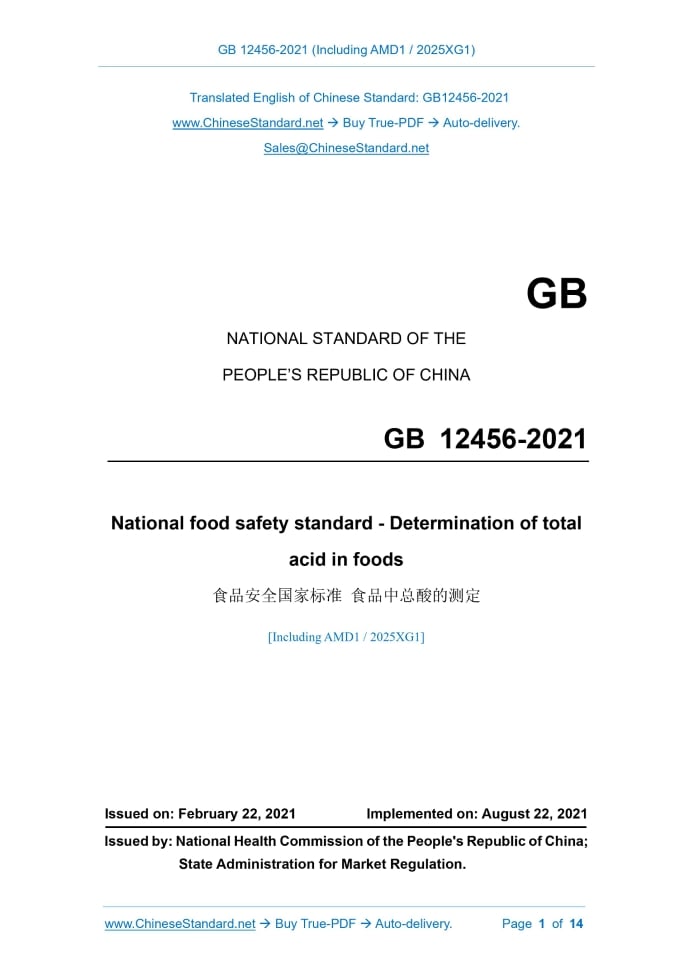
GB NATIONAL STANDARD OF THE PEOPLE’S REPUBLIC OF CHINA National food safety standard - Determination of total acid in foods ISSUED ON: FEBRUARY 22, 2021 IMPLEMENTED ON: AUGUST 22, 2021 Issued by: National Health Commission of the People's Republic of China; State Administration for Market Regulation.
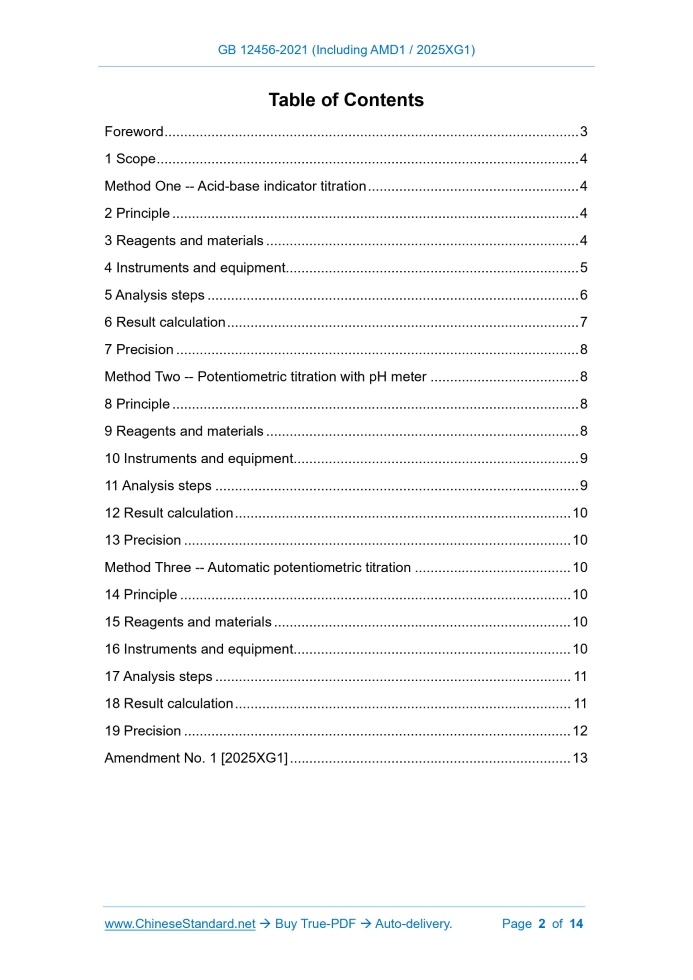
Table of Contents
Foreword ... 3 1 Scope ... 4 Method One -- Acid-base indicator titration ... 4 2 Principle ... 4 3 Reagents and materials ... 4 4 Instruments and equipment... 5 5 Analysis steps ... 6 6 Result calculation ... 7 7 Precision ... 8 Method Two -- Potentiometric titration with pH meter ... 8 8 Principle ... 8 9 Reagents and materials ... 8 10 Instruments and equipment... 9 11 Analysis steps ... 9 12 Result calculation ... 10 13 Precision ... 10 Method Three -- Automatic potentiometric titration ... 10 14 Principle ... 10 15 Reagents and materials ... 10 16 Instruments and equipment... 10 17 Analysis steps ... 11 18 Result calculation ... 11 19 Precision ... 11 National food safety standard - Determination of total acid in foods1 Scope
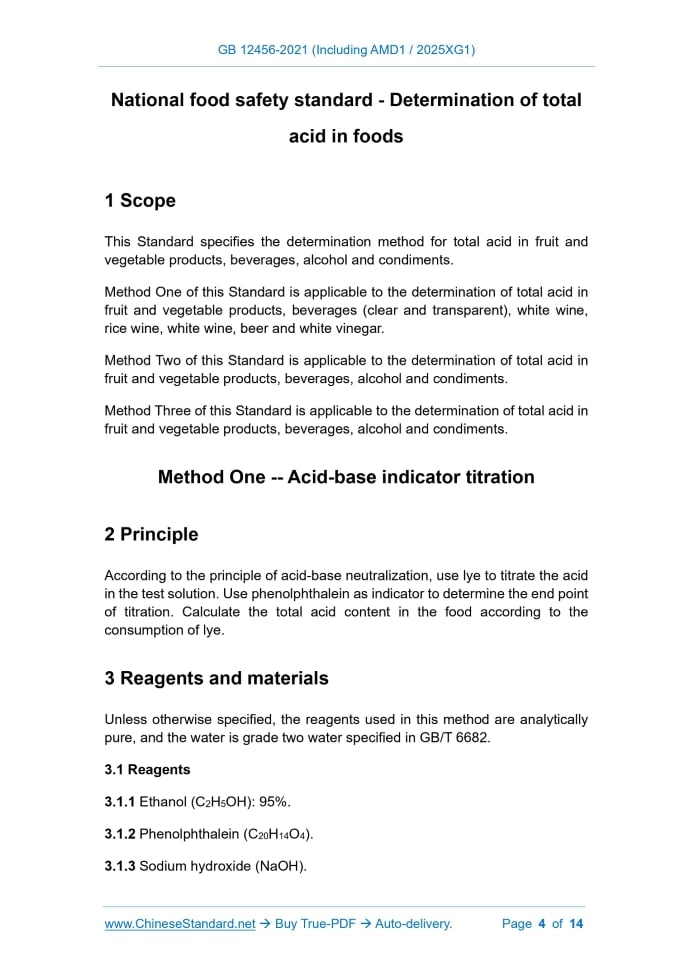
This Standard specifies the determination method for total acid in fruit and vegetable products, beverages, alcohol and condiments. Method One of this Standard is applicable to the determination of total acid in fruit and vegetable products, beverages (clear and transparent), white wine, rice wine, white wine, beer and white vinegar. Method Two of this Standard is applicable to the determination of total acid in fruit and vegetable products, beverages, alcohol and condiments. Method Three of this Standard is applicable to the determination of total acid in fruit and vegetable products, beverages, alcohol and condiments. Method One -- Acid-base indicator titration2 Principle
According to the principle of acid-base neutralization, use lye to titrate the acid in the test solution. Use phenolphthalein as indicator to determine the end point of titration. Calculate the total acid content in the food according to the consumption of lye.3 Reagents and materials
Unless otherwise specified, the reagents used in this method are analytically pure, and the water is grade two water specified in GB/T 6682. 3.1 Reagents 3.1.1 Ethanol (C2H5OH): 95%. 3.1.2 Phenolphthalein (C20H14O4). 3.1.3 Sodium hydroxide (NaOH). 3.2 Reagent preparation5 Analysis steps
5.1 Preparation of specimen The specimen is placed, sealed and stored at room temperature. 5.1.1 Liquid sample Samples without carbon dioxide: Mix well and place them in a closed glass container. Samples with carbon dioxide: Take at least 200g of sample (to the nearest of 0.01g) in a 500mL beaker. Shake under reduced pressure for 3min~4min to remove carbon dioxide in the liquid sample. 5.1.2 Solid sample Take at least 200g of representative sample (to the nearest of 0.01g). Place in a mortar or tissue masher. Add the same amount of carbon dioxide-free water as the sample. Use a mortar or a tissue masher to crush. Mix it into a slurry and place it in a closed glass container. 5.1.3 Solid-liquid mixed sample Take at least 200g according to the solid and liquid ratio of the sample (to the nearest of 0.01g). Use a mortar or a tissue masher to crush. After mixing well, place in a closed glass container. 5.2 Preparation of test solution 5.2.1 Liquid sample Weigh 25g (to the nearest of 0.01g) or pipette 25.0mL of specimen into a 250mL volumetric flask. Use carbon dioxide-free water to set volume to the scale mark. Shake well. Use a quick filter paper to filter. Collect the filtrate for determination. 5.2.2 Other samples Weigh 25g of specimen (to the nearest of 0.01g). Place in a 150mL conical flask with condenser. Add about 50mL of carbon dioxide-free water at 80°C. Mix well. Place in a boiling water bath and boil for 30min (shake 2~3 times to make all the organic acids in the specimen dissolve in the solution). Take out. Cool to room temperature. Use carbon dioxide-free water to set volume to 250mL. Use a quick filter paper to filter. Collect the filtrate for determination. 5.3 Analysis steps 1000 - The conversion factor. The calculation result is expressed as the arithmetic mean of two independent measurement results obtained under repeatability conditions. The result is rounded to two decimal places.7 Precision
The absolute difference between two independent determination results obtained under repeatability conditions shall not exceed 10% of the arithmetic mean. Method Two -- Potentiometric titration with pH meter8 Principle
According to the principle of acid-base neutralization, use sodium hydroxide standard titration solution to titrate the acid in the test solution. When the specimen solution is neutralized to pH 8.2 (if the acid is phosphoric acid, the end point is 8.7~8.8), it is determined as the end point of the titration. Calculate the total acid content in the food according to the consumption of lye.9 Reagents and materials
Unless otherwise specified, the reagents used in this method are analytically pure, and the water is grade two water specified in GB/T 6682. 9.1 Reagents 9.1.1 Sodium hydroxide (NaOH). 9.1.2 Dipotassium hydrogen phosphate (K2HPO4). 9.1.3 Potassium dihydrogen phosphate (KH2PO4). 9.2 Reagent preparation 9.2.1 Sodium hydroxide standard titration solution (0.1mol/L): same as 3.2. 9.2.2 pH8.0 buffer solution: Take 5.59g of dipotassium hydrogen phosphate and 0.41g of potassium dihydrogen phosphate. Use water to set volume to 1000mL.12 Result calculation
Same as the requirements of Chapter 6.13 Precision
The absolute difference between two independent determination results obtained under repeatability conditions shall not exceed 10% of the arithmetic mean. Method Three -- Automatic potentiometric titration14 Principle
According to the principle of acid-base neutralization, use sodium hydroxide standard titration solution to titrate the acid in the test solution. When the sample solution is neutralized to pH 8.2, it is determined as the end point of the titration. Calculate the total acid content in the food according to the consumption of lye.15 Reagents and materials
Unless otherwise specified, the reagents used in this method are analytically pure, and the water is grade two water specified in GB/T 6682. 15.1 Reagents 15.1.1 Sodium hydroxide (NaOH). 15.2 Reagent preparation Same with 3.2.16 Instruments and equipment
16.1 Analytical balance: Resolution is 0.01g and 0.1mg. 16.2 Potentiometric titrator. 16.3 Agitator. ......Source: Above contents are excerpted from the full-copy PDF -- translated/reviewed by: www.ChineseStandard.net / Wayne Zheng et al.