YY 0792-2024 English PDF
Price & Delivery
US$245.00 · In stock · Download in 9 secondsYY 0792-2024: Ophthalmic instruments - Endoilluminators
Delivery: 9 seconds. True-PDF full-copy in English & invoice will be downloaded + auto-delivered via email. See step-by-step procedure
Status: Valid
YY 0792: Historical versions
| Standard ID | USD | BUY PDF | Delivery | Standard Title (Description) | Status |
| YY 0792-2024 | 245 | Add to Cart | Auto, 9 seconds. | Ophthalmic instruments - Endoilluminators | Valid |
| YY 0792.1-2016 | 199 | Add to Cart | 3 days | Ophthalmic instruments - Endoilluminators - Part 1: Requirements and test methods | Valid |
Click to Preview this PDF
YY 0792-2024: Ophthalmic instruments - Endoilluminators
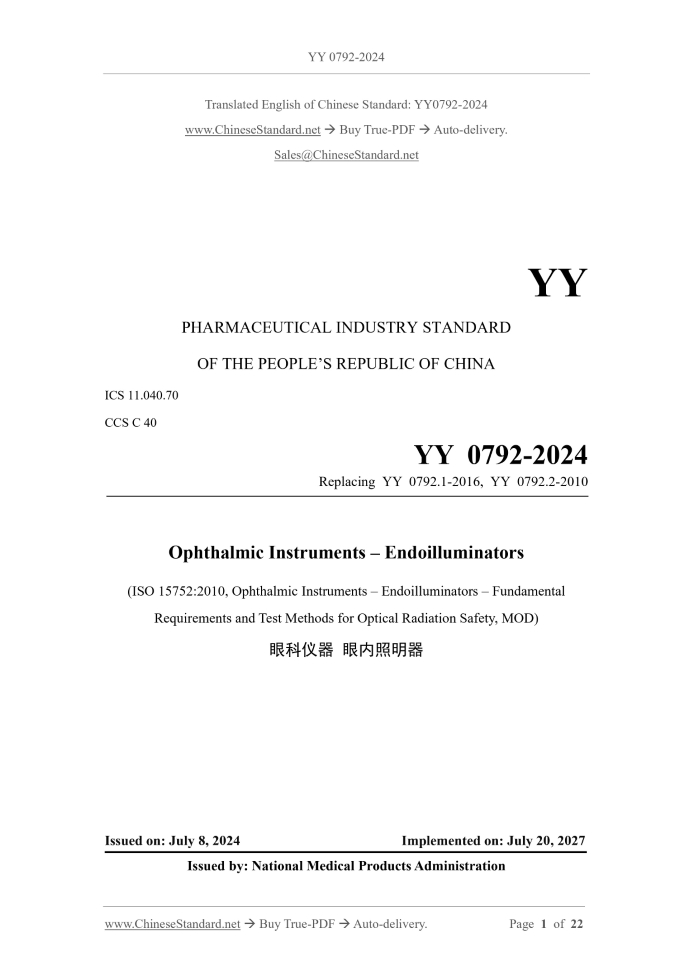
---This is an excerpt. Full copy of true-PDF in English version (including equations, symbols, images, flow-chart, tables, and figures etc.), auto-downloaded/delivered in 9 seconds, can be purchased online: https://www.ChineseStandard.net/PDF.aspx/YY0792-2024YY PHARMACEUTICAL INDUSTRY STANDARD ICS 11.040.70 CCS C 40 Replacing YY 0792.1-2016, YY 0792.2-2010 Ophthalmic Instruments – Endoilluminators (ISO 15752.2010, Ophthalmic Instruments – Endoilluminators – Fundamental Requirements and Test Methods for Optical Radiation Safety, MOD) Issued on: JULY 8, 2024 Implemented on: JULY 20, 2027 Issued by. National Medical Products Administration
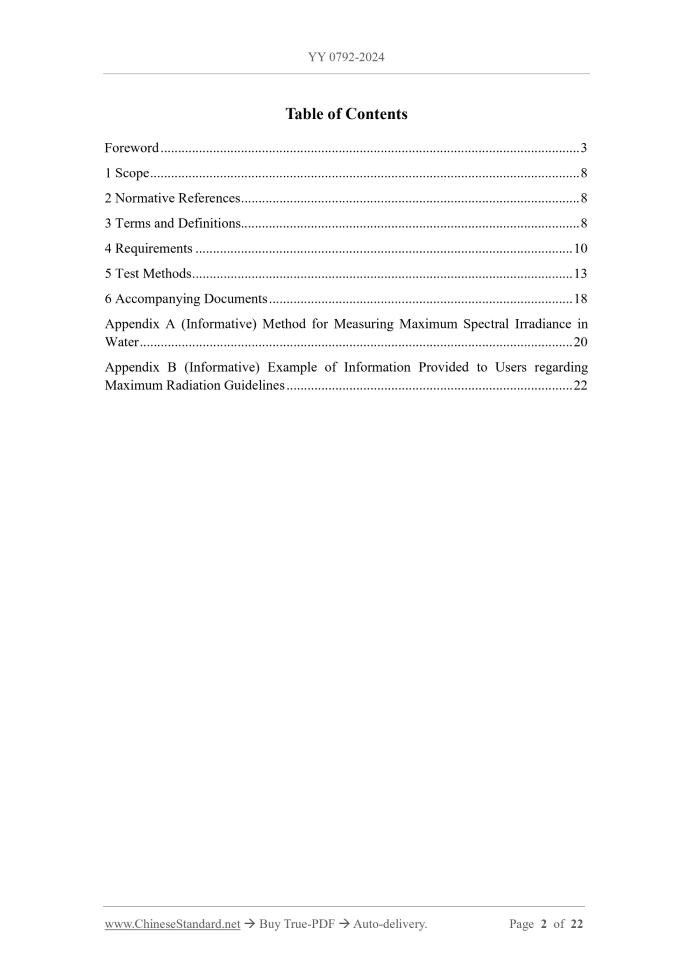
Table of Contents
Foreword... 3 1 Scope... 8 2 Normative References... 8 3 Terms and Definitions... 8 4 Requirements... 10 5 Test Methods... 13 6 Accompanying Documents... 18 Appendix A (Informative) Method for Measuring Maximum Spectral Irradiance in Water... 20 Appendix B (Informative) Example of Information Provided to Users regarding Maximum Radiation Guidelines... 22 Ophthalmic Instruments – Endoilluminators1 Scope
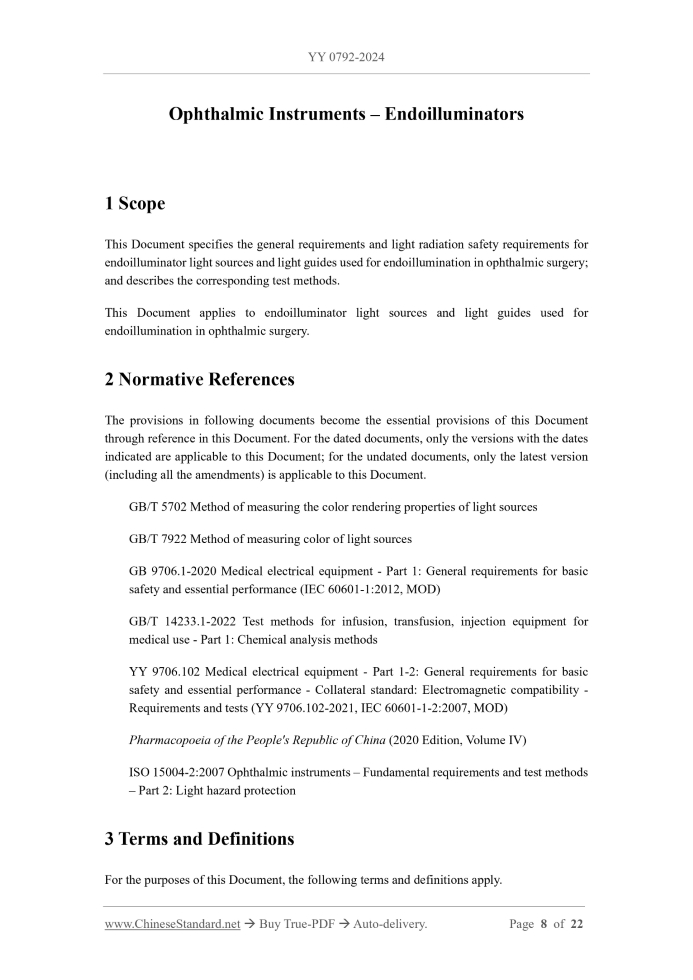
This Document specifies the general requirements and light radiation safety requirements for endoilluminator light sources and light guides used for endoillumination in ophthalmic surgery; and describes the corresponding test methods. This Document applies to endoilluminator light sources and light guides used for endoillumination in ophthalmic surgery.2 Normative References
The provisions in following documents become the essential provisions of this Document through reference in this Document. For the dated documents, only the versions with the dates indicated are applicable to this Document; for the undated documents, only the latest version (including all the amendments) is applicable to this Document. GB/T 5702 Method of measuring the color rendering properties of light sources GB/T 7922 Method of measuring color of light sources GB 9706.1-2020 Medical electrical equipment - Part 1.General requirements for basic safety and essential performance (IEC 60601-1.2012, MOD) GB/T 14233.1-2022 Test methods for infusion, transfusion, injection equipment for medical use - Part 1.Chemical analysis methods YY 9706.102 Medical electrical equipment - Part 1-2.General requirements for basic safety and essential performance - Collateral standard. Electromagnetic compatibility - Requirements and tests (YY 9706.102-2021, IEC 60601-1-2.2007, MOD) Pharmacopoeia of the People's Republic of China (2020 Edition, Volume IV) ISO 15004-2.2007 Ophthalmic instruments – Fundamental requirements and test methods – Part 2.Light hazard protection3 Terms and Definitions
For the purposes of this Document, the following terms and definitions apply.4 Requirements
4.1 Endoilluminator light source 4.1.1 Output half-divergence angle The manufacturer shall provide the nominal value of the output half-divergence angle of the endoilluminator light guide, with a tolerance of ±10%. 4.1.2 Central illuminance The manufacturer shall provide the maximum central illuminance of the endoilluminator light guide at the recommended working distance, with a tolerance of ±25%. 4.1.3 Color rendering index (CRI) The general CRI (Rα) of the emitted light from the endoilluminator light guide shall be no less than 85. NOTE. If the endoilluminator is equipped with a safety filter, the CRI of the emitted light shall be reduced. The manufacturer needs to state the risk of reduced CRI in the instruction manual. 4.1.4 Correlated color temperature The correlated color temperature of the emitted light from the endoilluminator light guide shall be 3000 K to 6700 K. 4.1.5 Light source requirements for camera systems (if applicable) For light sources suitable for use in camera systems, the matching relationship of the spectral response of the corresponding camera system detector shall be provided. Based on the green light radiant flux Φeg in the wavelength range of 515 nm to 545 nm, the manufacturer shall provide nominal values for the ratio of red light radiant flux Φer to Φeg in the wavelength range of 630 nm to 660 nm, AND the ratio of blue light radiant flux Φeb to Φeg in the wavelength range of 435 nm to 465 nm, with a tolerance of ±20%. If the light source claims to be unsuitable for the above response ranges, the distribution and matching ratio for the corresponding response range shall be provided. 4.1.6 Lamp failure prevention function The light source shall have preventative and emergency measures against lamp failure. These measures shall employ a lamp usage time counting device or a backup lamp switching method. 4.2 Endoilluminator light guide 4.2.1 Temperature of the portion of the light guide inserted into the eye5 Test Methods
5.1 Endoilluminator light source 5.1.1 Output half-divergence angle The output half-divergence angle shall be the angle at which the irradiance is equal to half the maximum irradiance when measured through a 1 mm aperture. The uncertainty of the angle shall be less than 1°. For endoilluminator that produces a uniform beam with a diameter less than 1 mm on the retina at the recommended working distance, a measuring aperture equal to the diameter of the endoilluminator light guide probe shall be used. For endoilluminator that cannot produce a uniform beam on the retina at the recommended working distance, a measuring aperture with a diameter of 0.03 mm shall be used. 5.1.2 Central illuminance Set the light source intensity to its maximum position and measure using an illuminance meter at the recommended working distance. 5.1.3 Color rendering index 5.1.3.1 Apparatus A spectral radiometric measurement system with a spectral measurement range of at least 380 nm to 780 nm, a wavelength resolution of no more than 2 nm, and a relative spectral radiance difference of no more than 1%. 5.1.3.2 Procedure Control the test environment; the ambient illuminance shall not exceed 1 lx. Maintain a stable power supply to the light source at its nominal voltage, with voltage stability controlled within ±2%. The light source warm-up time shall be no less than 30 min. Select a wavelength interval of 5 nm for the spectral radiometric system. Measure the relative spectral power distribution S(λ) of the light source when the light intensity setting is adjusted to its maximum value. 5.1.3.3 Calculation It shall be conducted according to GB/T 5702 and GB/T 7922. A horizontal platform 1 m above the top surface of the test-purposed board. 5.2.2.4.3 Test procedure The light guide is first placed naturally and horizontally on the platform; and measure the center illuminance according to the method in 5.1.2, recorded as E0.Fix one end of the light guide and allow the other end to fall freely from that height onto the test-purposed board. Each end of the light guide is dropped 3 times; and then the light guide is restored to its natural and horizontal position. The center illuminance is measured according to the method specified in 5.1.2 and recorded as E1.The light attenuation rate η is calculated according to Formula (4). 5.2.3 Dimension It is measured using general measuring tools. 5.2.4 Insulation requirements After moisture pretreatment according to the provisions of 5.7 in GB 9706.1-2020, the test shall be conducted according to the provisions of 8.8.3 in GB 9706.1-2020. 5.2.5 Sterility The test shall be conducted according to the sterility test method in General Rule 1101 of the Pharmacopoeia of the People's Republic of China (2020 Edition, Volume IV). 5.2.6 Ethylene oxide residue The test shall be conducted according to the method in Clause 9 of GB/T 14233.1-2022. 5.3 Light radiation hazards of the endoilluminator 5.3.1 Determination of irradiance, spectral irradiance, and spectral weighted irradiance for Group 1 and Group 2 instruments For endoilluminator that produces a uniform beam with a diameter greater than 1 mm on the retina at the recommended working distance, the following requirements shall be met. To determine the irradiance or spectrally weighted irradiance of standard/collimated endoilluminator light guides, the maximum radiant power or spectrally weighted radiant power of each light source at maximum intensity over an average region with a diameter of 1 mm is measured at a distance of 15 mm from the exit aperture. To determine the irradiance or spectrally weighted irradiance of light guides for wide angle/diffusing and chandelier, the maximum radiant power or spectrally weighted radiant power of each light source at maximum intensity over an average region with a diameter of 1 mm is measured at a distance of 18 mm from the exit aperture. To determine the irradiance or spectrally weighted irradiance of endoilluminator light guide with pic/forceps, the maximum radiant power or spectrally weighted radiant power of each light source at maximum intensity over an average region with a diameter of 1 mm is measured at a distance of 1 mm from the tip expected to contact the macula. For endoilluminator that produces a uniform beam of light less than 1 mm in diameter on the retina at the recommended working distance, a measuring aperture with the same diameter as the endoilluminator light guide probe is used. When the working distance differs from the above, measurements are performed at the manufacturer-specified working distance. Measurements are performed in water or a saline solution. The spectrally weighted irradiance at maximum light intensity is equal to the maximum spectrally weighted radiant power over an area with diameter of 1 mm divided by the area (7.9 × 10⁻³ cm²). For endoilluminator that cannot produce a uniform beam of light on the retina at the recommended working distance, a measuring aperture with a diameter of 0.03 mm is used. Appendix A provides a method for measuring maximum spectral irradiance in water. 5.3.2 Measurements for classifying instruments as Group 1 or Group 2 To determine whether an instrument is a Group 1 or Group 2 instrument, follow 5.1.1, 5.3.1 of this Document; and 6.1, 6.2, and 6.4 in ISO 15004-2.2007. 5.3.3 Measurements for Group 2 instruments For measurements of Group 2 instruments, follow 5.1.1, 5.3.1 of this Document; and 6.1, 6.3, 6.4, 6.5.1, and 6.5.2 in ISO 15004-2.2007. 5.3.4 Retinal protection measures Check whether the status of retinal protection measures can be observed during operation. Under maximum output operating conditions, if the time to reach the guideline value for maximum aphakic weighted retinal irradiance is less than 30 min, retinal protection measures shall be activated; and the time to reach the guideline value for maximum aphakic weighted retinal irradiance shall be measured according to 5.3.1 and ISO 15004-2.2007. 5.3.5 Light intensity stability Verify compliance by checking the provisions regarding aging, maintenance, repair, and replacement of bulbs and components in the instruction manual. Or verify compliance by checking the risk management documentation. 5.4 Electrical safety The test shall be conducted according to the provisions of GB 9706.1-2020. 5.5 Electromagnetic compatibility The test shall be conducted according to the provisions of YY 9706.102.6 Accompanying Documents
6.1 General requirements For Group 2 endoilluminator, it shall meet the requirements of Clause 7 in ISO 15004-2.2007. 6.2 Information provided by manufacturers of Group 2 endoilluminators (combined products, with light source and light guide) 6.2.1 Manufacturers of endoilluminator that combines a light source and a light guide shall provide users with the exposure time required to achieve the aphakic weighted safety guidelines for each light guide intended for use, with the light source set at maximum and 50% of its maximum value, and with and without retinal protection measures. These guideline values shall be indicated on the endoilluminator light source or on the outer packaging of each light guide. An example of manufacturer-provided information is provided in Appendix B. 6.2.2 If requested by the user, the endoilluminator light source manufacturer shall provide a relative spectral output diagram in the 320 nm to 1100 nm range of the light source at maximum light intensity in conjunction with the recommended endoilluminator light guide, with and without retinal protection measures. 6.2.3 The endoilluminator light source manufacturer shall provide risk information related to the replacement of components (including the endoilluminator light guide). 6.3 Information provided by Group 2 endoilluminator light source manufacturers 6.3.1 If requested by the user, the endoilluminator light source manufacturer shall provide a relative spectral output diagram in the 320nm to 1100 nm range of the light source at maximum light intensity in conjunction with the recommended endoilluminator light guide, with and without retinal protection measures. 6.3.2 The endoilluminator light source manufacturer shall provide risk information related to the replacement of components (including the endoilluminator light guide). 6.4 Information provided by endoilluminator light guide manufacturer For each light source intended for use, the endoilluminator light guide manufacturer shall ......Source: Above contents are excerpted from the full-copy PDF -- translated/reviewed by: www.ChineseStandard.net / Wayne Zheng et al.