YS/T 953.10-2014 English PDF
Price & Delivery
US$160.00 · In stock · Download in 9 secondsYS/T 953.10-2014: Methods for chemical analysis of fire smelting nickel substrate material - Part 10: Determination of nickel, chromium, manganese, cobalt, copper and phosphorus contents - Inductively coupled plasma atomic emission spectrometric method
Delivery: 9 seconds. True-PDF full-copy in English & invoice will be downloaded + auto-delivered via email. See step-by-step procedure
Status: Valid
| Standard ID | USD | BUY PDF | Delivery | Standard Title (Description) | Status |
| YS/T 953.10-2014 | 160 | Add to Cart | Auto, 9 seconds. | Methods for chemical analysis of fire smelting nickel substrate material - Part 10: Determination of nickel, chromium, manganese, cobalt, copper and phosphorus contents - Inductively coupled plasma atomic emission spectrometric method | Valid |
Click to Preview this PDF
Similar standards
YS/T 953.10-2014: Methods for chemical analysis of fire smelting nickel substrate material - Part 10: Determination of nickel, chromium, manganese, cobalt, copper and phosphorus contents - Inductively coupled plasma atomic emission spectrometric method
---This is an excerpt. Full copy of true-PDF in English version (including equations, symbols, images, flow-chart, tables, and figures etc.), auto-downloaded/delivered in 9 seconds, can be purchased online: https://www.ChineseStandard.net/PDF.aspx/YST953.10-2014
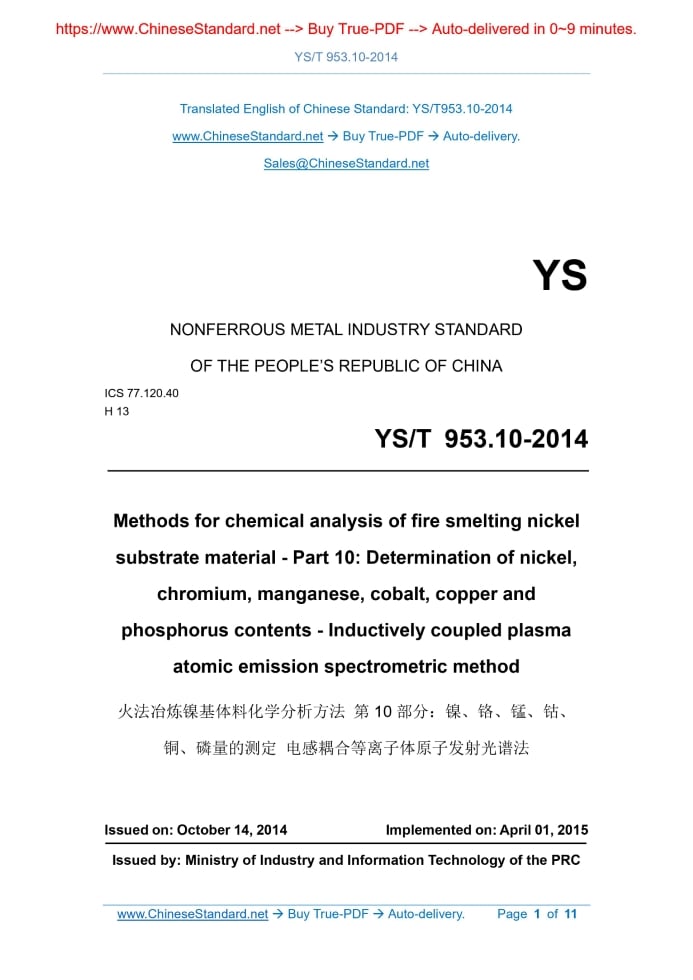
YS NONFERROUS METAL INDUSTRY STANDARD ICS 77.120.40 H 13 Methods for chemical analysis of fire smelting nickel substrate material - Part 10.Determination of nickel, chromium, manganese, cobalt, copper and phosphorus contents - Inductively coupled plasma atomic emission spectrometric method Issued on. OCTOBER 14, 2014 Implemented on. APRIL 01, 2015 Issued by. Ministry of Industry and Information Technology of the PRC
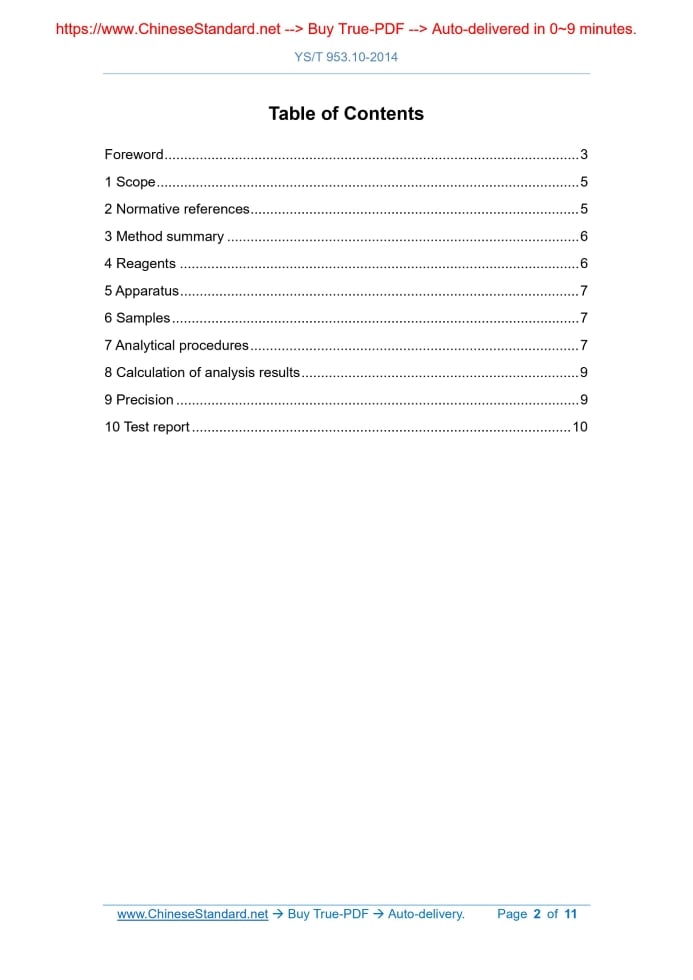
Table of Contents
Foreword... 3 1 Scope... 5 2 Normative references... 5 3 Method summary... 6 4 Reagents... 6 5 Apparatus... 7 6 Samples... 7 7 Analytical procedures... 7 8 Calculation of analysis results... 9 9 Precision... 9 10 Test report... 101 Scope
This Part of YS/T 953 specifies the inductively coupled plasma atomic emission spectrometric method for the determination of nickel, chromium, manganese, cobalt, copper and phosphorus contents in the fire smelting nickel substrate material. This Part applies to the determination of nickel, chromium, manganese, cobalt, copper and phosphorus contents in the fire smelting nickel substrate material. The determination range is shown in Table 1. Table 1 -- Determination range2 Normative references
The following documents are indispensable for the application of this document. For the dated references, only the editions with the dates indicated are applicable to this document. For the undated references, the latest edition (including all the amendments) are applicable to this document. GB/T 20066 Steel and iron - Sampling and preparation of samples for the determination of chemical composition3 Method summary
USE hydrochloric acid, nitric acid and hydrofluoric acid to dissolve the test portion; ADD perchloric acid to blow off the fluoride. If necessary, add yttrium as an internal standard;4 Reagents
Unless otherwise specified, only reagents confirmed to be analytically pure and distilled water or deionized water or water of equivalent purity are used in the analysis. 4.1 Hydrochloric acid (ρ=1.19 g/mL). 4.2 Nitric acid (ρ=1.42 g/mL). 4.6 Mixed standard solution. Respectively PIPETTE 5.00 mL each of copper and phosphorus single-element standard stock solutions (4.5), 10.00 mL each of chromium, cobalt, and manganese single-element standard stock solutions (4.5), 4.7 Yttrium internal standard solution. PIPETTE 25.00 mL of yttrium single- element standard stock solution (4.5) into a 1000 mL volumetric flask; ADD 50 mL of hydrochloric acid (4.1); USE water to dilute to the mark and mix well. 1 mL of this solution contains 25 μg of yttrium.5 Apparatus
5.1 Inductively coupled plasma atomic emission spectrometer Spectral line. There is no special requirement for analysis line. Only recommended analysis lines are listed in Table 2. 5.2 Short-term stability requirements for the apparatus. When the maximum mass concentration solution of the measured element is continuously measured for 5 times, the relative standard deviation of the absolute intensity of the emitted light shall be less than 0.8%.6 Samples
TAKE and prepare samples according to GB/T 20066 or appropriate national or industrial standards.7 Analytical procedures
7.1 Mass of test portion According to Table 3, weigh the test portion, accurate to 0.0001 g. 7.4 Determination 7.4.1 Dissolution of test portion PLACE the test portion (7.1) in a polytetrafluoroethylene beaker; ADD 5 mL of hydrochloric acid (4.1), 5 mL of nitric acid (4.2); HEAT to no longer react. ADD 2~3 drops of hydrofluoric acid (4.3); 7.4.2 Measurement On the inductively coupled plasma emission spectrometer, after the apparatus runs stably, under the selected apparatus working conditions, use the prepared standard series solution (7.5) to standardize or calibrate the working curve. The correlation coefficient of the working curve of each element shall be above 0.999.Otherwise it is necessary to re-standardize or re-prepare standard series solution for standardization. MEASURE the spectral intensity of the analysis test solution (7.4.1) and the blank test solution (7.3). According to the working curve, the apparatus automatically processes the data, calculates and outputs the mass concentration of each element.8 Calculation of analysis results
The content of each element is calculated by mass fraction wx, expressed in %, calculated according to formula (1).9 Precision
9.1 Repeatability For the measured values of two independent test results obtained under repeatability conditions, within the average range given below, the absolute difference between the two test results does not exceed the repeatability limit (r). 9.2 Reproducibility For the measured values of two independent test results obtained under reproducibility conditions, within the average range given below, the absolute difference between the two test results does not exceed the reproducibility limit (R).10 Test report
This clause specifies the content to be included in the test report. At least the following shall be given. YS/T 953.10-2014 YS NONFERROUS METAL INDUSTRY STANDARD ICS 77.120.40 H 13 Methods for chemical analysis of fire smelting nickel substrate material - Part 10.Determination of nickel, chromium, manganese, cobalt, copper and phosphorus contents - Inductively coupled plasma atomic emission spectrometric method Issued on. OCTOBER 14, 2014 Implemented on. APRIL 01, 2015 Issued by. Ministry of Industry and Information Technology of the PRCTable of Contents
Foreword... 3 1 Scope... 5 2 Normative references... 5 3 Method summary... 6 4 Reagents... 6 5 Apparatus... 7 6 Samples... 7 7 Analytical procedures... 7 8 Calculation of analysis results... 9 9 Precision... 9 10 Test report... 101 Scope
This Part of YS/T 953 specifies the inductively coupled plasma atomic emission spectrometric method for the determination of nickel, chromium, manganese, cobalt, copper and phosphorus contents in the fire smelting nickel substrate material. This Part applies to the determination of nickel, chromium, manganese, cobalt, copper and phosphorus contents in the fire smelting nickel substrate material. The determination range is shown in Table 1. Table 1 -- Determination range2 Normative references
The following documents are indispensable for the application of this document. For the dated references, only the editions with the dates indicated are applicable to this document. For the undated references, the latest edition (including all the amendments) are applicable to this document. GB/T 20066 Steel and iron - Sampling and preparation of samples for the determination of chemical composition3 Method summary
USE hydrochloric acid, nitric acid and hydrofluoric acid to dissolve the test portion; ADD perchloric acid to blow off the fluoride. If necessary, add yttrium as an internal standard;4 Reagents
Unless otherwise specified, only reagents confirmed to be analytically pure and distilled water or deionized water or water of equivalent purity are used in the analysis. 4.1 Hydrochloric acid (ρ=1.19 g/mL). 4.2 Nitric acid (ρ=1.42 g/mL). 4.6 Mixed standard solution. Respectively PIPETTE 5.00 mL each of copper and phosphorus single-element standard stock solutions (4.5), 10.00 mL each of chromium, cobalt, and manganese single-element standard stock solutions (4.5), 4.7 Yttrium internal standard solution. PIPETTE 25.00 mL of yttrium single- element standard stock solution (4.5) into a 1000 mL volumetric flask; ADD 50 mL of hydrochloric acid (4.1); USE water to dilute to the mark and mix well. 1 mL of this solution contains 25 μg of yttrium.5 Apparatus
5.1 Inductively coupled plasma atomic emission spectrometer Spectral line. There is no special requirement for analysis line. Only recommended analysis lines are listed in Table 2. 5.2 Short-term stability requirements for the apparatus. When the maximum mass concentration solution of the measured element is continuously measured for 5 times, the relative standard deviation of the absolute intensity of the emitted light shall be less than 0.8%.6 Samples
TAKE and prepare samples according to GB/T 20066 or appropriate national or industrial standards.7 Analytical procedures
7.1 Mass of test portion According to Table 3, weigh the test portion, accurate to 0.0001 g. 7.4 Determination 7.4.1 Dissolution of test portion PLACE the test portion (7.1) in a polytetrafluoroethylene beaker; ADD 5 mL of hydrochloric acid (4.1), 5 mL of nitric acid (4.2); HEAT to no longer react. ADD 2~3 drops of hydrofluoric acid (4.3); 7.4.2 Measurement On the inductively coupled plasma emission spectrometer, after the apparatus runs stably, under the selected apparatus working conditions, use the prepared standard series solution (7.5) to standardize or calibrate the working curve. The correlation coefficient of the working curve of each element shall be above 0.999.Otherwise it is necessary to re-standardize or re-prepare standard series solution for standardization. MEASURE the spectral intensity of the analysis test solution (7.4.1) and the blank test solution (7.3). According to the working curve, the apparatus automatically processes the data, calculates and outputs the mass concentration of each element.8 Calculation of analysis results
The content of each element is calculated by mass fraction wx, expressed in %, calculated according to formula (1).9 Precision
9.1 Repeatability For the measured values of two independent test results obtained under repeatability conditions, within the average range given below, the absolute difference between the two test results does not exceed the repeatability limit (r). 9.2 Reproducibility For the measured values of two independent test results obtained under reproducibility conditions, within the average range given below, the absolute difference between the two test results does not exceed the reproducibility limit (R).10 Test report
This clause specifies the content to be included in the test report. At least the following shall be given. ......Source: Above contents are excerpted from the full-copy PDF -- translated/reviewed by: www.ChineseStandard.net / Wayne Zheng et al.