YS/T 928.4-2013 English PDF
Price & Delivery
US$170.00 · In stock · Download in 9 secondsYS/T 928.4-2013: Methods for chemical analysis of nickel cobalt manganese composite hydrogen oxide - Part 4: Determination of iron, calcium, magnesium, copper, zinc, silicon, aluminium, sodium contents - Inductively coupled plasma atomic emission spectrometric
Delivery: 9 seconds. True-PDF full-copy in English & invoice will be downloaded + auto-delivered via email. See step-by-step procedure
Status: Valid
| Standard ID | USD | BUY PDF | Delivery | Standard Title (Description) | Status |
| YS/T 928.4-2013 | 170 | Add to Cart | Auto, 9 seconds. | Methods for chemical analysis of nickel cobalt manganese composite hydrogen oxide - Part 4: Determination of iron, calcium, magnesium, copper, zinc, silicon, aluminium, sodium contents - Inductively coupled plasma atomic emission spectrometric | Valid |
Click to Preview this PDF
Similar standards
YS/T 928.4-2013: Methods for chemical analysis of nickel cobalt manganese composite hydrogen oxide - Part 4: Determination of iron, calcium, magnesium, copper, zinc, silicon, aluminium, sodium contents - Inductively coupled plasma atomic emission spectrometric
---This is an excerpt. Full copy of true-PDF in English version (including equations, symbols, images, flow-chart, tables, and figures etc.), auto-downloaded/delivered in 9 seconds, can be purchased online: https://www.ChineseStandard.net/PDF.aspx/YST928.4-2013
YS NONFERROUS INDUSTRY STANDARD ICS 77.120.60 H 13 Methods for Chemical Analysis of Nickel Cobalt Manganese Composite Hydrogenoxide - Part 4.Determination of Iron, Calcium, Magnesium, Copper, Zinc, Silicon, Aluminum, Sodium Contents - Inductively Coupled Plasma Atomic Emission Spectrometric Issued on. OCTOBER 17, 2013 Implemented on. MARCH 1, 2014 Issued by. Ministry of Industry and Information Technology of the People’s Republic of China
Table of Contents
Foreword... 3 1 Scope... 4 2 Method Summary... 4 3 Reagents... 5 4 Instrument... 6 5 Analytical Procedures... 7 6 Calculation and Expression of Analysis Results... 8 7 Precision... 8 8 Test Report... 10Foreword
YS/T 928 Methods for Chemical Analysis of Nickel Cobalt Manganese Composite Hydrogenoxide includes the following six parts. ---Part 1.Determination of Chloride Ion Contents - Silver Chloride Turbidimetry; ---Part 2.Determination of Nickel Contents - Dimethylglyoxime Gravimetric; ---Part 3.Determination of Nickel, Cobalt, Manganese Content - Inductively Coupled Plasma Atomic Emission Spectrometric; ---Part 4.Determination of Iron, Calcium, Magnesium, Copper, Zinc, Silicon, Aluminum, Sodium Contents - Inductively Coupled Plasma Atomic Emission Spectrometric; ---Part 5.Determination of Lead Contents - Inductively Coupled Plasma Mass Spectrometry; ---Part 6.Determination of Sulfate Ion Contents - Ion Chromatography. This is Part 4 of YS/T 928. This Part was drafted in accordance with the rules provided in GB/T 1.1-2009. This Standard shall be under the jurisdiction of National Technical Committee 243 on Nonferrous Metals of Standardization Administration of China (SAC/TC 243). The responsible drafting organizations of this Standard. Jinchuan Group Co., Ltd.; Foshan BRUNP Recycling Technology Co., Ltd.; Beijing BGRIMM Research Institute of Mining & Metallurgy. The drafting organizations of this Part. Jinchuan Group Co., Ltd.; Foshan BRUNP Recycling Technology Co., Ltd. The participating drafting organizations of this Part. Zhejiang Huayou Cobalt Co., Ltd.; Tianjin Maolian Technology Co., Ltd.; CITIC Guoan MGL Power Technology Co., Ltd. The main drafters of this Part. Guo Peiqing, Li Changdong, Qin Fanglin, Yu Haijun, Qiu Ping, Wu Yahui, Xie Bohua, Zhang Ping, Pan Haiyun, Ren Xingting. Methods for Chemical Analysis of Nickel Cobalt Manganese Composite Hydrogenoxide - Part 4.Determination of Iron, Calcium, Magnesium, Copper, Zinc, Silicon, Aluminum, Sodium Contents - Inductively Coupled Plasma Atomic Emission Spectrometric1 Scope
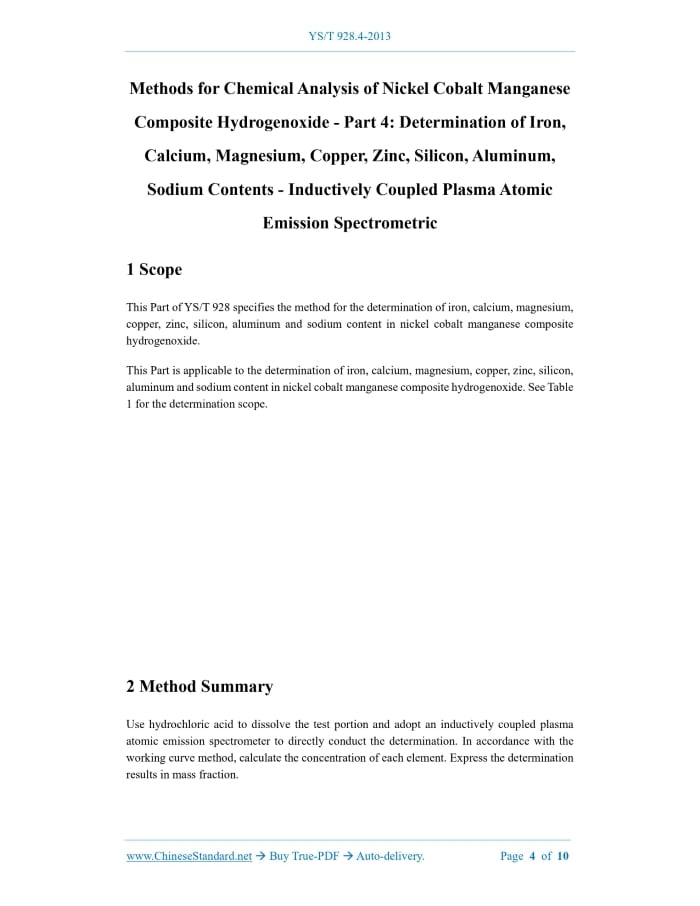
This Part of YS/T 928 specifies the method for the determination of iron, calcium, magnesium, copper, zinc, silicon, aluminum and sodium content in nickel cobalt manganese composite hydrogenoxide. This Part is applicable to the determination of iron, calcium, magnesium, copper, zinc, silicon, aluminum and sodium content in nickel cobalt manganese composite hydrogenoxide. See Table 1 for the determination scope. Table 1 -- Determination Scope2 Method Summary
Use hydrochloric acid to dissolve the test portion and adopt an inductively coupled plasma atomic emission spectrometer to directly conduct the determination. In accordance with the working curve method, calculate the concentration of each element. Express the determination results in mass fraction. Element Determination Scope (w)/%3 Reagents
All reagents used in this Part are of top-grade purity, and only pure water with an electrical resistivity of not less than 18.2 M cm shall be used in the analysis. 3.1 Hydrochloric acid (ρ = 1.19 g/mL). 3.2 Nitric acid (ρ = 1.42 g/mL). 3.3 Hydrochloric acid (1 + 1). 3.4 Nitric acid (1 + 1). 3.8 Copper standard stock solution. weigh-take 0.2000 g of pure copper (wCu 99.99%) in a 300 mL beaker, slowly add 30 mL of nitric acid (3.4), use a watch glass to cover it; at a low temperature, dissolve it and drive out nitrogen oxides, then, remove and cool it. Use water to wash the watch glass and beaker wall. Transfer to a 1,000 mL volumetric flask, use water to dilute to the scale and mix it well. 1 mL of this solution contains 200 g of copper. 3.13 Aluminum, magnesium, calcium, copper, iron and zinc standard solutions. accurately transfer-take 10.00 mL of the standard stock solutions (3.5, 3.6, 3.7, 3.8, 3.9 and 3.10) in a 200 mL volumetric flask. Use water to dilute to the scale and mix it well. 1 mL of this solution contains 10 g of aluminum, magnesium, calcium, copper, iron and zinc. 3.14 Sodium standard solution. accurately transfer-take 10.00 mL of the standard stock solution (3.11) in a 200 mL volumetric flask. Use water to dilute to the scale, mix it well, and immediately transfer it into a dry plastic bottle. 1 mL of this solution contains 10 g of sodium. 3.15 Silicon standard solution. accurately transfer-take 10.00 mL of the standard stock solution (3.12) in a 200 mL volumetric flask. Use water to dilute to the scale, mix it well, and immediately transfer it into a dry plastic bottle. 1 mL of this solution contains 10 g of silicon.4 Instrument
In terms of the inductively coupled plasma atomic emission spectrometer, the spectral lines of the various element are shown in Table 2; the working parameters of the instrument for sodium determination are shown in Table 3; the working parameters of the instrument for the determination of other elements are shown in Table 4.5 Analytical Procedures
5.1 Test Portion Weigh-take two portions of 0.20 g of specimen, accurate to 0.0001 g. 5.2 Blank Test Along with the specimen, conduct the blank test. 5.3 Treatment of Test Portion Place the test portion (5.1) in a 100 mL polytetrafluoroethylene beaker, add 20 mL of hydrochloric acid (3.3), use a watch glass to cover it, dissolve it with slight heat. After the test portion is completely dissolved, remove it, cool it, then, use water to wash the watch glass and beaker wall. Transfer it to a 200 mL volumetric flask, use water to dilute to the scale and mix it well. On an inductively coupled plasma atomic emission spectrometer, conduct the determination. 5.4 Drawing of Working Curve7 Precision
7.1 Repeatability Under repeatability conditions, obtain the determined values of two independent test results. Within the average value range provided in Table 5, the absolute difference between the two test results does not exceed the repeatability limit (r), and the circumstances of exceeding the repeatability limit (r) does not exceed 5%. The repeatability limit (r) is calculated using the linear interpolation method and the extrapolation method in accordance with the data in Table 5.8 Test Report
The test report shall include the following content. ......Source: Above contents are excerpted from the full-copy PDF -- translated/reviewed by: www.ChineseStandard.net / Wayne Zheng et al.