WS/T 799-2022 English PDF
Price & Delivery
US$195.00 · In stock · Download in 9 secondsWS/T 799-2022: Method for enrichment and nucleic acid detection of SARS-CoV-2 in sewage
Delivery: 9 seconds. True-PDF full-copy in English & invoice will be downloaded + auto-delivered via email. See step-by-step procedure
Status: Valid
| Standard ID | USD | BUY PDF | Delivery | Standard Title (Description) | Status |
| WS/T 799-2022 | 195 | Add to Cart | Auto, 9 seconds. | Method for enrichment and nucleic acid detection of SARS-CoV-2 in sewage | Valid |
Click to Preview this PDF
Similar standards
WS/T 799-2022: Method for enrichment and nucleic acid detection of SARS-CoV-2 in sewage
---This is an excerpt. Full copy of true-PDF in English version (including equations, symbols, images, flow-chart, tables, and figures etc.), auto-downloaded/delivered in 9 seconds, can be purchased online: https://www.ChineseStandard.net/PDF.aspx/WST799-2022WS HYGIENIC INDUSTRY STANDARD OF THE PEOPLE’S REPUBLIC OF CHINA ICS 13.060 CCS C 51 Method for enrichment and nucleic acid detection of SARS- CoV-2 in sewage Issued on: MARCH 24, 2022 Implemented on: MARCH 24, 2022 Issued by. National Health Commission of the People's Republic of China
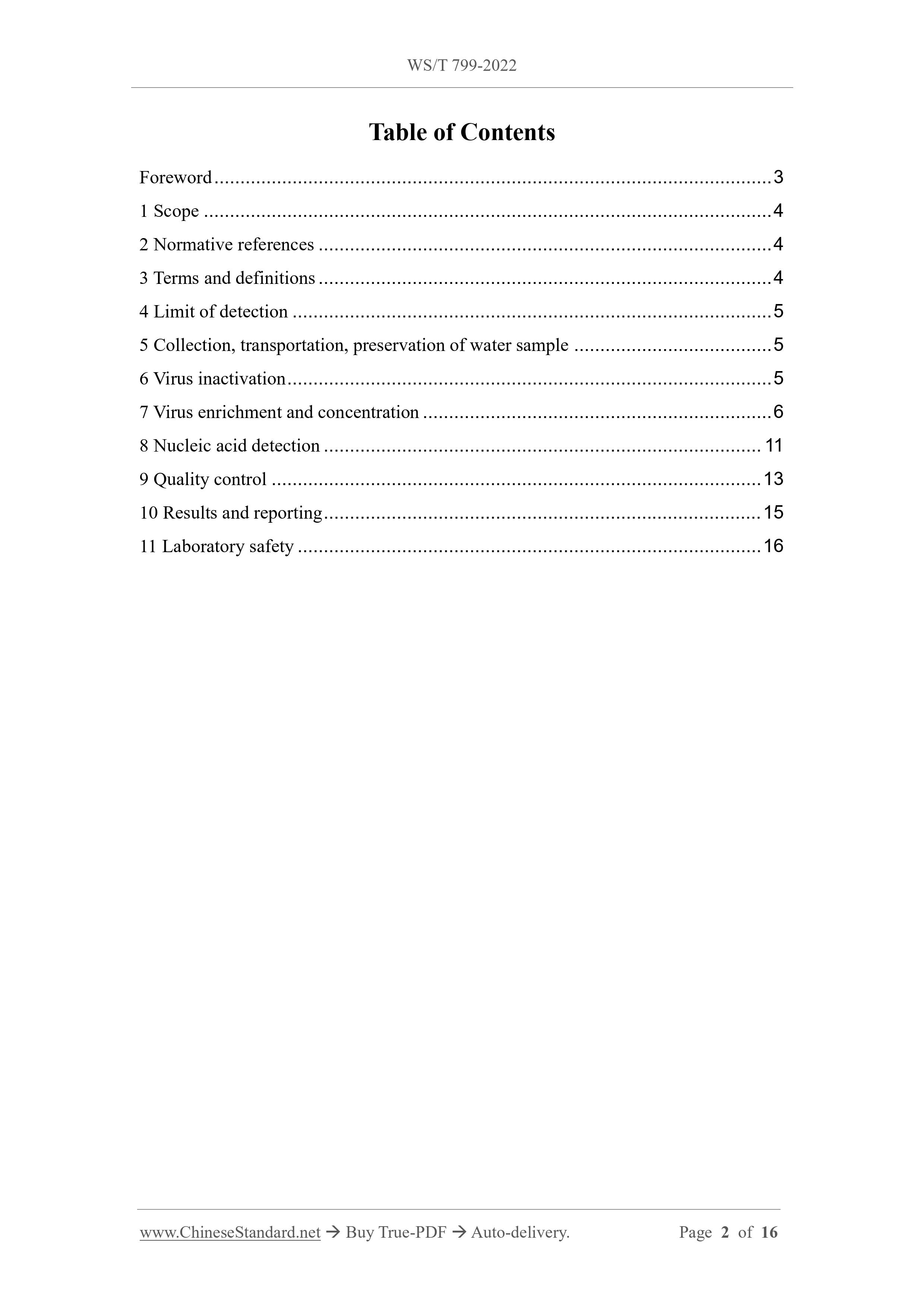
Table of Contents
Foreword... 3 1 Scope... 4 2 Normative references... 4 3 Terms and definitions... 4 4 Limit of detection... 5 5 Collection, transportation, preservation of water sample... 5 6 Virus inactivation... 5 7 Virus enrichment and concentration... 6 8 Nucleic acid detection... 11 9 Quality control... 13 10 Results and reporting... 15 11 Laboratory safety... 16 Method for enrichment and nucleic acid detection of SARS- CoV-2 in sewage1 Scope
This standard specifies the method for enrichment and nucleic acid detection of SARS- CoV-2 in sewage. This standard applies to the enrichment and nucleic acid detection of SARS-CoV-2 in in domestic sewage and medical wastewater.2 Normative references
The following documents, through normative references in the text, constitute essential provisions of this standard. For dated references, only the edition cited applies; for undated references, the latest edition of the referenced document (including any amendments) applies. GB/T 6682 Water for analytical laboratory use - Specification and test methods WS/T 697 Personal protection guidelines for specific groups of people during the COVID-19 epidemic3 Terms and definitions
The following terms and definitions apply to this standard. 3.1 Severe acute respiratory syndrome coronavirus, SARS-CoV-2 Belonging to the β-coronavirus genus, it is a linear, single-stranded, positive-sense RNA virus, approximately 30 kb in length, enveloped, spherical or elliptical granules with a diameter of 60 nm ~ 140 nm. 3.2 Cycle threshold, Ct value In real-time quantitative PCR, the number of cycles required for the fluorescence signal in each reaction system to reach a set threshold. 3.3 Real-time fluorescent reverse transcription polymerase chain reaction A method for quantitative and qualitative analysis of the starting template by adding fluorescent chemicals to the amplification reaction of reverse transcription DNA polymerase chain reaction (RTRP), through real-time detection of the fluorescence signal of each cycle product in the amplification reaction.4 Limit of detection
When enrichment and concentration are performed using polyethylene glycol precipitation or aluminum salt coagulation precipitation, the method limit of detection is 10 copies/mL; when enrichment and concentration are performed using centrifugation and ultrafiltration, the method limit of detection is 100 copies/mL.5 Collection, transportation, preservation of water sample
Based on the distribution of the drainage system at the sampling site, key locations such as sewage outlets and internal pipe network convergence points are selected for sampling of untreated sewage. Sewage samples are collected using sterile polyethylene bottles, with a sampling volume of 300 mL. The water sample collection method can be determined according to site conditions and testing requirements, such as instantaneous water samples (samples randomly collected at a sampling point at a certain time) or mixed water samples (samples obtained by mixing instantaneous water samples collected at different times at the same sampling point). After sample collection, the outer surface of the sampling bottle shall be disinfected on-site with 75% alcohol. Then, the sampling bottle shall be placed in a sealed sampling bag; the outer surface of the sealed sampling bag shall be disinfected again. The sample shall be delivered to the laboratory as soon as possible, ensuring refrigerated transport at 0 °C ~ 4 °C. Upon arrival at the laboratory, the sample shall also be stored at 0 °C ~ 4 °C. The laboratory shall perform enrichment and concentration processing within 24 hours of receiving the sample; complete nucleic acid extraction and real-time fluorescent reverse transcription polymerase chain reaction (real-time fluorescent RT-PCR) detection within 24 hours after enrichment and concentration.6 Virus inactivation
After thoroughly mixing the sample, place it in a 60 °C water bath for 30 min. Note. The water level in the water bath shall be higher than the sample liquid level, to ensure that the sample in the container reaches the target temperature.7 Virus enrichment and concentration
Note. The three methods for enriching and concentrating the severe acute respiratory syndrome coronavirus in this section have the same applicable conditions. The appropriate method can be selected based on experimental conditions. 7.1 Polyethylene glycol precipitation method 7.1.1 Principle Polyethylene glycol (PEG) is added to wastewater. Under certain salt concentration conditions, PEG causes virus particles to form polymers. Under centrifugal force, the aqueous solution is separated from the virus polymers. The precipitate formed by the virus polymers is collected for subsequent nucleic acid extraction and real-time fluorescent RT-PCR detection. 7.1.2 Reagents and materials 7.1.2.1 Reagents 7.1.2.1.1 Polyethylene glycol. Molecular biology grade, which has an average molecular weight of 8000. 7.1.2.1.2 Sodium chloride. Molecular biology grade. 7.1.2.1.3 Nuclease-free water. Molecular biology grade. 7.1.2.2 Materials 7.1.2.2.1 Sterile capped centrifuge tubes. 1.5 mL, nuclease-free; 50 mL or 250 mL, capable of withstanding centrifugal force ≥ 12000 g. 7.1.2.2.2 Sterile pipette tips. 1 mL, with filter cartridge, nuclease-free. 7.1.2.2.3 Sterile pipette tubes. 50 mL. 7.1.3 Instruments and equipment 7.1.3.1 High-speed refrigerated centrifuge. 4 °C, 50 mL or 250 mL rotor, capable of withstanding centrifugal force ≥ 12000 g. 7.1.3.2 Electronic balance. Resolution not less than 0.001 g. 7.1.3.3 Biosafety cabinet. Grade II or higher. 7.1.3.4 Autoclave. 7.1.3.5 Pipettes. 1 mL. 7.1.3.6 Large-capacity electric pipettes. 7.1.4 Enrichment and concentration procedure 7.1.4.1 Pre-centrifugation Using a large-capacity electric pipette, to transfer three 35 mL aliquots of sewage sample into three 50 mL centrifuge tubes. Centrifuge at 4 °C and 2500 g for 30 min. Transfer the supernatant to three additional 50 mL centrifuge tubes for later use. The remaining sewage sample is kept as a backup. Note 1.When the suspended solids content of the sewage sample is too high, which may affect viral nucleic acid extraction and real-time fluorescent RT-PCR detection, pre-centrifugation shall be performed to discard the suspended solids before proceeding with subsequent operations. Note 2.If using 250 mL centrifuge tubes, directly transfer 105 mL of sewage sample into a 250 mL centrifuge tube, centrifuge under the above conditions; transfer the supernatant to another 250 mL centrifuge tube for later use. 7.1.4.2 Second centrifugation Add 3.5 g ± 0.1 g of polyethylene glycol and 0.79 g ± 0.01 g of sodium chloride to three 50 mL centrifuge tubes containing 35 mL of sewage sample or pre-centrifuged supernatant, respectively. Mix thoroughly until the reagents are completely dissolved, which shall take approximately 15 min. Then centrifuge at 4 °C and 12000 g for 120 min. Do not use braking force when the centrifuge is decelerating. After the centrifuge stops, pour out and discard the supernatant from the centrifuge tubes, until no more supernatant flows out. Note. If using 250 mL centrifuge tubes, when operating in 250 mL centrifuge tubes containing 105 mL of sewage sample or pre-centrifuged supernatant, the amounts of polyethylene glycol and sodium chloride shall be increased proportionally; other procedures remain the same. 7.1.4.3 Enrichment and concentration 7.1.4.3.1 Centrifuge the remaining sample after the second centrifugation at 4 °C and 12000 g for 5 min again. Do not use braking force when the centrifuge is decelerating. After the centrifuge stops, pipette the remaining supernatant from the centrifuge tube and discard it. 7.1.4.3.2 Add 0.4 mL of nuclease-free water to one of the centrifuge tubes. Repeatedly pipette the precipitate; then briefly centrifuge to allow all liquid to collect at the bottom of the tube. Pipe the suspension and add it to a second centrifuge tube. 7.1.4.3.3 Repeat the pipette precipitation and brief centrifugation process; then pipette the suspension again and add it to a third centrifuge tube. ......Source: Above contents are excerpted from the full-copy PDF -- translated/reviewed by: www.ChineseStandard.net / Wayne Zheng et al.