QC/T 272-2025 English PDF
Price & Delivery
US$425.00 · In stock · Download in 9 secondsQC/T 272-2025: Technical specifications of aluminum alloy castings for automobiles
Delivery: 9 seconds. True-PDF full-copy in English & invoice will be downloaded + auto-delivered via email. See step-by-step procedure
Status: Valid
QC/T 272: Historical versions
| Standard ID | USD | BUY PDF | Delivery | Standard Title (Description) | Status |
| QC/T 272-2025 | 425 | Add to Cart | Auto, 9 seconds. | Technical specifications of aluminum alloy castings for automobiles | Valid |
| QC/T 272-1999 | 279 | Add to Cart | 3 days | (Automotive aluminum castings) |
Click to Preview this PDF
QC/T 272-2025: Technical specifications of aluminum alloy castings for automobiles
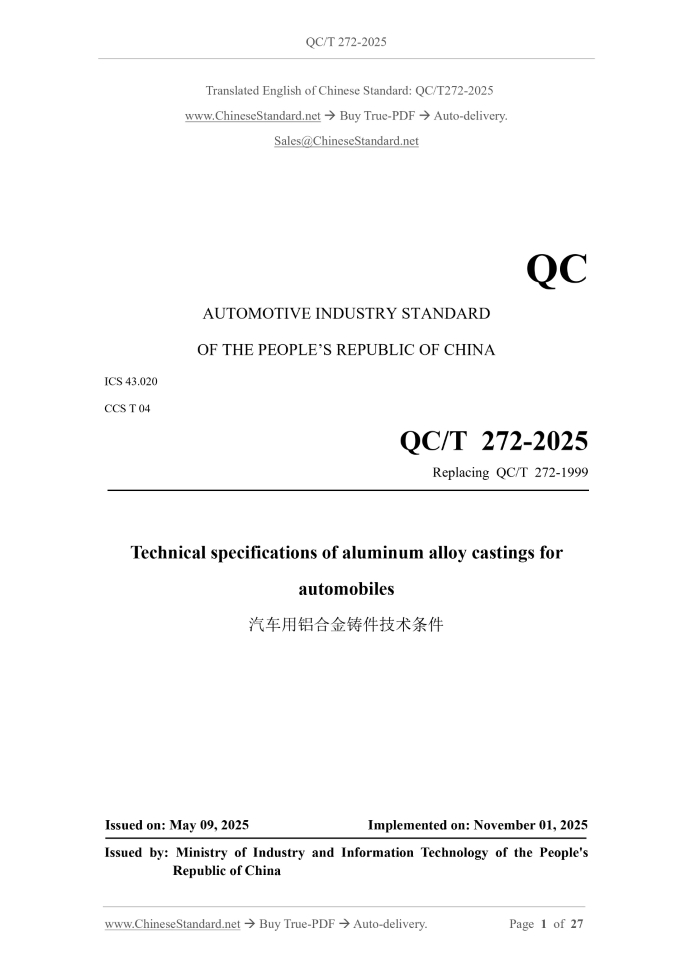
---This is an excerpt. Full copy of true-PDF in English version (including equations, symbols, images, flow-chart, tables, and figures etc.), auto-downloaded/delivered in 9 seconds, can be purchased online: https://www.ChineseStandard.net/PDF.aspx/QCT272-2025QC AUTOMOTIVE INDUSTRY STANDARD ICS 43.020 CCS T 04 Replacing QC/T 272-1999 Technical specifications of aluminum alloy castings for automobiles Issued on: MAY 09, 2025 Implemented on: NOVEMBER 01, 2025 Issued by. Ministry of Industry and Information Technology of the People's Republic of China
Table of Contents
Foreword... 3 1 Scope... 6 2 Normative references... 6 3 Terms and definitions... 7 4 Codes... 8 5 Casting classification... 9 6 Technical requirements... 9 7 Inspection methods... 14 8 Inspection criteria... 15 9 Marks, packaging... 19 Annex A (informative) Comparison of commonly used domestic and international aluminum alloy codes and designations... 20 Annex B (normative) Mechanical properties of cast aluminum alloys... 21 Annex C (informative) Commonly used mechanical property values of aluminum casting body sampling... 24 Annex D (normative) Porosity and maximum pore size testing of machined surfaces and metallographic sections of castings... 25 Technical specifications of aluminum alloy castings for automobiles1 Scope
This document specifies the classification, technical requirements, inspection methods, inspection criteria, marks, and packaging of aluminum alloy castings for automobiles. This document applies to sand-cast and metal-cast aluminum alloy castings for automotive applications (excluding high-pressure castings).2 Normative references
The following referenced documents are indispensable for the application of this document. For dated references, only the edition cited applies. For undated references, the latest edition of the referenced document (including any amendments) applies. GB/T 228.1, Metallic materials -- Tensile testing -- Part 1.Method of test at room temperature GB/T 231.1, Metallic materials -- Brinell hardness test -- Part 1.Test method GB/T 1173, Casting aluminum alloy GB/T 3075, Metallic materials -- Fatigue testing -- Axial force-controlled method GB/T 6414, Castings -- Dimensional tolerances and geometrical tolerances and machining allowances GB/T 7999, Optical Emission Spectrometric Analysis Method of Aluminum and Aluminum Alloys GB/T 11351, Mass tolerances of casting GB/T 13298, Inspection Methods of Microstructure for Metals GB/T 15056, Casting surface roughness -- Appraising method GB/T 20975 (all parts), Methods for chemical analysis of aluminium and aluminium alloys GB/T 25745, Heat treatment of cast aluminium alloys GB/T 36589, Casting -- Industrial computed tomography (CT) testing JB/T 7946.1, Metallograph of cast aluminium alloys -- Part 1.Cast aluminium- silicon alloys modification JB/T 7946.2, Metallograph of cast aluminium alloys -- Part 2.Cast aluminium- silicon alloys burning JB/T 7946.3, Metallograph of cast aluminium alloys -- Part 3.Cast aluminium alloys pinhole HB/Z 61, Penetration testing ASTM E155, Standard reference radiographs for inspection of aluminum and magnesium castings ASTM E2422, Standard digital reference images for inspection of aluminum castings3 Terms and definitions
For the purposes of this document, the terms and definitions defined in GB/T 1800.1 apply. 3.1 high stress zone The area in the CAE stress analysis cloud map of the casting where the value is greater than or equal to 60% of the minimum yield strength of the material. 3.2 functional zone The area that castings require sealing and assembly, such as threaded holes and bearing mounting surfaces. 3.3 non-critical zone Areas on the casting other than high stress zones and functional zones. 3.4 separately cast test sample Standard casting samples that are obtained by using the same furnace of molten aluminum as the production castings, and by employing the same casting method and heat treatment process as the production castings. 3.5 cast-on test sample A sample cut and processed from a test block attached to a casting or gating system. 3.6 test sample from casting A sample cut directly from the casting body and machined. 3.7 porosity The percentage of the total area of pores within the reference envelope shape to the area of the selected reference surface. 3.8 maximum pore size The maximum circumscribed circle diameter of a single hole.4 Codes
4.1 Heat treatment state codes To achieve the desired properties, castings undergo heat treatment in the as-cast state or using different heat treatment methods. The heat treatment state codes are as follows. F - As-cast state; O - Annealed state; T4 - Solution treatment plus natural aging; T5 - Controlled cooling plus artificial aging; T6 - Solution treatment plus fully artificial aging; T64 - Solution treatment plus insufficient aging; T7 - Solution treatment plus stabilization treatment. 4.2 Alloy casting methods and modification treatment codes Different castings may employ different casting processes or undergo modification treatments. The codes for these casting processes and modification treatments are shown below. S - Sand casting; J - Metal mold casting; LP - Low-pressure casting; CP - Differential pressure casting; B - Modification treatment.5 Casting classification
Aluminum alloy castings are classified into the following three categories according to the load they bear and the working conditions. They shall meet the requirements of Table 1.6 Technical requirements
6.1 Casting method and heat treatment condition 6.1.1 The casting method and heat treatment condition of the casting shall be agreed upon by the supplier and the purchaser. 6.1.2 The heat treatment process for castings shall be carried out in accordance with GB/T 25745 or the process specifications agreed upon by both the supplier and the purchaser. 6.1.3 The heat treatment state code, alloy casting method, and modification treatment code shall be marked on the drawings or technical agreements in accordance with 4.1 and 4.2. 6.2 Chemical composition The chemical composition and permissible impurities of cast aluminum alloys shall conform to GB/T 1173 or the relevant material standards and technical agreements agreed upon by both the supplier and the purchaser. Annex A lists a comparison table of commonly used domestic and international codes and designations of major cast aluminum and silicon alloys. 6.3 Mechanical properties 6.3.1 When using separately cast test samples for testing, their mechanical properties shall be in accordance with Annex B or the relevant material standards and technical agreements determined by both the supplier and the purchaser. 6.3.2 When using cast-on test samples or test samples from casting for mechanical property testing, the technical requirements shall be agreed upon by both the supplier and the purchaser. Unless otherwise agreed, the average tensile and yield strength and elongation of the 3 cast-on test samples or test samples from casting shall not be less than 75% and 50% of the performance of the separately cast test sample, respectively. The mechanical properties of one of the samples may be lower than normal. For Class I castings, the tensile and yield strength and elongation in the high stress zone shall not be less than 70% and 50% of the specified values, respectively. For Class I castings in non-critical zones and Class II castings, the values shall not be less than 65% and 40% of the specified values, respectively. Annex C lists the commonly used mechanical property values for aluminum casting samples. 6.3.3 Hardness testing shall be performed on designated areas of the casting. The hardness value shall conform to Annex B or the relevant material standards and technical agreements agreed upon by both the supplier and the purchaser. 6.3.4 When castings have other mechanical property requirements (such as fatigue), the technical requirements and inspection methods shall be agreed upon by the supplier and the purchaser. 6.4 Microstructure 6.4.1 Overheated structures are not allowed inside the casting. 6.4.2 The microstructure of the casting (such as the degree of alteration, the spacing of secondary dendrite arms, etc.) shall conform to the specifications of the drawings or technical agreement between the supplier and the purchaser. 6.5 Casting shape, dimensions and weight tolerance 6.5.1 The geometry and dimensions of the castings shall conform to the requirements of the drawings. Unless otherwise specified, the dimensional tolerances shall conform to GB/T 6414. 6.5.2 Unless otherwise specified by the supplier and the purchaser, the weight of the casting shall conform to the requirements of the drawings. Its tolerances shall be in accordance with GB/T 11351. 6.6 Surface quality 6.6.1 The surface roughness of castings shall meet the requirements of the drawings and technical agreements. The surface roughness of sand castings shall not exceed Ra25. The surface roughness of metal mold castings shall not exceed Ra6.3.For decorative surfaces that shall be polished and anodized, the roughness shall not exceed Ra1.6. 6.6.2 The surface of the casting shall not have cold shuts, cracks, shrinkage cavities, penetrating defects, or defects that affect product performance (such as incomplete filling, mechanical damage, etc.). The surface to be machined may have any defects that can be removed through subsequent machining. 6.9.3 With the consent of the purchaser, castings may be repaired by welding. The welding wire, welding location, area, depth, and number of welds shall be agreed upon by both the supplier and the purchaser. Castings requiring heat treatment shall be heat treated after the welding repair is completed.7 Inspection methods
7.1 Chemical composition The chemical composition testing methods for castings shall conform to GB/T 20975 (all parts) or GB/T 7999.Other testing methods are permitted provided that the accuracy of the analysis is guaranteed. In case of disputes over analytical results, arbitration shall be conducted in accordance with GB/T 20975 (all parts). 7.2 Mechanical properties 7.2.1 Tensile property testing shall be conducted in accordance with GB/T 228.1.The test sample may be a separately cast test sample, an cast-on test sample, or a sample cut from the casting body. 7.2.2 Hardness testing shall be performed in accordance with GB/T 231.1. 7.2.3 Fatigue performance testing shall be conducted in accordance with GB/T 3075. 7.3 Microstructure 7.3.1 The microstructure of castings shall be tested in accordance with the provisions of GB/T 13298 or the testing method agreed upon by the supplier and the purchaser. 7.3.2 Overheating testing of castings shall be conducted in accordance with JB/T 7946.2. 7.3.3 The testing of casting defects shall be carried out in accordance with JB/T 7946.1. 7.4 Dimensions Dimensional testing of castings can typically be performed using conventional inspection tools and methods such as 3D scanning and coordinate measuring machines. Dimensions of deep cavities and internal structural features that are difficult to measure can be inspected using CT scanning or sectioning methods. 7.5 Surface quality 7.5.1 The roughness rating of the unmachined surfaces of castings shall be in accordance with GB/T 15056. 7.5.2 The pinhole rating of machined surfaces shall be in accordance with JB/T 7946.3. 7.5.3 Surface cracks in castings shall be subjected to penetrant testing in accordance with HB/Z 61. 7.6 Internal quality 7.6.1 When using X-rays to inspect castings for internal defects, the rating of internal defects such as porosity, shrinkage cavities, and pinholes shall be in accordance with ASTM E155 or ASTM E2422.Appropriate and reliable X-ray flaw detection methods shall be developed for different castings to ensure the accuracy of the inspection results. 7.6.2 When metallographic sectioning is used to inspect castings for internal defects (porosity, pore size), the sectioning location shall be agreed upon by both the supplier and the purchaser. The section to be inspected shall be pre-ground and metallographically polished, and shall comply with the provisions of Annex D. 7.6.3 When using CT to detect internal defects in castings, the requirements of GB/T 36589 shall apply. 7.6.4 When there is a dispute over the X-ray testing results, the CT testing method shall be used as the arbitration method. 7.7 Airtightness The airtightness of castings can be tested using dry methods (such as leakage testing) and wet methods (such as water immersion method). The testing method shall be agreed upon by the supplier and the purchaser.8 Inspection criteria
8.1 Batching rules Castings from the same smelting furnace, the same casting shift, and the same heat treatment process are generally considered a batch. Special circumstances can be agreed upon by both the supplier and the purchaser. 8.2 Inspection items 8.2.1 Castings shall be inspected according to the categories in Table 1.The inspection items for each type of casting are shown in Table 4. ......Source: Above contents are excerpted from the full-copy PDF -- translated/reviewed by: www.ChineseStandard.net / Wayne Zheng et al.