QB/T 5805-2023 English PDF
Price & Delivery
US$260.00 · In stock · Download in 9 secondsQB/T 5805-2023: Milk (Whey) protein powder with milk fat globule membranes
Delivery: 9 seconds. True-PDF full-copy in English & invoice will be downloaded + auto-delivered via email. See step-by-step procedure
Status: Valid
| Standard ID | USD | BUY PDF | Delivery | Standard Title (Description) | Status |
| QB/T 5805-2023 | 260 | Add to Cart | Auto, 9 seconds. | Milk (Whey) protein powder with milk fat globule membranes | Valid |
Click to Preview this PDF
QB/T 5805-2023: Milk (Whey) protein powder with milk fat globule membranes
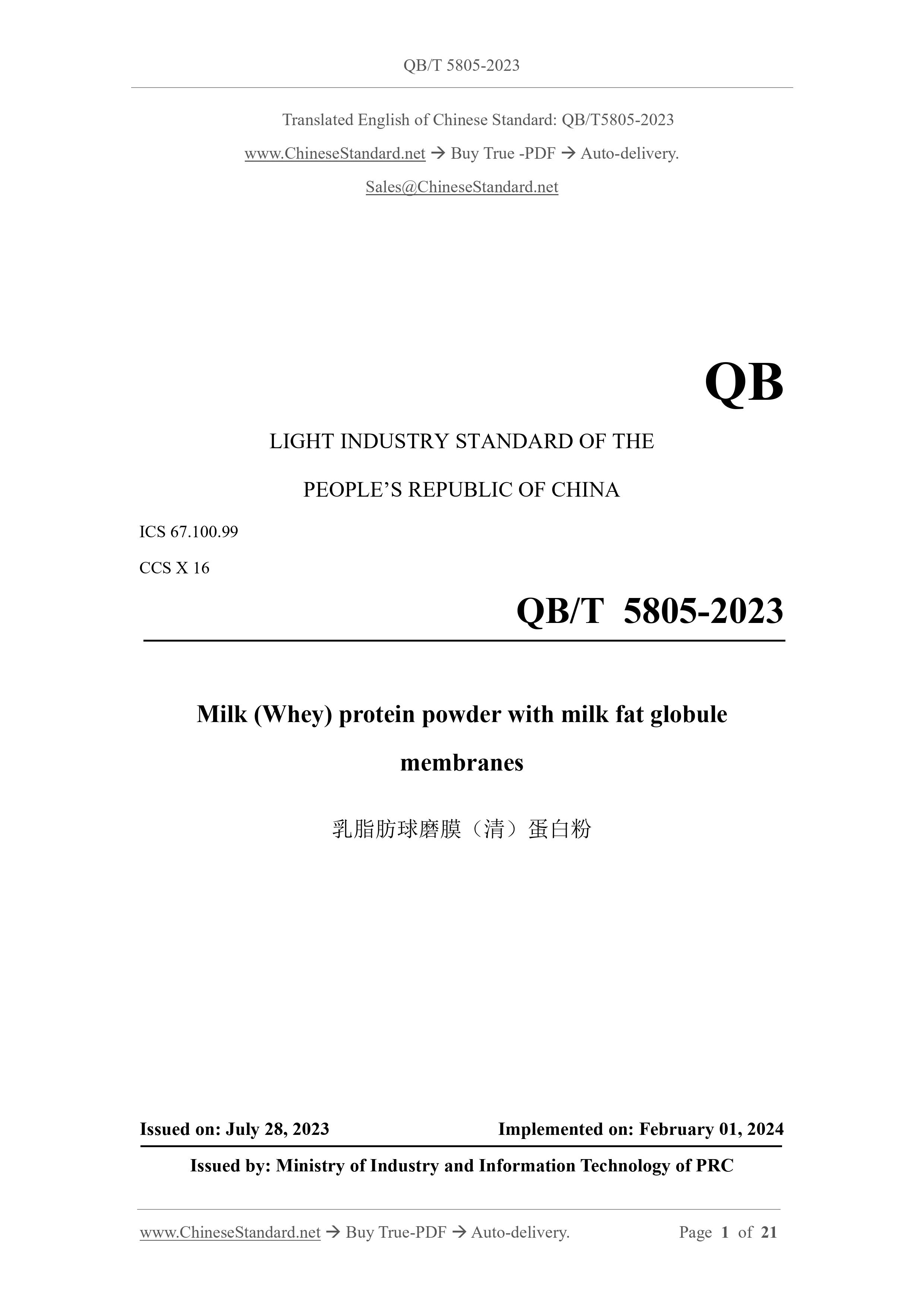
---This is an excerpt. Full copy of true-PDF in English version (including equations, symbols, images, flow-chart, tables, and figures etc.), auto-downloaded/delivered in 9 seconds, can be purchased online: https://www.ChineseStandard.net/PDF.aspx/QBT5805-2023QB LIGHT INDUSTRY STANDARD OF THE PEOPLE’S REPUBLIC OF CHINA ICS 67.100.99 CCS X 16 Milk (Whey) protein powder with milk fat globule membranes 乳脂肪球磨膜(清)蛋白粉 Issued on: JULY 28, 2023 Implemented on: FEBRUARY 01, 2024 Issued by. Ministry of Industry and Information Technology of PRC
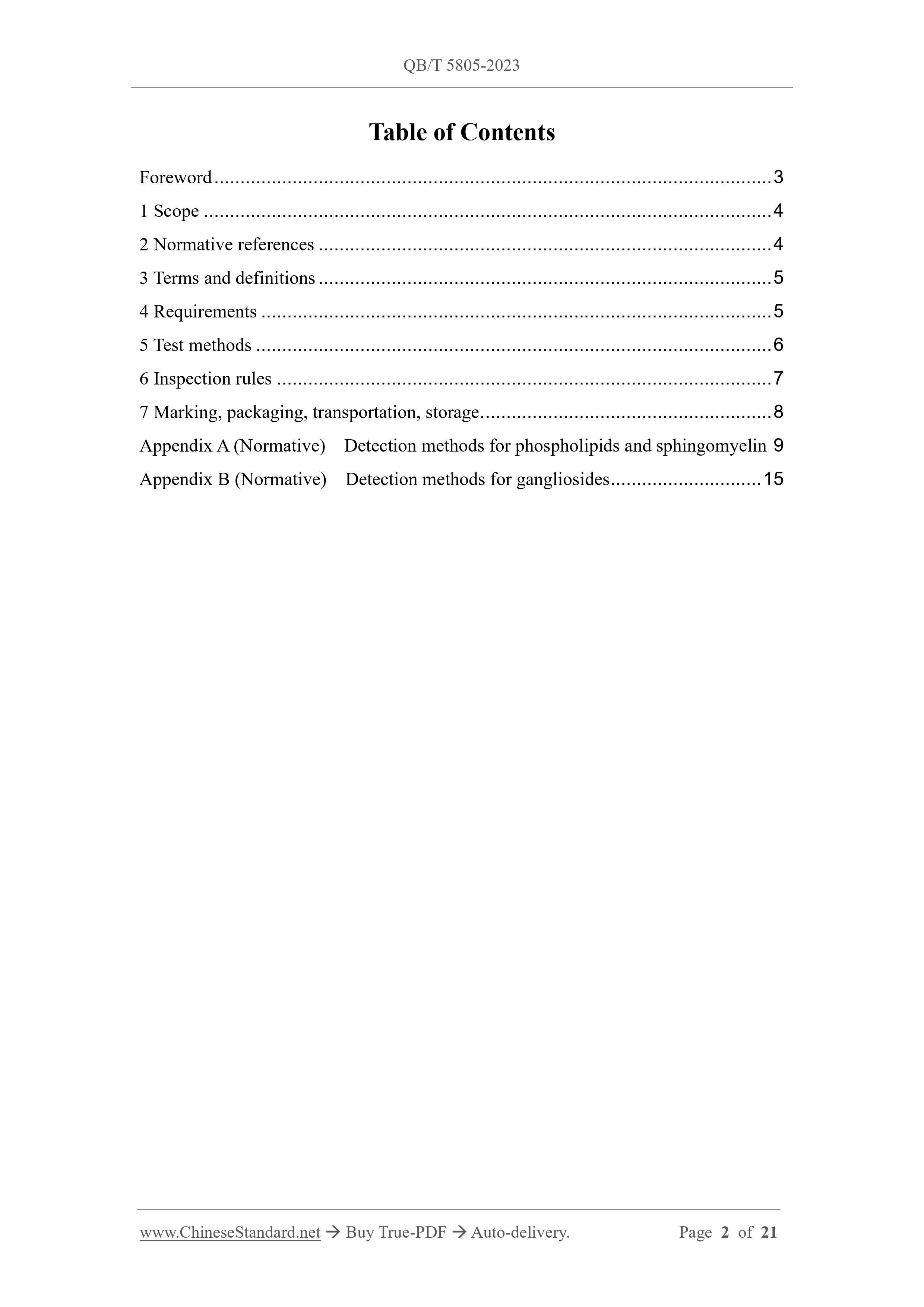
Table of Contents
Foreword... 3 1 Scope... 4 2 Normative references... 4 3 Terms and definitions... 5 4 Requirements... 5 5 Test methods... 6 6 Inspection rules... 7 7 Marking, packaging, transportation, storage... 8 Appendix A (Normative) Detection methods for phospholipids and sphingomyelin 9 Appendix B (Normative) Detection methods for gangliosides... 15 Milk (Whey) protein powder with milk fat globule membranes1 Scope
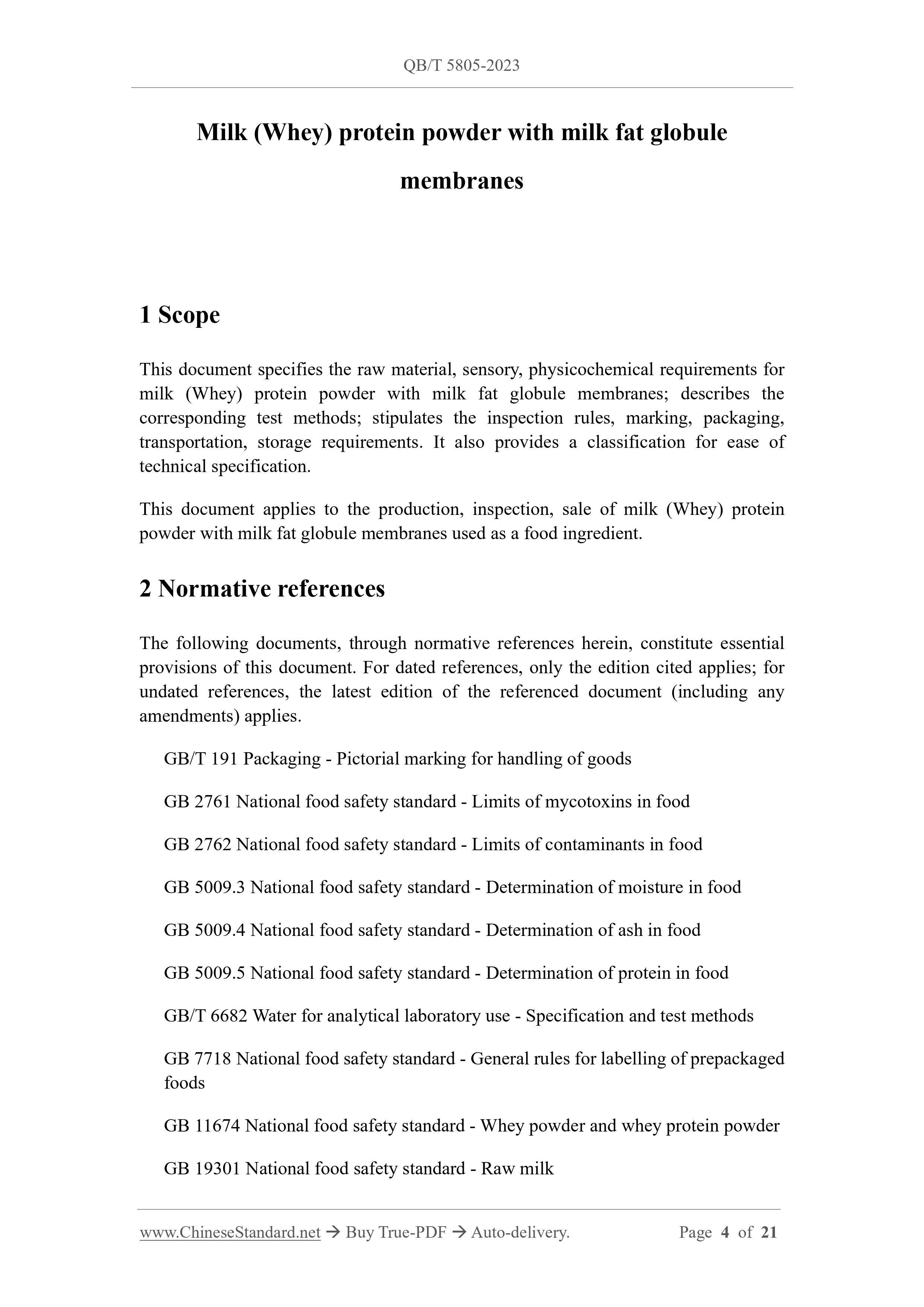
This document specifies the raw material, sensory, physicochemical requirements for milk (Whey) protein powder with milk fat globule membranes; describes the corresponding test methods; stipulates the inspection rules, marking, packaging, transportation, storage requirements. It also provides a classification for ease of technical specification. This document applies to the production, inspection, sale of milk (Whey) protein powder with milk fat globule membranes used as a food ingredient.2 Normative references
The following documents, through normative references herein, constitute essential provisions of this document. For dated references, only the edition cited applies; for undated references, the latest edition of the referenced document (including any amendments) applies. GB/T 191 Packaging - Pictorial marking for handling of goods GB 2761 National food safety standard - Limits of mycotoxins in food GB 2762 National food safety standard - Limits of contaminants in food GB 5009.3 National food safety standard - Determination of moisture in food GB 5009.4 National food safety standard - Determination of ash in food GB 5009.5 National food safety standard - Determination of protein in food GB/T 6682 Water for analytical laboratory use - Specification and test methods GB 7718 National food safety standard - General rules for labelling of prepackaged foods GB 11674 National food safety standard - Whey powder and whey protein powder GB 19301 National food safety standard - Raw milk GB 19646 National food safety standard - Cream, butter and anhydrous butter GB 28050 National food safety standard - General rules for nutrition labelling of prepackaged foods GB 29921 National food safety standard - Limits of pathogenic bacteria in prepackaged foods3 Terms and definitions
The following terms and definitions apply to this document. 3.1 Milk fat globule membranes A complex three-layered phospholipid membrane, which is composed of polar lipids, cholesterol, proteins that surrounds the surface of milk fat globules. 3.2 Whey protein powder with milk fat globule membranes A powdered product containing milk fat globule membranes (3.1), which is produced from raw milk or whey through processes such as separation, concentration, drying. 3.3 Milk protein powder with milk fat globule membranes A powdered product containing milk fat globule membranes (3.1), which is produced from raw milk or light cream through processes such as separation, concentration, drying.4 Requirements
4.1 Raw material requirements 4.1.1 Raw milk. It shall comply with the provisions of GB 19301. 4.1.2 Whey. It shall comply with the provisions of GB 11674. 4.1.3 Light cream. It shall comply with the provisions of GB 19646. 4.2 Sensory requirements It shall comply with the requirements in Table 1. 4.3 Physicochemical indicators It shall comply with the requirements in Table 2. 4.4 Safety requirements 4.4.1 The limits for mycotoxins shall comply with the provisions of GB 2761. 4.4.2 The limits for contaminants shall comply with the provisions of GB 2762. 4.4.3 The limits for microorganisms shall comply with the provisions of GB 29921.5 Test methods
5.1 Sensory evaluation Take an appropriate amount of specimen; place it in a clean, dry white porcelain dish; observe its color and appearance under natural light; smell its odor; rinse your mouth with warm water; taste it. 5.2 Protein Determine it according to the method described in GB 5009.5. 5.3 Phospholipids Detect it according to the method described in Appendix A. 5.4 Sphingomyelin Detect it according to the method described in Appendix A. 5.5 Gangliosides Detect it according to the method described in Appendix B. 5.6 Moisture Determine it according to the method described in GB 5009.3. 5.7 Ash Determine it according to the method described in GB 5009.4.6 Inspection rules
6.1 Group-batching Products of the same variety produced from the same batch of raw materials constitute one batch. 6.2 Sampling Products are sampled by batch. For pre-packaged products, 5 packages are sampled. For bulk packaging products weighing 10 kg or more, 500 g portions of each of the five randomly selected packages can be used as samples, with a total sample size of no less than 2500 g. 6.3 Exit-factory inspection Before leaving the factory, each batch of products shall be tested by the manufacturer's quality inspection department. Testing items shall be carried out according to relevant requirements. Only products that pass the tests can leave the factory. 6.4 Judgment rules 6.4.1 If all inspection indicators are qualified, the batch of products is judged as qualified. 6.4.2 If any inspection result is unqualified, the sample size can be doubled from the batch of products for retesting the unqualified items. If all retest results are qualified, the batch of products is judged as qualified. If even one item fails the retest, the batch of products is judged as unqualified. Retesting is not allowed, if the microbial limit is unqualified. ......Source: Above contents are excerpted from the full-copy PDF -- translated/reviewed by: www.ChineseStandard.net / Wayne Zheng et al.