QB/T 2706-2005 English PDF
Price & Delivery
US$85.00 · In stock · Download in 9 secondsQB/T 2706-2005: Leather. Chemical, physical and mechanical and fastness tests. Sampling location
Delivery: 9 seconds. True-PDF full-copy in English & invoice will be downloaded + auto-delivered via email. See step-by-step procedure
Status: Valid
| Standard ID | USD | BUY PDF | Delivery | Standard Title (Description) | Status |
| QB/T 2706-2005 | 85 | Add to Cart | Auto, 9 seconds. | Leather. Chemical, physical and mechanical and fastness tests. Sampling location | Valid |
Click to Preview this PDF
Similar standards
QB/T 2706-2005: Leather. Chemical, physical and mechanical and fastness tests. Sampling location
---This is an excerpt. Full copy of true-PDF in English version (including equations, symbols, images, flow-chart, tables, and figures etc.), auto-downloaded/delivered in 9 seconds, can be purchased online: https://www.ChineseStandard.net/PDF.aspx/QBT2706-2005LIGHT INDUSTRY STANDARD OF THE PEOPLE’S REPUBLIC OF CHINA ICS 59.140 Classification No.: Y45 Filing No.: 15758-2005 Replacing QB/T 3812.1-1999 Leather - Chemical, physical and mechanical and fastness tests - Sampling location (ISO 2418:2002, Leather - Chemical, physical and mechanical and fastness tests - Sampling location, MOD) ISSUED ON: MARCH 19, 2005 IMPLEMENTED ON: SEPTEMBER 01, 2005 Issued by: National Development and Reform Commission of PRC
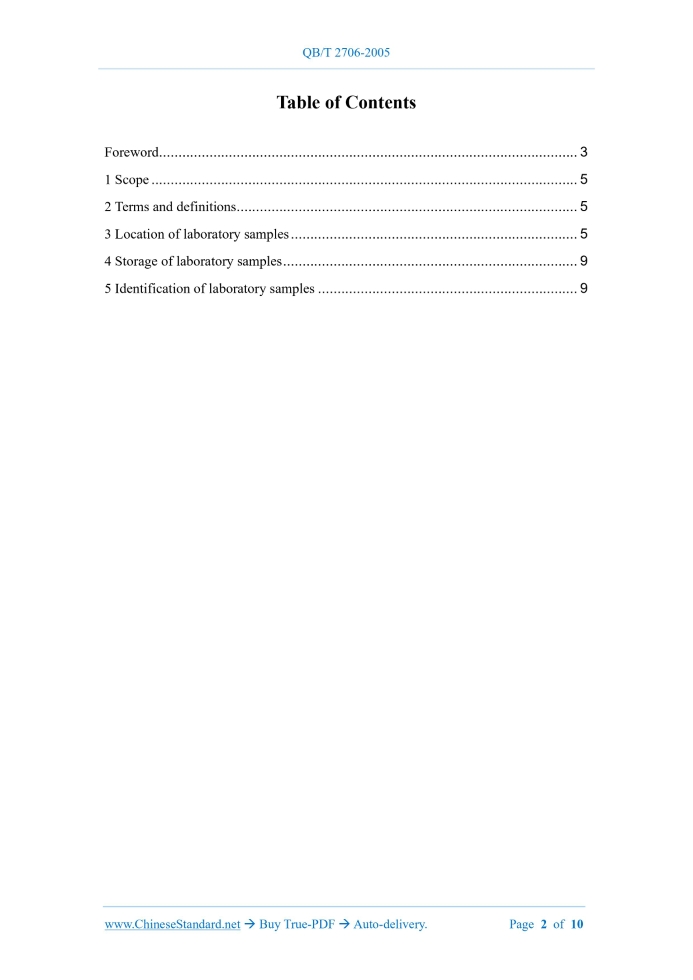
Table of Contents
Foreword ... 3 1 Scope ... 5 2 Terms and definitions... 5 3 Location of laboratory samples ... 5 4 Storage of laboratory samples ... 9 5 Identification of laboratory samples ... 9Foreword
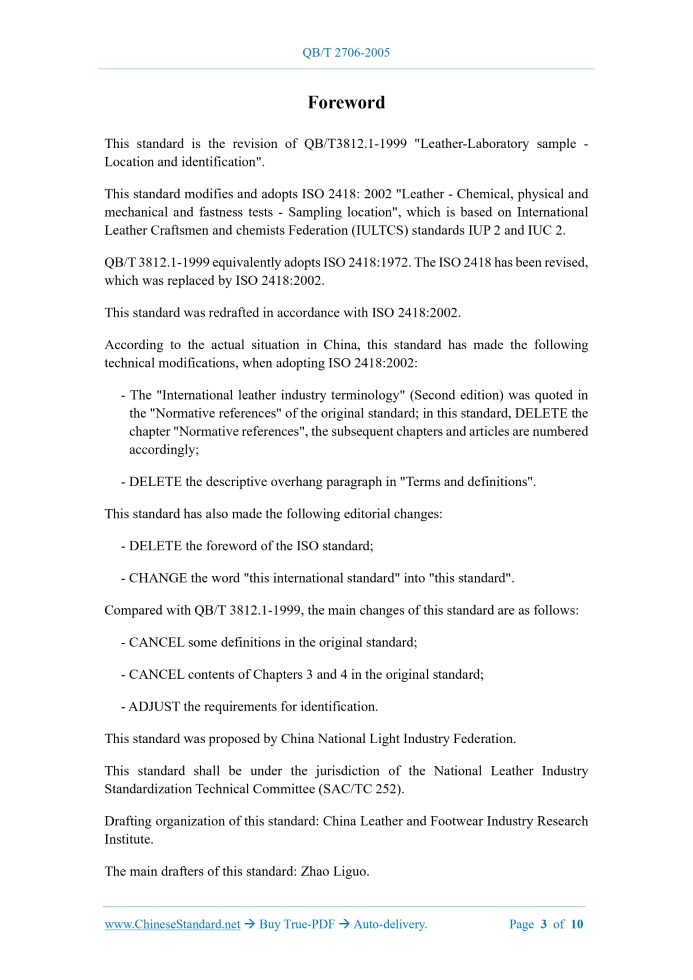
This standard is the revision of QB/T3812.1-1999 "Leather-Laboratory sample - Location and identification". This standard modifies and adopts ISO 2418: 2002 "Leather - Chemical, physical and mechanical and fastness tests - Sampling location", which is based on International Leather Craftsmen and chemists Federation (IULTCS) standards IUP 2 and IUC 2. QB/T 3812.1-1999 equivalently adopts ISO 2418:1972. The ISO 2418 has been revised, which was replaced by ISO 2418:2002. This standard was redrafted in accordance with ISO 2418:2002. According to the actual situation in China, this standard has made the following technical modifications, when adopting ISO 2418:2002: - The "International leather industry terminology" (Second edition) was quoted in the "Normative references" of the original standard; in this standard, DELETE the chapter "Normative references", the subsequent chapters and articles are numbered accordingly; - DELETE the descriptive overhang paragraph in "Terms and definitions". This standard has also made the following editorial changes: - DELETE the foreword of the ISO standard; - CHANGE the word "this international standard" into "this standard". Compared with QB/T 3812.1-1999, the main changes of this standard are as follows: - CANCEL some definitions in the original standard; - CANCEL contents of Chapters 3 and 4 in the original standard; - ADJUST the requirements for identification. This standard was proposed by China National Light Industry Federation. This standard shall be under the jurisdiction of the National Leather Industry Standardization Technical Committee (SAC/TC 252). Drafting organization of this standard: China Leather and Footwear Industry Research Institute. The main drafters of this standard: Zhao Liguo. Leather - Chemical, physical and mechanical and fastness tests - Sampling location1 Scope
This standard specifies the location, where laboratory samples are cut, from a single (piece) of leather, as well as the method for marking the cut laboratory samples. This standard applies to leather, which is processed from various mammalian skins. This standard does not apply to leather, which is processed from bird, fish, reptile skins.2 Terms and definitions
The following terms and definitions apply to this standard. 2.1 Laboratory sample Samples, which are taken from the areas specified in Chapter 4.3 Location of laboratory samples
3.1 Overview 3.1.1 Selection of samples 3.1.1.1 The area, where the laboratory sample is selected, shall be free from obvious defects of various types, such as scratches and knives from peeling. 3.1.1.2 The sampling procedure applies to sampling for physical, chemical, color fastness tests. 3.1.2 Sampling for physical and color fastness tests Samples for physical and color fastness tests are cut from the areas in Figures 1 ~ 4, where there is no shadow bar. 3.1.3 Sampling for chemical tests 3.1.3.1 The samples for chemical test are cut from the area with shadow bars, in Figures 1 ~ 4. 3.1.3.2 If the minimum sample block, which is required for the chemical test, cannot be obtained, take a sample from the corresponding part on the other side of the back ridge line of the sample. If sufficient samples cannot be obtained, take samples from areas, which are adjacent to the sampling location. 3.1.3.3 Except for arbitration analysis, clean specimens, which are not contaminated during physical testing, may be used for chemical test. In arbitration analysis, leather specimens for chemical test can only be taken from the correct location. 3.2 Whole leather Cut out the square block GJKH without shadow bar AND/OR the square block HLMN with shadow bar, according to Figure 1. In smaller leathers, the distances, EF and JK, which are required for a single specimen, can be shortened appropriately. When sampling from smaller leather, if the sampling method is changed, a minimum deviation from this procedure shall be maintained. 3.3 Half-hip back leather Cut out the square block GJKH without shadow bar AND/OR the square block HLMN with shadow bar, according to Figure 2. 3.4 Shoulder leather Cut out the square block ABCD without shadow bar AND/OR the square block AEFG with shadow bar, according to Figure 3. 3.5 Ventral leather Cut out the square blocks GJKH without shadow bars AND/OR the square blocks LMNG and HPQR with shadow bars, according to Figure 4. ......Source: Above contents are excerpted from the full-copy PDF -- translated/reviewed by: www.ChineseStandard.net / Wayne Zheng et al.