QB/T 1333-2018 English PDF
Price & Delivery
US$85.00 · In stock · Download in 9 secondsQB/T 1333-2018: Travelling case and trolley bag
Delivery: 9 seconds. True-PDF full-copy in English & invoice will be downloaded + auto-delivered via email. See step-by-step procedure
Status: Valid
QB/T 1333: Historical versions
| Standard ID | USD | BUY PDF | Delivery | Standard Title (Description) | Status |
| QB/T 1333-2018 | 85 | Add to Cart | Auto, 9 seconds. | Travelling case and trolley bag | Valid |
| QB/T 1333-2010 | 85 | Add to Cart | Auto, 9 seconds. | [2014XG included] Handbag and knapsack | Obsolete |
| QB/T 1333-2004 | 319 | Add to Cart | 3 days | Handbag and knapsack | Obsolete |
| QB/T 1333-1996 | 199 | Add to Cart | 2 days | (Back bag) | Obsolete |
| QB/T 1333-1991 | RFQ | ASK | 3 days | (Back bag) | Obsolete |
Click to Preview this PDF
QB/T 1333-2018: Travelling case and trolley bag
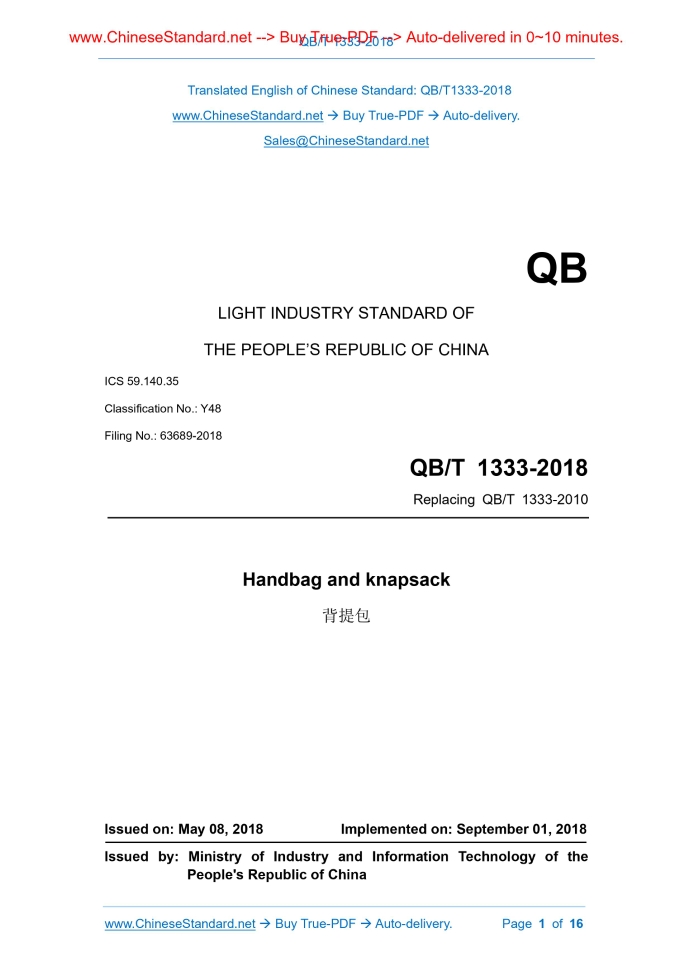
---This is an excerpt. Full copy of true-PDF in English version (including equations, symbols, images, flow-chart, tables, and figures etc.), auto-downloaded/delivered in 9 seconds, can be purchased online: https://www.ChineseStandard.net/PDF.aspx/QBT1333-2018QB LIGHT INDUSTRY STANDARD OF THE PEOPLE’S REPUBLIC OF CHINA ICS 59.140.35 Classification No.. Y48 Filing No.. 63689-2018 Replacing QB/T 1333-2010 Handbag and knapsack Issued on. MAY 08, 2018 Implemented on. SEPTEMBER 01, 2018 Issued by. Ministry of Industry and Information Technology of the People's Republic of China
Table of Contents
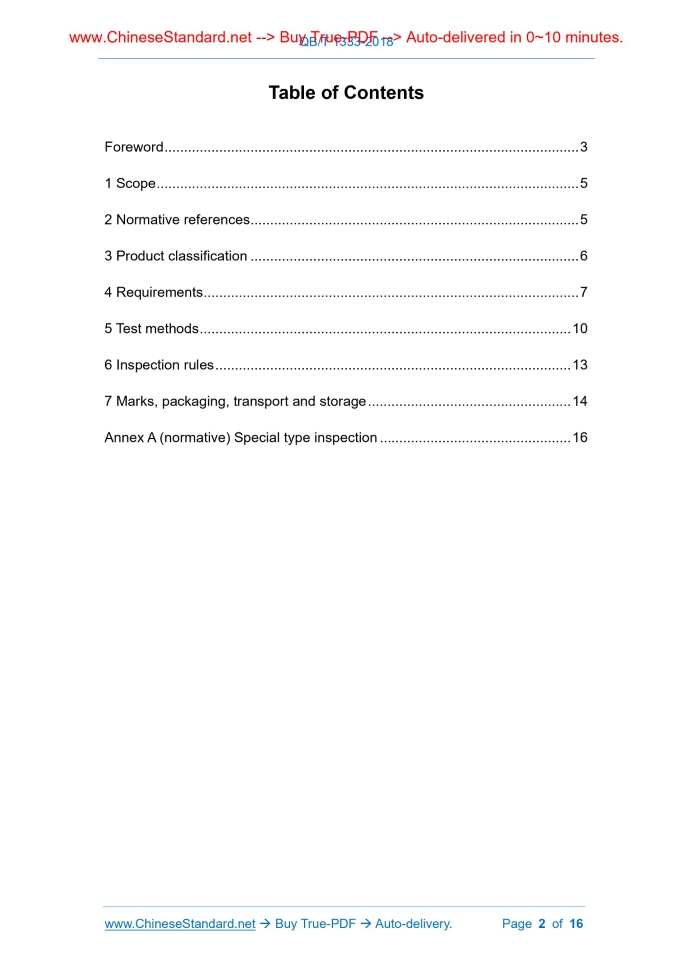
Foreword... 3 1 Scope... 5 2 Normative references... 5 3 Product classification... 6 4 Requirements... 7 5 Test methods... 10 6 Inspection rules... 13 7 Marks, packaging, transport and storage... 14 Annex A (normative) Special type inspection... 16Foreword
This Standard was drafted in accordance with the rules given in GB/T 1.1-2009. This Standard is a revision to GB/T 1333-2010 “Handbag and knapsack”. Compared with QB/T 1333-2010, in addition to editorial modifications, the main technical changes in this Standard are as follows. - modified and added references in “Normative references”; - modified “Classification according to variety (top layer material)”; - added requirements for “magnetic buckle”, “zipper” in “raw materials and accessories”; - deleted requirements for “specifications”; - deleted requirements for “superior products”; - modified requirements for “appearance quality”, added requirements for "fur", "other materials" in “top layer materials”; - modified requirements for "oscillation impact performance"; - modified requirements for “accessories”, item name changed to “lock durability”; - modified requirements for “stitching strength”; - modified and refined requirements and test methods for "friction fastness"; - modified requirements for "corrosion resistance of hardware accessories"; - added requirements for "fastener performance", "plastic buckle durability", "back strap folding performance"; - added measurement method for “volume”; - modified the content of “marks”, modified it from Clause 4 to Clause 7. This Standard was proposed by Light Industry Federation. This Standard shall be under the jurisdiction of National Technical Committee on Leather Industry of Standardization Administration of China (SAC/TC 252). Main drafting organizations of this Standard. Zhejiang Zhishang Industrial Co., Ltd., Guangdong Wanli Ma Industrial Co., Ltd., Daphne Investment (Group) Co., Ltd., Guangzhou Honggu Leather Co., Ltd., Kezhishi International Trade (Shanghai) Co., Ltd., Fujian Baolande Luggage Leather Co., Ltd., Guangdong Fei Anni Leather Co., Ltd., Guangzhou Niujunjun Leather Co., Ltd., Coach Shanghai Limited, National Leather Products Quality Supervision and Inspection Center (Guangzhou), Dongguan Hengyu Instrument Co., Ltd. Main drafters of this Standard. Zou Lisheng, Lin Dazhou, Huang Yongqin, Zou Suhe, Chen Zongliang, Zhao Liguo, Zhou Guanghua, Shao Qingtao, Su Danxia. Since the implementation of this Standard, it shall replace QB/T 1333-2010 “Handbag and knapsack”. QB/T 1333-2010, the previous light industry standard, is repealed simultaneously. Versions of standard substituted by this Standard are. - QB/T 1333-2010; - QB/T 1333-2004; - QB/T 1333-1996; - QB/T 1333-1991. Handbag and knapsack1 Scope
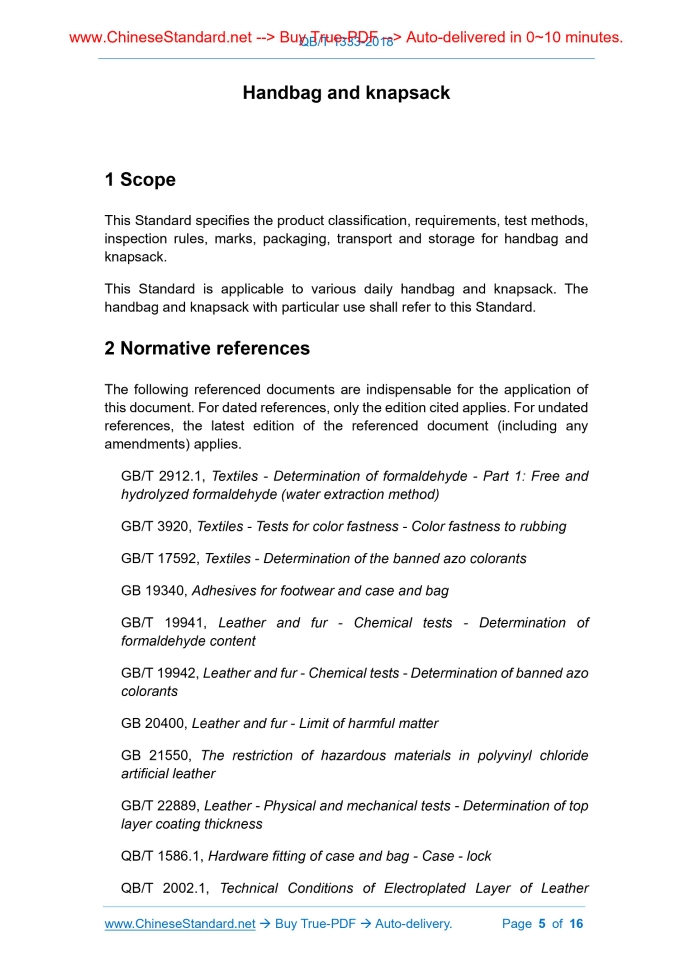
This Standard specifies the product classification, requirements, test methods, inspection rules, marks, packaging, transport and storage for handbag and knapsack. This Standard is applicable to various daily handbag and knapsack. The handbag and knapsack with particular use shall refer to this Standard.2 Normative references
The following referenced documents are indispensable for the application of this document. For dated references, only the edition cited applies. For undated references, the latest edition of the referenced document (including any amendments) applies. GB/T 2912.1, Textiles - Determination of formaldehyde - Part 1.Free and hydrolyzed formaldehyde (water extraction method) GB/T 3920, Textiles - Tests for color fastness - Color fastness to rubbing GB/T 17592, Textiles - Determination of the banned azo colorants GB 19340, Adhesives for footwear and case and bag GB/T 19941, Leather and fur - Chemical tests - Determination of formaldehyde content GB/T 19942, Leather and fur - Chemical tests - Determination of banned azo colorants GB 20400, Leather and fur - Limit of harmful matter GB 21550, The restriction of hazardous materials in polyvinyl chloride artificial leather3 Product classification
3.1 Classification according to variety (top layer material). 3.2 Classification according to type (structure).4 Requirements
4.1 Raw materials and accessories Select according to related product standards. 4.1.1 Harmful substance limit The limit value of harmful substances in leather, fur and recycled leather materials shall comply with the provisions of GB 20400 and Table 1. 4.1.2 Lock In accordance with QB/T 1586.1 or related product standards. 4.1.3 Magnetic buckle In accordance with QB/T 5085. 4.1.4 Zipper In accordance with QB/T 2171, QB/T 2172, QB/T 2173. 4.1.5 Hardware accessories In accordance with QB/T 2002.1, QB/T 2002.2. 4.4 Dual bag in bag If the bag supplied with the product has a completely separate structure, components (with handles and/or straps), functions, and can be used separately as a handbag and knapsack, it shall be inspected separately and in accordance with the provisions of Clause 4, otherwise only need to comply with 4 1.1 requirements.5 Test methods
5.1 Raw materials and accessories Before processing and production, inspect or verify according to relevant standards, the limit of harmful substances shall be tested according to GB 20400, GB 19340, GB 21550, GB/T 2912.1 and GB/T 17592. 5.3 Physical and mechanical properties 5.3.1 Oscillation impact 5.3.1.1 Determination of volume Inspect according to QB/T 5083. 5.3.2.2 Mechanical password lock. use any 10 different garbled for tests; key lock and electronic code lock use non-dedicated key for the test 10 times. 5.3.3 Fastener durability Inspect according to QB/T 5084.Test 1000 times. 5.3.4 Zipper durability Select 20cm in zipper length. Test at a frequency of 20 times/min. One opening and one closing shall be recorded as once. Test 200 times. When the zipper length is less than 20cm, test within the maximum length of the zipper. 5.3.6 Plastic buckle durability Inspect according to QB/T 5247.Test 1000 times. 5.3.7 Color fastness to rubbing Test according to the followings. 5.3.8 Corrosion resistance of hardware accessories Inspect according to QB/T 3826 (excluding pull rod, riveting parts, metal fasteners). The zipper head only detects the pull tab, and the test time is 16 h. 5.3.9 Strap folding resistance Inspect according to QB/T 5246.Test 500 times.6 Inspection rules
6.1 Batching An inspection lot consists of the products of the same variety, of the same specification, in the same production process. 6.2 Exit-factory inspection Each batch of products shall be inspected one by one before leaving the factory, and may leave factory after being tested. 6.3 Routine type inspection In any of the following cases, 3 pieces shall be randomly selected from the products that have passed the exit-factory inspection for routine type inspection. 6.5 Qualification determination 6.5.1 Determination rules for single piece If one of the harmful material limit and physical and mechanical properties fails, the product is determined as unqualified. 6.5.2 Determination rules for batch If all the three tested samples meet the requirements for qualified products, the batch of products shall be qualified. If one (or more) fails, double the sample for re-inspection. If all the re-inspections are qualified, the batch of products shall be qualified.7 Marks, packaging, transport and storage
7.1 Marks 7.1.1 Products that pass the inspection shall have the following marks. 7.1.2 Product label shall meet the following requirements. 7.2 Packaging The inner and outer packaging of the product shall be made of suitable packaging materials to prevent damage during transport and storage. 7.3 Transport and storage In accordance with the followings. QB/T 1333-2018 QB LIGHT INDUSTRY STANDARD OF THE PEOPLE’S REPUBLIC OF CHINA ICS 59.140.35 Classification No.. Y48 Filing No.. 63689-2018 Replacing QB/T 1333-2010 Handbag and knapsack Issued on. MAY 08, 2018 Implemented on. SEPTEMBER 01, 2018 Issued by. Ministry of Industry and Information Technology of the People's Republic of ChinaTable of Contents
Foreword... 3 1 Scope... 5 2 Normative references... 5 3 Product classification... 6 4 Requirements... 7 5 Test methods... 10 6 Inspection rules... 13 7 Marks, packaging, transport and storage... 14 Annex A (normative) Special type inspection... 16Foreword
This Standard was drafted in accordance with the rules given in GB/T 1.1-2009. This Standard is a revision to GB/T 1333-2010 “Handbag and knapsack”. Compared with QB/T 1333-2010, in addition to editorial modifications, the main technical changes in this Standard are as follows. - modified and added references in “Normative references”; - modified “Classification according to variety (top layer material)”; - added requirements for “magnetic buckle”, “zipper” in “raw materials and accessories”; - deleted requirements for “specifications”; - deleted requirements for “superior products”; - modified requirements for “appearance quality”, added requirements for "fur", "other materials" in “top layer materials”; - modified requirements for "oscillation impact performance"; - modified requirements for “accessories”, item name changed to “lock durability”; - modified requirements for “stitching strength”; - modified and refined requirements and test methods for "friction fastness"; - modified requirements for "corrosion resistance of hardware accessories"; - added requirements for "fastener performance", "plastic buckle durability", "back strap folding performance"; - added measurement method for “volume”; - modified the content of “marks”, modified it from Clause 4 to Clause 7. This Standard was proposed by Light Industry Federation. This Standard shall be under the jurisdiction of National Technical Committee on Leather Industry of Standardization Administration of China (SAC/TC 252). Main drafting organizations of this Standard. Zhejiang Zhishang Industrial Co., Ltd., Guangdong Wanli Ma Industrial Co., Ltd., Daphne Investment (Group) Co., Ltd., Guangzhou Honggu Leather Co., Ltd., Kezhishi International Trade (Shanghai) Co., Ltd., Fujian Baolande Luggage Leather Co., Ltd., Guangdong Fei Anni Leather Co., Ltd., Guangzhou Niujunjun Leather Co., Ltd., Coach Shanghai Limited, National Leather Products Quality Supervision and Inspection Center (Guangzhou), Dongguan Hengyu Instrument Co., Ltd. Main drafters of this Standard. Zou Lisheng, Lin Dazhou, Huang Yongqin, Zou Suhe, Chen Zongliang, Zhao Liguo, Zhou Guanghua, Shao Qingtao, Su Danxia. Since the implementation of this Standard, it shall replace QB/T 1333-2010 “Handbag and knapsack”. QB/T 1333-2010, the previous light industry standard, is repealed simultaneously. Versions of standard substituted by this Standard are. - QB/T 1333-2010; - QB/T 1333-2004; - QB/T 1333-1996; - QB/T 1333-1991. Handbag and knapsack1 Scope
This Standard specifies the product classification, requirements, test methods, inspection rules, marks, packaging, transport and storage for handbag and knapsack. This Standard is applicable to various daily handbag and knapsack. The handbag and knapsack with particular use shall refer to this Standard.2 Normative references
The following referenced documents are indispensable for the application of this document. For dated references, only the edition cited applies. For undated references, the latest edition of the referenced document (including any amendments) applies. GB/T 2912.1, Textiles - Determination of formaldehyde - Part 1.Free and hydrolyzed formaldehyde (water extraction method) GB/T 3920, Textiles - Tests for color fastness - Color fastness to rubbing GB/T 17592, Textiles - Determination of the banned azo colorants GB 19340, Adhesives for footwear and case and bag GB/T 19941, Leather and fur - Chemical tests - Determination of formaldehyde content GB/T 19942, Leather and fur - Chemical tests - Determination of banned azo colorants GB 20400, Leather and fur - Limit of harmful matter GB 21550, The restriction of hazardous materials in polyvinyl chloride artificial leather3 Product classification
3.1 Classification according to variety (top layer material). 3.2 Classification according to type (structure).4 Requirements
4.1 Raw materials and accessories Select according to related product standards. 4.1.1 Harmful substance limit The limit value of harmful substances in leather, fur and recycled leather materials shall comply with the provisions of GB 20400 and Table 1. 4.1.2 Lock In accordance with QB/T 1586.1 or related product standards. 4.1.3 Magnetic buckle In accordance with QB/T 5085. 4.1.4 Zipper In accordance with QB/T 2171, QB/T 2172, QB/T 2173. 4.1.5 Hardware accessories In accordance with QB/T 2002.1, QB/T 2002.2. 4.4 Dual bag in bag If the bag supplied with the product has a completely separate structure, components (with handles and/or straps), functions, and can be used separately as a handbag and knapsack, it shall be inspected separately and in accordance with the provisions of Clause 4, otherwise only need to comply with 4 1.1 requirements.5 Test methods
5.1 Raw materials and accessories Before processing and production, inspect or verify according to relevant standards, the limit of harmful substances shall be tested according to GB 20400, GB 19340, GB 21550, GB/T 2912.1 and GB/T 17592. 5.3 Physical and mechanical properties 5.3.1 Oscillation impact 5.3.1.1 Determination of volume Inspect according to QB/T 5083. 5.3.2.2 Mechanical password lock. use any 10 different garbled for tests; key lock and electronic code lock use non-dedicated key for the test 10 times. 5.3.3 Fastener durability Inspect according to QB/T 5084.Test 1000 times. 5.3.4 Zipper durability Select 20cm in zipper length. Test at a frequency of 20 times/min. One opening and one closing shall be recorded as once. Test 200 times. When the zipper length is less than 20cm, test within the maximum length of the zipper. 5.3.6 Plastic buckle durability Inspect according to QB/T 5247.Test 1000 times. 5.3.7 Color fastness to rubbing Test according to the followings. 5.3.8 Corrosion resistance of hardware accessories Inspect according to QB/T 3826 (excluding pull rod, riveting parts, metal fasteners). The zipper head only detects the pull tab, and the test time is 16 h. 5.3.9 Strap folding resistance Inspect according to QB/T 5246.Test 500 times.6 Inspection rules
6.1 Batching An inspection lot consists of the products of the same variety, of the same specification, in the same production process. 6.2 Exit-factory inspection Each batch of products shall be inspected one by one before leaving the factory, and may leave factory after being tested. 6.3 Routine type inspection In any of the following cases, 3 pieces shall be randomly selected from the products that have passed the exit-factory inspection for routine type inspection. 6.5 Qualification determination 6.5.1 Determination rules for single piece If one of the harmful material limit and physical and mechanical properties fails, the product is determined as unqualified. 6.5.2 Determination rules for batch If all the three tested samples meet the requirements for qualified products, the batch of products shall be qualified. If one (or more) fails, double the sample for re-inspection. If all the re-inspections are qualified, the batch of products shall be qualified.7 Marks, packaging, transport and storage
7.1 Marks 7.1.1 Products that pass the inspection shall have the following marks. 7.1.2 Product label shall meet the following requirements. 7.2 Packaging The inner and outer packaging of the product shall be made of suitable packaging materials to prevent damage during transport and storage. 7.3 Transport and storage In accordance with the followings. ......Source: Above contents are excerpted from the full-copy PDF -- translated/reviewed by: www.ChineseStandard.net / Wayne Zheng et al.