GB/T 8982-2025 English PDF
Price & Delivery
US$200.00 · In stock · Download in 9 secondsGB/T 8982-2025: Oxygen supplies for medicine and aircraft breathing
Delivery: 9 seconds. True-PDF full-copy in English & invoice will be downloaded + auto-delivered via email. See step-by-step procedure
Status: Valid
GB/T 8982: Historical versions
| Standard ID | USD | BUY PDF | Delivery | Standard Title (Description) | Status |
| GB/T 8982-2025 | 200 | Add to Cart | Auto, 9 seconds. | Oxygen supplies for medicine and aircraft breathing | Valid |
| GB 8982-2009 | 155 | Add to Cart | Auto, 9 seconds. | Oxygen supplies for medicine and aircraft breathing | Valid |
| GB 8982-1998 | 519 | Add to Cart | 4 days | Oxygen supplies for medicine | Obsolete |
| GB 8982-1988 | RFQ | ASK | 3 days | Gaseous oxygen supplies for medicine | Obsolete |
Click to Preview this PDF
GB/T 8982-2025: Oxygen supplies for medicine and aircraft breathing
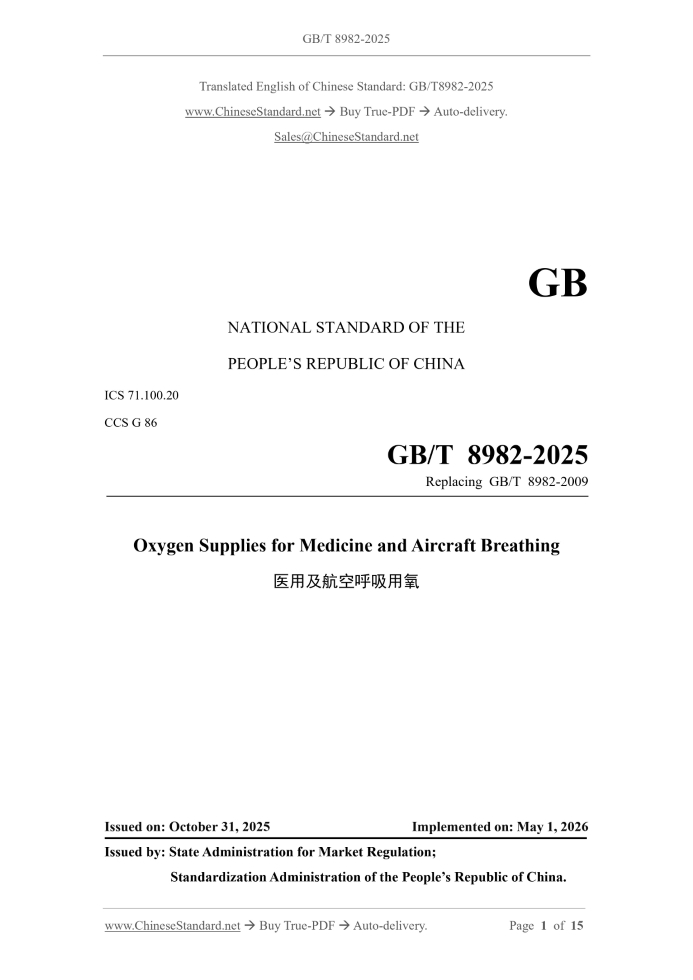
---This is an excerpt. Full copy of true-PDF in English version (including equations, symbols, images, flow-chart, tables, and figures etc.), auto-downloaded/delivered in 9 seconds, can be purchased online: https://www.ChineseStandard.net/PDF.aspx/GBT8982-2025GB NATIONAL STANDARD OF THE PEOPLE’S REPUBLIC OF CHINA ICS 71.100.20 CCS G 86 Replacing GB/T 8982-2009 Oxygen Supplies for Medicine and Aircraft Breathing Issued on: OCTOBER 31, 2025 Implemented on: MAY 1, 2026 Issued by. State Administration for Market Regulation; Standardization Administration of the People’s Republic of China.
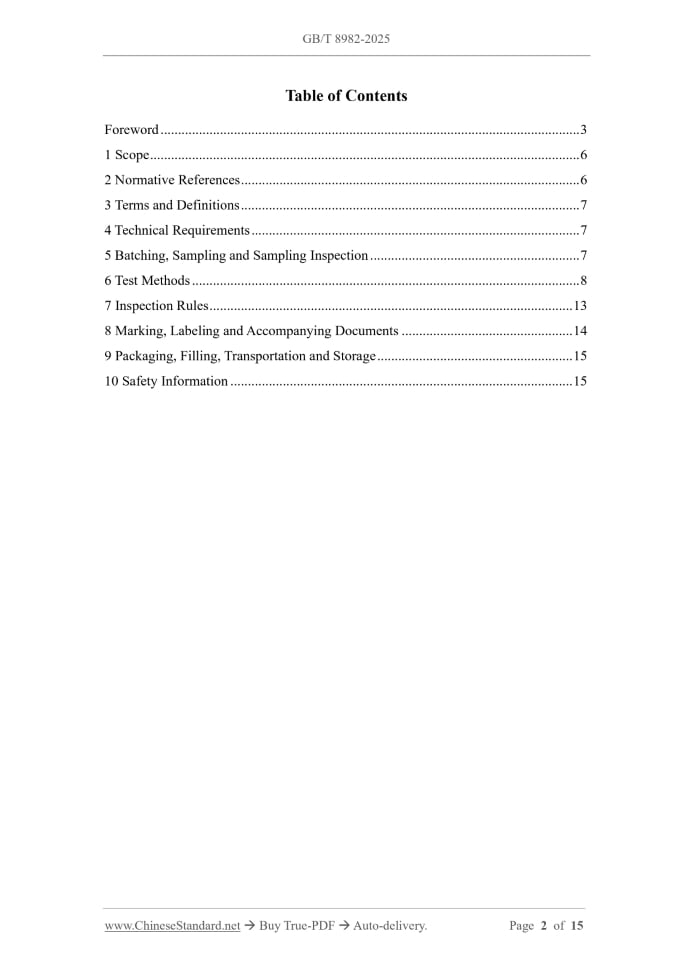
Table of Contents
Foreword... 3 1 Scope... 6 2 Normative References... 6 3 Terms and Definitions... 7 4 Technical Requirements... 7 5 Batching, Sampling and Sampling Inspection... 7 6 Test Methods... 8 7 Inspection Rules... 13 8 Marking, Labeling and Accompanying Documents... 14 9 Packaging, Filling, Transportation and Storage... 15 10 Safety Information... 15 Oxygen Supplies for Medical and Aircraft Breathing1 Scope
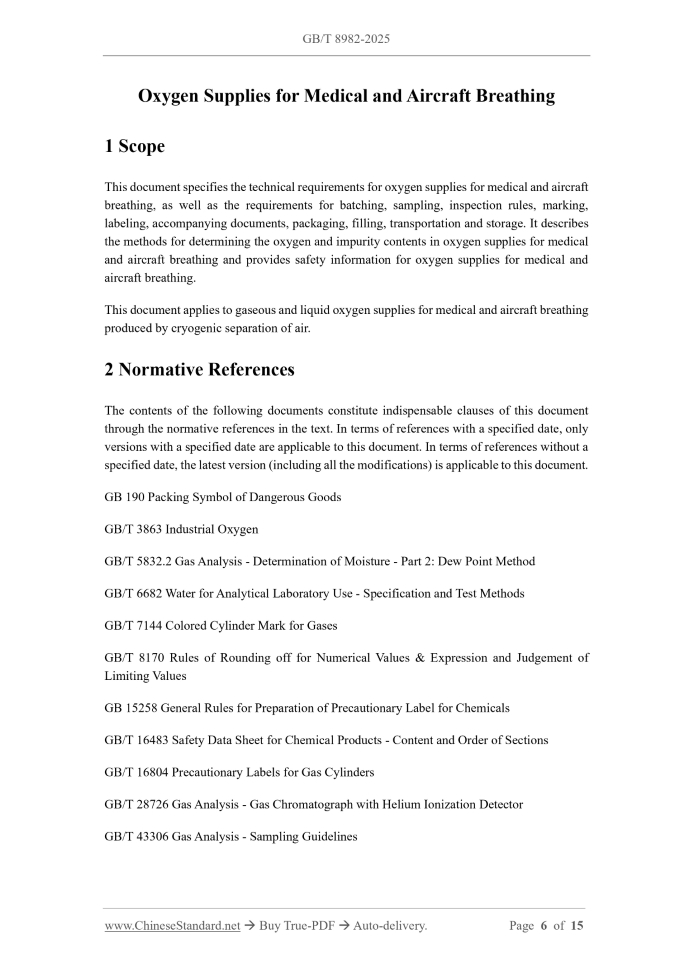
This document specifies the technical requirements for oxygen supplies for medical and aircraft breathing, as well as the requirements for batching, sampling, inspection rules, marking, labeling, accompanying documents, packaging, filling, transportation and storage. It describes the methods for determining the oxygen and impurity contents in oxygen supplies for medical and aircraft breathing and provides safety information for oxygen supplies for medical and aircraft breathing. This document applies to gaseous and liquid oxygen supplies for medical and aircraft breathing produced by cryogenic separation of air.2 Normative References
The contents of the following documents constitute indispensable clauses of this document through the normative references in the text. In terms of references with a specified date, only versions with a specified date are applicable to this document. In terms of references without a specified date, the latest version (including all the modifications) is applicable to this document. GB 190 Packing Symbol of Dangerous Goods GB/T 3863 Industrial Oxygen GB/T 5832.2 Gas Analysis - Determination of Moisture - Part 2.Dew Point Method GB/T 6682 Water for Analytical Laboratory Use - Specification and Test Methods GB/T 7144 Colored Cylinder Mark for Gases GB/T 8170 Rules of Rounding off for Numerical Values & Expression and Judgement of Limiting Values GB 15258 General Rules for Preparation of Precautionary Label for Chemicals GB/T 16483 Safety Data Sheet for Chemical Products - Content and Order of Sections GB/T 16804 Precautionary Labels for Gas Cylinders GB/T 28726 Gas Analysis - Gas Chromatograph with Helium Ionization Detector GB/T 43306 Gas Analysis - Sampling Guidelines3 Terms and Definitions
This document does not have terms or definitions that need to be defined.4 Technical Requirements
4.1 The technical requirements for oxygen supplies for medical and aircraft breathing shall comply with the provisions of Table 1. 4.2 No requirements are made regarding the moisture content or odor of liquid oxygen.5 Batching, Sampling and Sampling Inspection
5.1 Batching The oxygen supplies products for medical and aircraft breathing continuously and stably produced on the same production line constitute a batch. The oxygen supplies for medical and aircraft breathing packaged in cylinder bundles constitute a batch based on the quantity of products from one cylinder bundle. 5.2 Sampling It shall comply with the provisions of GB/T 43306. 5.3 Sampling Inspection 5.3.1 For oxygen supplies for medical and aircraft breathing packaged in cylinders (including welded insulated cylinders), random sampling inspection shall be conducted in accordance with the sampling quantities specified in Table 2. 5.3.2 The oxygen supplies products for medical and aircraft breathing packaged in cylinder bundles shall be individually inspected as a whole for each bundle. 5.3.3 The oxygen supplies for medical and aircraft breathing packaged in mobile pressure vessels shall be individually inspected. 5.3.4 For oxygen supplies for medical and aircraft breathing transported via pipelines, sampling inspection shall be conducted every 4 hours, or the sampling frequency shall be agreed upon by the supply-side and the demand-side.6 Test Methods
WARNING---during the test, the exhaust gas shall be discharged outdoors to prevent its accumulation indoors. 6.1 Determination of Oxygen Content 6.1.1 Paramagnetic oxygen analysis method 6.1.1.1 Principle Oxygen molecules will be magnetized in a magnetic field, generating an additional magnetic field that is in the same direction as the external magnetic field, exhibiting paramagnetism. A paramagnetic oxygen analyzer typically contains a pair of nitrogen-filled glass spheres (dumbbells), which are mounted between the two magnetic poles of the sensor’s enclosed chamber. There is a reflecting mirror on the central axis of the dumbbells that reflects the light beam emitted by the light source onto the photoelectric sensor. Oxygen in the gas to be tested will be drawn into the magnetic field, which exerts an acting force on the spheres, causing them to rotate. This changes the angle of the reflecting mirror, resulting in a change in the light intensity received by the photoelectric sensor. To ensure that the photoelectric sensor receives a strong light signal, the control system drives the electromagnetic coil of the dumbbells with current, making them return to their original positions. The driving current is proportional to the oxygen content; the oxygen content can be determined by determining the magnitude of the driving current. 6.1.1.2 Test conditions The following requirements shall be met. ---Temperature of operating environment. 5 C ~ 40 C; ---Relative humidity of operating environment. 20% ~ 85%; ---No electromagnetic fields affecting the normal operation of the instrument, no interfering gases affecting the accuracy of the determination, and no strong vibrations; ---Power supply. AC voltage (220 22) V, frequency (50 0.5) Hz; ---Instrument earthing requirements. reliable earthing (earthing resistance 4 ). 6.1.1.3 Reagents or materials 6.1.1.3.1 Zero-point gas The oxygen content in the zero-point gas shall be less than 0.01% of the instrument’s minimum measuring range, with the residual gas being high-purity nitrogen. 6.1.1.3.2 Gas standard samples (or standard substances) The oxygen content shall be 80% of the measuring range, with the residual gas being high- purity nitrogen, and its expanded uncertainty shall not exceed 1%. 6.1.1.4 Instruments and equipment 6.1.1.4.1 Instrument requirements Paramagnetic oxygen analyzer, with a measuring range of 98.00% ~ 100% (mole fraction). It shall be verified or calibrated by a metrological verification institution and within its validity period. 6.1.1.4.2 Indication error The indication error of the analyzer shall not exceed 0.05%. ......Source: Above contents are excerpted from the full-copy PDF -- translated/reviewed by: www.ChineseStandard.net / Wayne Zheng et al.