GB/T 5491-2025 English PDF
Price & Delivery
US$440.00 · In stock · Download in 9 secondsGB/T 5491-2025: Inspection of grain and oil seeds - Sampling and dividing
Delivery: 9 seconds. True-PDF full-copy in English & invoice will be downloaded + auto-delivered via email. See step-by-step procedure
Status: Valid
GB/T 5491: Historical versions
| Standard ID | USD | BUY PDF | Delivery | Standard Title (Description) | Status |
| GB/T 5491-2025 | 440 | Add to Cart | Auto, 9 seconds. | Inspection of grain and oil seeds - Sampling and dividing | Valid |
| GB 5491-1985 | 205 | Add to Cart | Auto, 9 seconds. | [GB/T 5491-1985] Inspection of grain and oilseeds. Methods for sampling and sample reduction | Valid |
Click to Preview this PDF
Similar standards
GB/T 5491-2025: Inspection of grain and oil seeds - Sampling and dividing
---This is an excerpt. Full copy of true-PDF in English version (including equations, symbols, images, flow-chart, tables, and figures etc.), auto-downloaded/delivered in 9 seconds, can be purchased online: https://www.ChineseStandard.net/PDF.aspx/GBT5491-2025GB NATIONAL STANDARD OF THE PEOPLE’S REPUBLIC OF CHINA ICS 67.060 CCS B 20; B 33 Replacing GB/T 5491-1985 Inspection of Grain and Oil Seeds – Sampling and Dividing Issued on: OCTOBER 31, 2025 Implemented on: MAY 1, 2026 Issued by. State Administration for Market Regulation; Standardization Administration of the People’s Republic of China.
Table of Contents
Foreword... 3 1 Scope... 5 2 Normative References... 5 3 Terms and Definitions... 5 4 General Requirements... 6 5 Sampling and Dividing Tools... 7 6 Sampling Methods... 9 7 Dividing Methods... 18 Appendix A (Informative) Sampling and Dividing Flowchart... 20 Appendix B (Informative) Examples of Sampling Devices for Static Grains (Packaged, Bulk)... 21 Appendix C (Informative) Examples of Mechanical Sampling Device for Dynamic Grains... 26 Appendix D (Informative) Examples of Sample Dividers... 29 Bibliography... 32 Inspection of Grain and Oil Seeds – Sampling and Dividing1 Scope
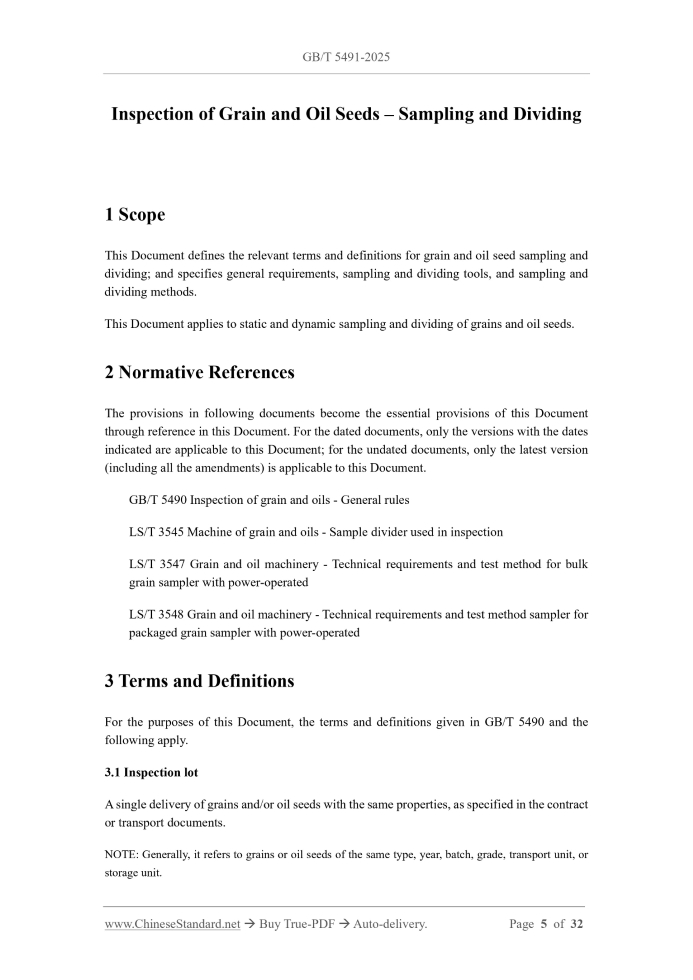
This Document defines the relevant terms and definitions for grain and oil seed sampling and dividing; and specifies general requirements, sampling and dividing tools, and sampling and dividing methods. This Document applies to static and dynamic sampling and dividing of grains and oil seeds.2 Normative References
The provisions in following documents become the essential provisions of this Document through reference in this Document. For the dated documents, only the versions with the dates indicated are applicable to this Document; for the undated documents, only the latest version (including all the amendments) is applicable to this Document. GB/T 5490 Inspection of grain and oils - General rules LS/T 3545 Machine of grain and oils - Sample divider used in inspection LS/T 3547 Grain and oil machinery - Technical requirements and test method for bulk grain sampler with power-operated LS/T 3548 Grain and oil machinery - Technical requirements and test method sampler for packaged grain sampler with power-operated3 Terms and Definitions
For the purposes of this Document, the terms and definitions given in GB/T 5490 and the following apply. 3.1 Inspection lot A single delivery of grains and/or oil seeds with the same properties, as specified in the contract or transport documents. NOTE. Generally, it refers to grains or oil seeds of the same type, year, batch, grade, transport unit, or storage unit. 3.2 Inspection unit An inspection unit is defined within an inspection lot. 3.3 Sampling The process of obtaining representative samples using appropriate tools and prescribed methods. 3.4 Dividing The process of selecting appropriate tools, thoroughly mixing the aggregated sample; and then progressively reducing it to obtain the submitted sample, the retained sample, the laboratory sample, and the test sample. 3.5 Static sampling The sampling process when the object under test is in a static state. 3.6 Dynamic sampling The sampling process when the object under test is in a dynamic state.4 General Requirements
4.1 Sampling and dividing shall include the following steps, as detailed in Appendix A. --- Develop a sampling plan; --- Collect a sufficient number of spot samples to form an aggregated sample; --- Mix the aggregated sample; --- Reduce the aggregated sample to submitted samples, retained samples, and laboratory samples according to the prescribed dividing method. 4.2 Ensure that the used instruments or equipment are clean and free from contamination; and prevent sample contamination during the sampling process. 4.3 The entire sampling process shall be completed in the shortest possible time; and the collected samples shall be placed in a clean sample container (5.5). 4.4 Appropriate sampling devices and dividing methods shall be selected based on the actual condition of the object under test (its own condition and environmental condition) and the test requirements. See Appendix B for a legend of a static grain sampling device. See Appendix C for a legend of a dynamic grain sampling device. See Appendix D for a legend of a dividing device. 4.5 If any localized dampness, condensation, heat, clumping, obvious mold, obvious insect infestation, or abnormal color and odor are found before sampling, the grains and oil seeds in the areas with abnormal conditions shall be sampled separately.5 Sampling and Dividing Tools
5.1 Manual sampler 5.1.1 Manual sampler for packaged grains 5.1.1.1 Single-tube sampler for large grains Approximately 75 cm in total length, with a probe length of approximately 55 cm and a mouth width of 1.5 cm to 1.8 cm. The top is pointed or duckbill-shaped, with an outer diameter of 1.7 cm to 2.2 cm. Suitable for sampling large grains such as corn and soybeans; see B.1. 5.1.1.2 Single-tube sampler for small and medium-sized grains Approximately 70 cm in total length, with a probe length of approximately 45 cm, a mouth width of approximately 1 cm. The top is pointed, with an outer diameter of approximately 1.5 cm. Suitable for sampling small and medium-sized grains such as wheat, paddy rice, rice, millet, mung beans, red beans, and rapeseed; see B.1. 5.1.1.3 Single-tube sampler for powdered grains Approximately 55 cm in total length, with a probe length of approximately 35 cm, a mouth width of approximately 0.6 cm ~ 0.7 cm. The top is pointed, with an outer diameter of approximately 1 cm. Suitable for sampling powdered grains such as wheat flour and corn flour; see B.1. 5.1.2 Manual samplers for bulk grains 5.1.2.1 Thin-walled sleeve sampler Available in three total lengths. 1 m, 2 m, and 4 m. It has three inlet holes, each approximately 15 cm long and 1.5 cm wide at the opening, with a top length of approximately 7 cm and an outer diameter of approximately 2.2 cm. Suitable for sampling bulk grains such as wheat and paddy rice; see B.2.1. 5.1.2.2 Thick-walled sleeve sampler Available in three total lengths. 1 m, 2 m, and 4 m. It has three inlet holes, each approximately 15 cm long and 1.8 cm wide at the opening, with a top length of approximately 7 cm and an outer diameter of approximately 2.8 cm. Suitable for sampling bulk grains such as corn and soybeans; see B.2.1. 5.1.2.3 Ellis cup sampler Made of lightweight aluminum, used for sampling from a grain stream running on a conveyor belt; see C.4. 5.1.2.4 Sampling shovel It is mainly used for sampling or bag dumping sampling of mobile grains and oil seeds, and extra-large grains and oil seeds. 5.2 Electric sampler 5.2.1 Fixed automatic grain sampler It is composed of a sampling rod, rotating arm, moving device, column, grain conveying pipe, negative pressure vacuum system, and electrical control system, etc. It is mainly used for automatic sampling of packaged or bulk grains in uncovered transport vehicles; the sampling port of the sampling rod shall be able to reach any position of the grain on the vehicle; see B.2.2. 5.2.2 Mobile electric suction grain sampler It is composed of a multi-hole end tube, sampling head, connector, sampling tube, discharge gate, storage box, vacuum chamber, hose, etc. It is designed and manufactured based on the negative pressure principle; and shall meet the requirements for deep bulk grain sampling; see B.2.3. When sampling by using this type of sampler, if the impurity content of the sample is greater than 1.0%, and relevant parties raise objections to the test results, the sampler described in 5.1 or 5.2.3 shall be used to resample and test the impurity content, or the relevant parties shall negotiate and confirm the requirements for correcting the impurity content test results. 5.2.3 Mobile electric bulk grain sampler It is composed of a motor, a negative pressure vacuum system, a handle, a grain suction port, a sampling connecting rod (outer tube), and a connecting sampling bucket (inner tube), etc. It shall comply with the provisions of LS/T 3547; see B.2.4. 5.2.4 Mobile electric suction packaged grain sampler It is composed of a machine head, filter screen, buffer sample collector, handle, sample dispensing port, sample connecting rod, sample receiving cup, and grain suction port, etc. It shall comply with the provisions of LS/T 3548; see B.2.5. 5.3 Sample divider It includes sample dividing plates, bell-shaped sample dividers, Riffle sample dividers, Canadian-style sample dividers, automatic sample dividers, etc.; see Appendix D. 5.4 Sample dividing cloth or padding The sample dividing cloth can be a thicker plastic sheet or other fabric. The padding material can be a smooth, flat wooden board or glass plate, etc. 5.5 Sample containers The commonly used containers include sample tubes, sample bags, sample bottles, etc.6 Sampling Methods
6.1 Representative quantity of inspection units 6.1.1 Bulk grains and oil seeds Generally, an inspection unit is defined as no more than 500 tons. For large ships, an inspection unit is defined as no more than 1,000 tons. For large flat warehouses and round silos, an inspection unit is defined as no more than 2,000 tons (this may be increased by no more than 15% if necessary, depending on the actual storage quantity). For extra-large grains and oil seeds (peanuts, peanut kernels, sunflower seeds, castor seeds, broad beans, sweet potato chips, etc.), an inspection unit is generally defined as no more than 100 tons. 6.1.2 Packaged grains and oil seeds Generally, an inspection unit is defined as no more than 500 tons. 6.1.3 Inspection lot An inspection lot may have one or more inspection units. For lots exceeding those specified in 6.1.1 and 6.1.2, the number of inspection units shall be increased accordingly. For round silos exceeding 2,000 tons, generally increase by no more than four inspection units. The inspection results for the entire silo or entire cargo location can be expressed as a weighted average of the inspection data from all inspection units when all inspection units meet the requirements. 6.2 Sampling type Based on the state of the grain or oil seed, sampling is divided into static sampling and dynamic sampling. Bulk grains and oil seeds can use either static or dynamic sampling, while packaged grains and oil seeds can use static sampling. 6.3 Static sampling method for bulk grain and oil seeds 6.3.1 Sampling of bulk grain and oil seeds by vehicles, ships, and warehouses 6.3.1.1 Large, medium, and small grains and oil seeds ......Source: Above contents are excerpted from the full-copy PDF -- translated/reviewed by: www.ChineseStandard.net / Wayne Zheng et al.