GB/T 44830-2024 English PDF
Price & Delivery
US$215.00 · In stock · Download in 9 secondsGB/T 44830-2024: General rules for determination of enzyme-linked immunosorbent assay kit
Delivery: 9 seconds. True-PDF full-copy in English & invoice will be downloaded + auto-delivered via email. See step-by-step procedure
Status: Valid
| Standard ID | USD | BUY PDF | Delivery | Standard Title (Description) | Status |
| GB/T 44830-2024 | 215 | Add to Cart | Auto, 9 seconds. | General rules for determination of enzyme-linked immunosorbent assay kit | Valid |
Click to Preview this PDF
Similar standards
GB/T 44830-2024: General rules for determination of enzyme-linked immunosorbent assay kit
---This is an excerpt. Full copy of true-PDF in English version (including equations, symbols, images, flow-chart, tables, and figures etc.), auto-downloaded/delivered in 9 seconds, can be purchased online: https://www.ChineseStandard.net/PDF.aspx/GBT44830-2024GB NATIONAL STANDARD OF THE PEOPLE’S REPUBLIC OF CHINA ICS 07.080 CCS A 40 General Rules for Determination of Enzyme-linked Immunosorbent Assay Kit Issued on: OCTOBER 26, 2024 Implemented on: OCTOBER 26, 2024 Issued by. State Administration for Market Regulation; Standardization Administration of the People’s Republic of China.
Table of Contents
Foreword... 3 1 Scope... 4 2 Normative References... 4 3 Terms and Definitions... 4 4 General Requirements... 4 5 Assay Procedures... 5 6 Result Report... 9 Appendix A (informative) Precision Evaluation Criteria within the Working Range. 10 Appendix B (informative) Consistency Evaluation with Reference Method... 12 Bibliography... 14 General Rules for Determination of Enzyme-linked Immunosorbent Assay Kit1 Scope
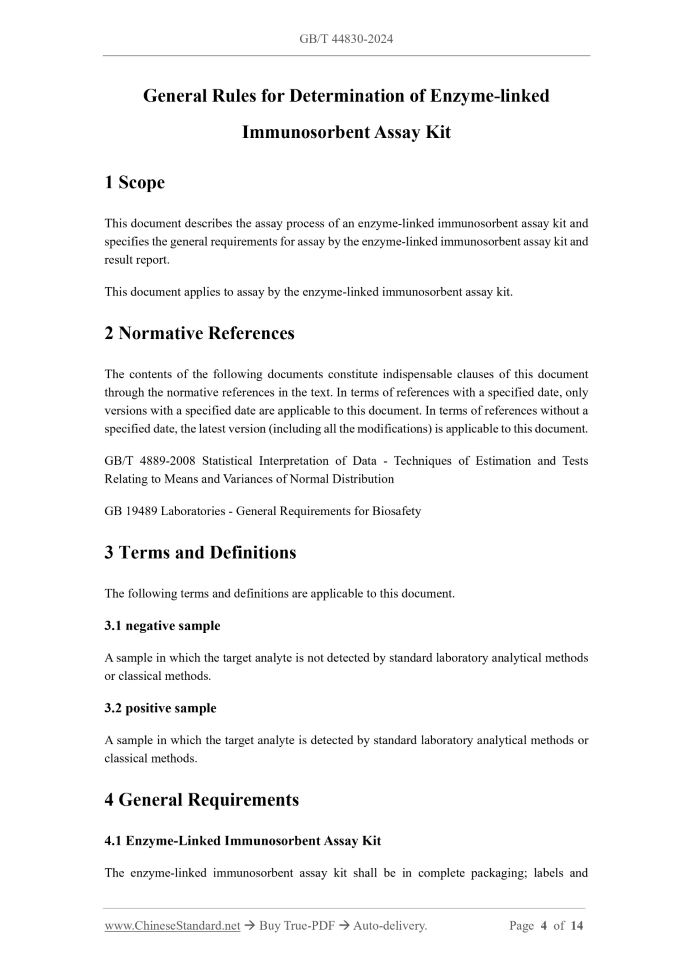
This document describes the assay process of an enzyme-linked immunosorbent assay kit and specifies the general requirements for assay by the enzyme-linked immunosorbent assay kit and result report. This document applies to assay by the enzyme-linked immunosorbent assay kit.2 Normative References
The contents of the following documents constitute indispensable clauses of this document through the normative references in the text. In terms of references with a specified date, only versions with a specified date are applicable to this document. In terms of references without a specified date, the latest version (including all the modifications) is applicable to this document. GB/T 4889-2008 Statistical Interpretation of Data - Techniques of Estimation and Tests Relating to Means and Variances of Normal Distribution GB 19489 Laboratories - General Requirements for Biosafety3 Terms and Definitions
The following terms and definitions are applicable to this document. 3.1 negative sample A sample in which the target analyte is not detected by standard laboratory analytical methods or classical methods. 3.2 positive sample A sample in which the target analyte is detected by standard laboratory analytical methods or classical methods.4 General Requirements
4.1 Enzyme-Linked Immunosorbent Assay Kit The enzyme-linked immunosorbent assay kit shall be in complete packaging; labels and markings shall be clear and standardized; an instruction manual or equivalent guidance document shall be attached, and the document shall include at least the following contents. a) Kit name; b) Scope of application. including the target analyte and applicable matrix range of assay; c) Assay principle; d) Kit composition, storage conditions and expiration date; e) Equipment and reagents required for tests; f) Operating instructions. including solution preparation, sample preparation, detailed assay procedures and result calculation; g) Precautions. including key operating points, safety tips, analysis and solutions to common problems. 4.2 Laboratory Laboratory biosafety management shall comply with the relevant requirements in GB 19489. 4.3 Assay Indicators Standard curve, limit of detection, precision, accuracy and cross-reactivity.5 Assay Procedures
5.1 Selection and Preparation of Assay Sample 5.1.1 Negative and positive samples shall have matrix compatibility and similarity to the actual sample in terms of components other than the target analyte. 5.1.2 Positive or negative samples should preferably use nationally certified matrix standard samples/standard substances, reference substances, or quality control materials. If these are unavailable, they can be prepared in-house. Appropriate laboratory standard analytical methods or classical methods shall be selected to determine the target analyte in the sample using instruments. Confirm that all negative samples are below the limit of detection and confirm the content of the target analyte in all positive samples. 5.1.3 Positive and negative samples, and samples to be tested shall all be pre-treated in accordance with the steps in the enzyme-linked immunosorbent assay kit’s instruction manual. 5.2 Reagent Preparation Remove the kit from the storage environment and allow it to equilibrate to room temperature (23 C 2 C). Then, operate in accordance with the enzyme-linked immunosorbent assay kit’s instruction manual. 5.3 Operating Procedures Each sample and standard solution shall be repeatedly determined at least twice, following the steps in the enzyme-linked immunosorbent assay kit’s instruction manual. 5.4 Result Calculation 5.4.1 Standard curve The standard curve consists of at least 6 concentrations. Operate in accordance with the enzyme-linked immunosorbent assay kit’s instruction manual, determine the absorbance value of each concentration, take the average value, and plot a four-parameter fitted standard curve or other specified standard curve. For accurate quantitative methods, the coefficient of determination (R²) of the linear regression equation shall be no less than 0.99. Use the absorbance value of the calibrator as the y-coordinate and the concentration of the calibrator as the x-coordinate to perform a four-parameter curve fitting, establish the equation in accordance with Formula (1), and calculate the correlation coefficient. Where, y---the absorbance value; d---the minimum absorbance value; a---the maximum absorbance value, upper asymptote of the fitted curve; X---the concentration of the calibrator; EC50---the median effect concentration; b---the absorbance increase rate parameter, i.e., the slope of the curve at EC50. Correlation coefficient calculation. the correlation coefficient is calculated using data statistical processing software. 5.4.2 Data calculation The determined concentration value of each sample is obtained by calculating the standard curve. If the absorbance value of the sample exceeds the range of the standard curve, then, it is diluted to an appropriate factor and re-perform the assay. The analytical result is the concentration obtained by the standard curve calculation multiplied by the dilution factor. ......Source: Above contents are excerpted from the full-copy PDF -- translated/reviewed by: www.ChineseStandard.net / Wayne Zheng et al.