GB/T 43753.2-2024 English PDF
Price & Delivery
US$585.00 · In stock · Download in 9 secondsGB/T 43753.2-2024: Methods for chemical analysis of precious metals alloys electroplating wastewater - Part 2: Determination of zinc, manganese, chromium, cadmium, lead, iron, aluminium, nickel, copper and beryllium contents - Inductively coupled plasma-atomic emission spec
Delivery: 9 seconds. True-PDF full-copy in English & invoice will be downloaded + auto-delivered via email. See step-by-step procedure
Status: Valid
| Standard ID | USD | BUY PDF | Delivery | Standard Title (Description) | Status |
| GB/T 43753.2-2024 | 585 | Add to Cart | Auto, 9 seconds. | Methods for chemical analysis of precious metals alloys electroplating wastewater - Part 2: Determination of zinc, manganese, chromium, cadmium, lead, iron, aluminium, nickel, copper and beryllium contents - Inductively coupled plasma-atomic emission spec | Valid |
Click to Preview this PDF
Similar standards
GB/T 43753.2-2024: Methods for chemical analysis of precious metals alloys electroplating wastewater - Part 2: Determination of zinc, manganese, chromium, cadmium, lead, iron, aluminium, nickel, copper and beryllium contents - Inductively coupled plasma-atomic emission spec
---This is an excerpt. Full copy of true-PDF in English version (including equations, symbols, images, flow-chart, tables, and figures etc.), auto-downloaded/delivered in 9 seconds, can be purchased online: https://www.ChineseStandard.net/PDF.aspx/GBT43753.2-2024
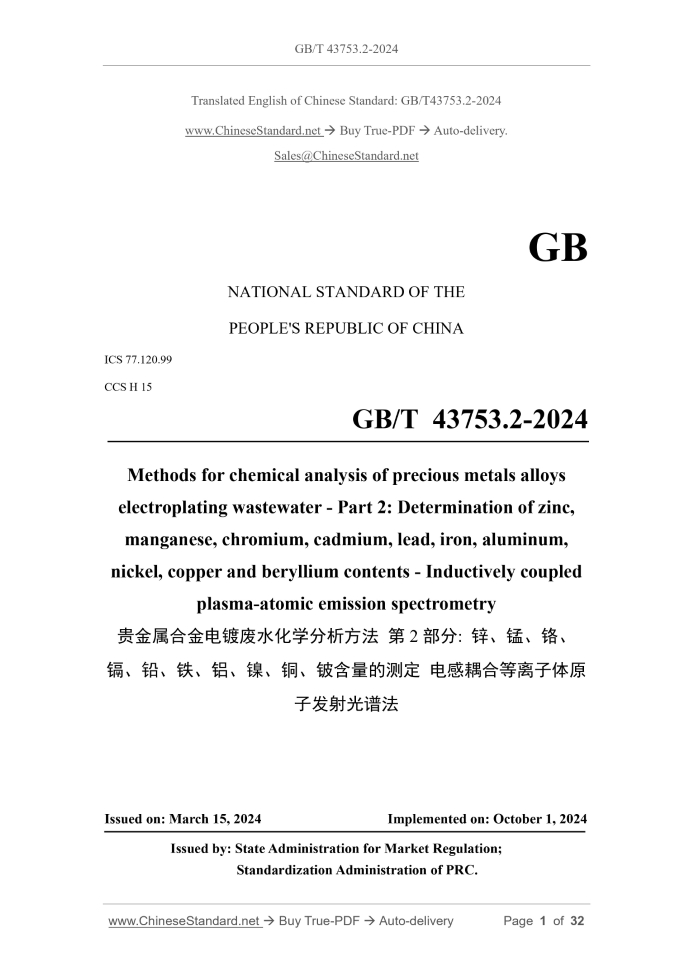
GB NATIONAL STANDARD OF THE PEOPLE'S REPUBLIC OF CHINA ICS 77.120.99 CCS H 15 Methods for chemical analysis of precious metals alloys electroplating wastewater - Part 2.Determination of zinc, manganese, chromium, cadmium, lead, iron, aluminum, nickel, copper and beryllium contents - Inductively coupled plasma-atomic emission spectrometry Issued on: MARCH 15, 2024 Implemented on: OCTOBER 1, 2024 Issued by. State Administration for Market Regulation; Standardization Administration of PRC.
Table of Contents
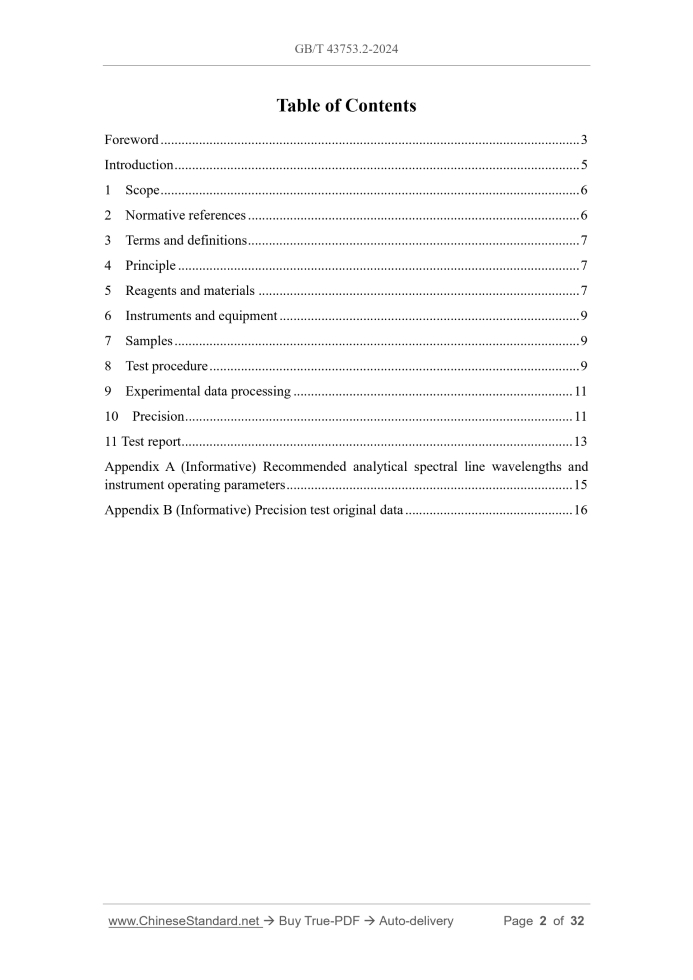
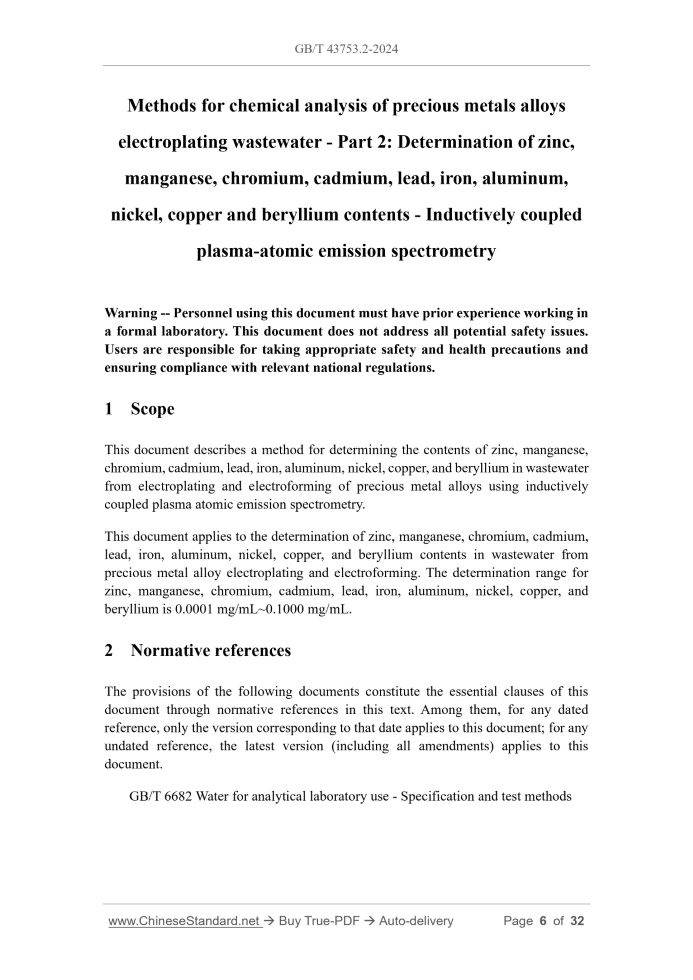
Foreword... 3 Introduction... 5 1 Scope... 6 2 Normative references... 6 3 Terms and definitions... 7 4 Principle... 7 5 Reagents and materials... 7 6 Instruments and equipment... 9 7 Samples... 9 8 Test procedure... 9 9 Experimental data processing... 11 10 Precision... 11 11 Test report... 13 Appendix A (Informative) Recommended analytical spectral line wavelengths and instrument operating parameters... 15 Appendix B (Informative) Precision test original data... 16 Methods for chemical analysis of precious metals alloys electroplating wastewater - Part 2.Determination of zinc, manganese, chromium, cadmium, lead, iron, aluminum, nickel, copper and beryllium contents - Inductively coupled plasma-atomic emission spectrometry Warning -- Personnel using this document must have prior experience working in a formal laboratory. This document does not address all potential safety issues. Users are responsible for taking appropriate safety and health precautions and ensuring compliance with relevant national regulations.1 Scope
This document describes a method for determining the contents of zinc, manganese, chromium, cadmium, lead, iron, aluminum, nickel, copper, and beryllium in wastewater from electroplating and electroforming of precious metal alloys using inductively coupled plasma atomic emission spectrometry. This document applies to the determination of zinc, manganese, chromium, cadmium, lead, iron, aluminum, nickel, copper, and beryllium contents in wastewater from precious metal alloy electroplating and electroforming. The determination range for zinc, manganese, chromium, cadmium, lead, iron, aluminum, nickel, copper, and beryllium is 0.0001 mg/mL~0.1000 mg/mL.2 Normative references
The provisions of the following documents constitute the essential clauses of this document through normative references in this text. Among them, for any dated reference, only the version corresponding to that date applies to this document; for any undated reference, the latest version (including all amendments) applies to this document. GB/T 6682 Water for analytical laboratory use - Specification and test methods3 Terms and definitions
This document does not contain any terms or definitions that need to be defined.4 Principle
After the organic matter in the test specimen is digested with perchloric acid, it is dissolved in a mixed acid. The contents of zinc, manganese, chromium, cadmium, lead, iron, aluminum, nickel, copper and beryllium are determined by inductively coupled plasma atomic emission spectrometry in the mixed acid medium.5 Reagents and materials
Unless otherwise specified, only reagents confirmed to be of analytical grade shall be used in the analysis. 5.1 Water, GB/T 6682, Grade II. 5.2 Perchloric acid (ρ=1.76 g/mL). 5.3 Nitric acid (ρ=1.42 g/mL). 5.4 Hydrochloric acid (ρ=1.18 g/mL). 5.5 Hydrogen peroxide (ρ=1.11 g/mL) 5.6 Nitric acid (1+1). 5.7 Hydrochloric acid (1+1). 5.8 Mixed acid (1+3+4). Mix 1 volume of nitric acid (5.3), 3 volumes of hydrochloric acid (5.4) and 4 volumes of water (5.1) thoroughly, and prepare fresh before use. 5.9 Zinc standard stock solution. Weigh 0.1000 g of metallic zinc (wZn≥99.99%) and place it in a 100 mL PTFE beaker. Add 20 mL of nitric acid (5.6), heat to dissolve, remove nitrogen oxides, cool to room temperature, transfer to a 100 mL plastic volumetric flask, and dilute to the mark with water (5.1). Mix well. 1 mL of this solution contains 1 mg of zinc. 5.10 Manganese standard stock solution. Weigh 0.1000 g of metallic manganese (wMn≥99.99%) and place it in a 100 mL PTFE beaker. Add 20 mL of nitric acid (5.6), heat to dissolve, remove nitrogen oxides, cool to room temperature, transfer to a 100 mL plastic volumetric flask, dilute to the mark with water (5.1), and mix well. 1 mL of this solution contains 1 mg of manganese. 5.11 Chromium standard stock solution. Weigh 0.1000 g of metallic chromium (wCr≥99.99%) and place it in a 100 mL PTFE beaker. Add 1 mL of nitric acid (5.6) and 5 mL of hydrochloric acid (5.7). Cover with a PTFE beaker lid, heat to dissolve, transfer to a 100 mL plastic volumetric flask, add 10 mL of hydrochloric acid (5.7), and dilute to the mark with water (5.1). Mix well. 1 mL of this solution contains 1 mg of chromium. 5.12 Cadmium standard stock solution. Weigh 0.1000 g of metallic cadmium (wCd≥99.99%) and place it in a 100 mL PTFE beaker. Add 20 mL of nitric acid (5.6), heat to dissolve, remove nitrogen oxides, cool to room temperature, transfer to a 100 mL plastic volumetric flask, and dilute to the mark with water (5.1). Mix well. 1 mL of this solution contains 1 mg of cadmium. 5.13 Lead standard stock solution. Weigh 0.1000 g of metallic lead (wPb≥99.99%) and place it in a 100 mL PTFE beaker. Add 20 mL of nitric acid (5.6), heat to dissolve, remove nitrogen oxides, cool to room temperature, transfer to a 100 mL plastic volumetric flask, and dilute to the mark with water (5.1). Mix well. 1 mL of this solution contains 1 mg of lead. 5.14 Iron standard stock solution. Weigh 0.1000 g of metallic iron (wFe≥99.99%) and place it in a 100 mL PTFE beaker. Add 20 mL of nitric acid (5.6), heat to dissolve, remove nitrogen oxides, cool to room temperature, transfer to a 100 mL plastic volumetric flask, and dilute to the mark with water (5.1). Mix well. 1 mL of this solution contains 1 mg of iron. 5.15 Aluminum standard stock solution. Weigh 0.1000 g of metallic aluminum (wAl≥99.99%) and place it in a 100 mL PTFE beaker. Add 20 mL of hydrochloric acid (5.7), heat to dissolve, cool to room temperature, transfer to a 100 mL plastic volumetric flask using hydrochloric acid (5.7), dilute to the mark with water (5.1), and mix well. 1 mL of this solution contains 1 mg of aluminum. 5.16 Nickel standard stock solution. Weigh 0.1000 g of metallic nickel (wNi≥99.99%) and place it in a 100 mL PTFE beaker. Add 20 mL of nitric acid (5.6), heat to dissolve, remove nitrogen oxides, cool to room temperature, transfer to a 100 mL plastic volumetric flask, and dilute to the mark with water (5.1). Mix well. 1 mL of this solution contains 1 mg of nickel. 5.17 Copper standard stock solution. Weigh 0.1000 g of metallic copper (wCu≥99.99%) and place it in a 100 mL PTFE beaker. Add 20 mL of nitric acid (5.6), heat to dissolve, remove nitrogen oxides, cool to room temperature, transfer to a 100 mL plastic volumetric flask, dilute to the mark with water (5.1), and mix well. 1 mL of this solution contains 1 mg of copper. 5.18 Beryllium standard stock solution. Weigh 0.1000 g of metallic beryllium (wBe≥99.95%) and place it in a 100 mL PTFE beaker. Add 20 mL of hydrochloric acid (5.7), heat until dissolved, cool to room temperature, transfer to a 100 mL volumetric flask, and dilute to the mark with water (5.1). Mix well. 1 mL of this solution contains 1 mg of beryllium. 5.19 Mixed standard solution of zinc, manganese, chromium, cadmium, lead, iron, aluminum, nickel, copper, and beryllium. Add 30 mL of hydrochloric acid (5.4) to a 200 mL plastic volumetric flask, transfer 2.00 mL of the standard stock solutions (5.9~5.18) each to the flask, dilute to the mark with water (5.1), and mix well. 1 mL of this solution contains 10 μg each of zinc, manganese, chromium, cadmium, lead, iron, aluminum, nickel, copper, and beryllium. 5.20 Argon (volume fraction≥99.99%).6 Instruments and equipment
Inductively coupled plasma atomic emission spectrometer. Under optimal operating conditions, any instrument meeting the following specifications can be used. a) Light source. Argon plasma light source, and the maximum output power of the emitter shall not be less than 1.3 kW. b) Resolution. The optical resolution at around 200 nm is no greater than 0.010 nm; the optical resolution at around 400 nm is no greater than 0.020 nm. c) Instrument stability. The instrument's stability (RSD) within 1 hour is no greater than 2.0%. d) Recommended operating parameters for the inductively coupled plasma atomic emission spectrometer are given in Appendix A.7 Samples
The samples are stored in plastic bottles for later use.8 Test procedure
8.1 Test specimens Transfer the sample accurately as shown in Table 1. ......Source: Above contents are excerpted from the full-copy PDF -- translated/reviewed by: www.ChineseStandard.net / Wayne Zheng et al.