GB/T 42923-2023 English PDF
Price & Delivery
US$165.00 · In stock · Download in 9 secondsGB/T 42923-2023: Glass-fibre-reinforced plastic products - Determination of fibre length
Delivery: 9 seconds. True-PDF full-copy in English & invoice will be downloaded + auto-delivered via email. See step-by-step procedure
Status: Valid
| Standard ID | USD | BUY PDF | Delivery | Standard Title (Description) | Status |
| GB/T 42923-2023 | 165 | Add to Cart | Auto, 9 seconds. | Glass-fibre-reinforced plastic products - Determination of fibre length | Valid |
Click to Preview this PDF
Similar standards
GB/T 42923-2023: Glass-fibre-reinforced plastic products - Determination of fibre length
---This is an excerpt. Full copy of true-PDF in English version (including equations, symbols, images, flow-chart, tables, and figures etc.), auto-downloaded/delivered in 9 seconds, can be purchased online: https://www.ChineseStandard.net/PDF.aspx/GBT42923-2023GB NATIONAL STANDARD OF THE PEOPLE’S REPUBLIC OF CHINA ICS 83.120 CCS Q 23 GB/T 42923-2023 / ISO 22314:2006 Glass-fiber-reinforced Plastic Products - Determination of Fiber Length (ISO 22314:2006, Plastics - Glass-fiber-reinforced Products - Determination of Fiber Length, IDT) ISSUED ON: AUGUST 6, 2023 IMPLEMENTED ON: MARCH 1, 2024 Issued by: State Administration for Market Regulation; Standardization Administration of the People’s Republic of China.
Table of Contents
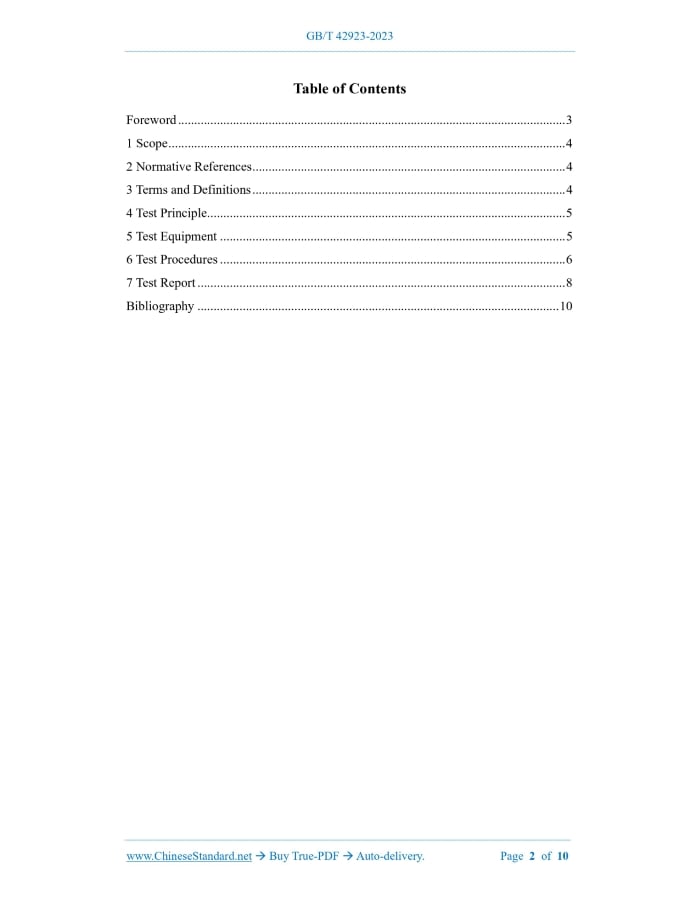
Foreword ... 3 1 Scope ... 4 2 Normative References ... 4 3 Terms and Definitions ... 4 4 Test Principle ... 5 5 Test Equipment ... 5 6 Test Procedures ... 6 7 Test Report ... 8 Bibliography ... 10 Glass-fiber-reinforced Plastic Products - Determination of Fiber Length1 Scope
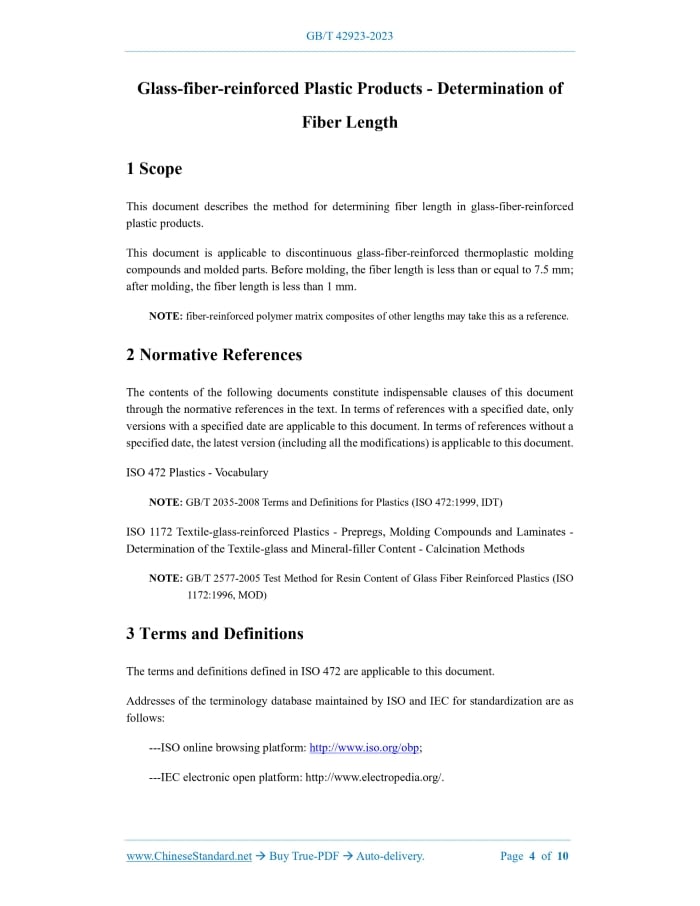
This document describes the method for determining fiber length in glass-fiber-reinforced plastic products. This document is applicable to discontinuous glass-fiber-reinforced thermoplastic molding compounds and molded parts. Before molding, the fiber length is less than or equal to 7.5 mm; after molding, the fiber length is less than 1 mm. NOTE: fiber-reinforced polymer matrix composites of other lengths may take this as a reference.2 Normative References
The contents of the following documents constitute indispensable clauses of this document through the normative references in the text. In terms of references with a specified date, only versions with a specified date are applicable to this document. In terms of references without a specified date, the latest version (including all the modifications) is applicable to this document. ISO 472 Plastics - Vocabulary NOTE: GB/T 2035-2008 Terms and Definitions for Plastics (ISO 472:1999, IDT) ISO 1172 Textile-glass-reinforced Plastics - Prepregs, Molding Compounds and Laminates - Determination of the Textile-glass and Mineral-filler Content - Calcination Methods NOTE: GB/T 2577-2005 Test Method for Resin Content of Glass Fiber Reinforced Plastics (ISO 1172:1996, MOD)3 Terms and Definitions
The terms and definitions defined in ISO 472 are applicable to this document. Addresses of the terminology database maintained by ISO and IEC for standardization are as follows: ---ISO online browsing platform: http://www.iso.org/obp; ---IEC electronic open platform: http://www.electropedia.org/.6 Test Procedures
6.1 Specimen Preparation Take a certain amount of sample from the calcined ash. Its fiber concentration is such that each image displayed on the screen contains approximately 100 fibers. The amount of sample depends on the fiber content and test conditions, especially the diameter of the crystallizing dish (since fibers are deposited on a horizontal plane, the water depth in the crystallizing dish has no effect on the concentration of fibers deposited on the glass slide). EXAMPLE: for a glass-fiber-reinforced polyamide composite material with a content of 30%, when using a crystallizing dish with a diameter of 90 mm, approximately 0.006 g of sample is required. NOTE 1: it is assumed that the fiber length is less than 1 mm. In accordance with the requirements of ISO 1172, at 625 C, calcinate the material for 1 hour and 30 minutes, then, cool it. NOTE 2: the obtained ash consists mainly of glass fibers and may also include mineral fillers. Since the fibers are extremely fragile, all subsequent treatment must be done with extreme care, so as to avoid breakage and invalid measurement results. NOTE 3: after cooling, transfer the ash in the crucible to a watch glass. NOTE 4: choose the material of an appropriate mass and size. If the material is not sufficiently calcined, properly extend the calcination time. Place the previously degreased glass slide into the crystallizing dish (5.2) and pour an appropriate amount of demineralized water (containing a small amount of surfactant) to cover the glass slide. In accordance with the mass and size of the fibers, determine the amount of water, so as to avoid the formation of convection currents during subsequent evaporation. Pour the ash in the watch glass onto the glass slide in the crystallizing dish (or use the tip of the scraper to transfer a sufficient amount of ash). Place the crystallizing dish containing the ash into the ultrasonic equipment to disperse the fibers without any mechanical action. The time required for dispersion ranges from a few seconds to one minute. NOTE 5: reasonably choose the power and frequency of the ultrasonic equipment, so as to avoid fiber breakage. Place the crystallizing dish into the oven (5.8) preheated to 130 C for about 1 h, so as to remove moisture. Then, let it cool. If heating causes fiber bonding, then, this step can be omitted. Place the crystallizing dish next to the microscope or stereoscope (5.4). Place the fiber-covered glass slide under the lens of a microscope or stereoscope. If necessary, wipe away all fibers from the bottom of the glass slide. 6.2 Calibration Use a reference scale to calibrate the system. It is recommended to use a calibration glass slide with a length of 1 mm or 1.5 mm. Calibrate by measuring the length of the calibration glass slide. In accordance with the method of measuring fiber length, use the mouse to click on both ends of the calibration glass slide, and compare the reading with the length of the calibration glass slide. The tolerance should be 0.01 mm. If necessary, increase the frequency of microscope calibration. 6.3 Examination and Measurement In the pattern of brightfield illumination or darkfield illumination (circular illumination), use reflected light or transmitted light to directly examine the fibers, and it is unnecessary to use coverslips or mounting fluid. Adjust the magnification area (optical and projection) to obtain an image magnified 50 ~ 100 on the screen. The magnification shall be such that (100 20) intact fibers can be displayed on the screen. Use the mouse to click on both ends of each fiber and manually measure the length of all intact fibers displayed on the screen. Adopt the method of manual measurement to respectively measure (100 20) fibers from three images and measure a total of (300 60) fibers. NOTE 1: this manual measurement method can be replaced by a semi-automatic measurement method. However, semi-automatic measurement method tends to measure fibers with a relatively small length, and the measurement results obtained will be systematically smaller than those obtained by the manual measurement method. NOTE 2: beyond the scope of this method, if relatively long fibers with a length not exceeding 5 mm are measures, as long as the quality of the optical system is good enough to obtain satisfying measurement data, then, the magnification can be reduced to 15 times. NOTE 3: if the measurement results of the three images are significantly different, then, increase the number of fibers for the measurement. 6.4 Result Expression The expression of the test results is as follows. ---The average fiber length is calculated in accordance with Formula (1): ......Source: Above contents are excerpted from the full-copy PDF -- translated/reviewed by: www.ChineseStandard.net / Wayne Zheng et al.