GB/T 40342-2021 English PDF
Price & Delivery
US$110.00 · In stock · Download in 9 secondsGB/T 40342-2021: Method for determination of aluminum content in hot dipped zinc-aluminum alloy coating on steel wire
Delivery: 9 seconds. True-PDF full-copy in English & invoice will be downloaded + auto-delivered via email. See step-by-step procedure
Status: Valid
| Standard ID | USD | BUY PDF | Delivery | Standard Title (Description) | Status |
| GB/T 40342-2021 | 110 | Add to Cart | Auto, 9 seconds. | Method for determination of aluminum content in hot dipped zinc-aluminum alloy coating on steel wire | Valid |
Click to Preview this PDF
Similar standards
GB/T 40342-2021: Method for determination of aluminum content in hot dipped zinc-aluminum alloy coating on steel wire
---This is an excerpt. Full copy of true-PDF in English version (including equations, symbols, images, flow-chart, tables, and figures etc.), auto-downloaded/delivered in 9 seconds, can be purchased online: https://www.ChineseStandard.net/PDF.aspx/GBT40342-2021
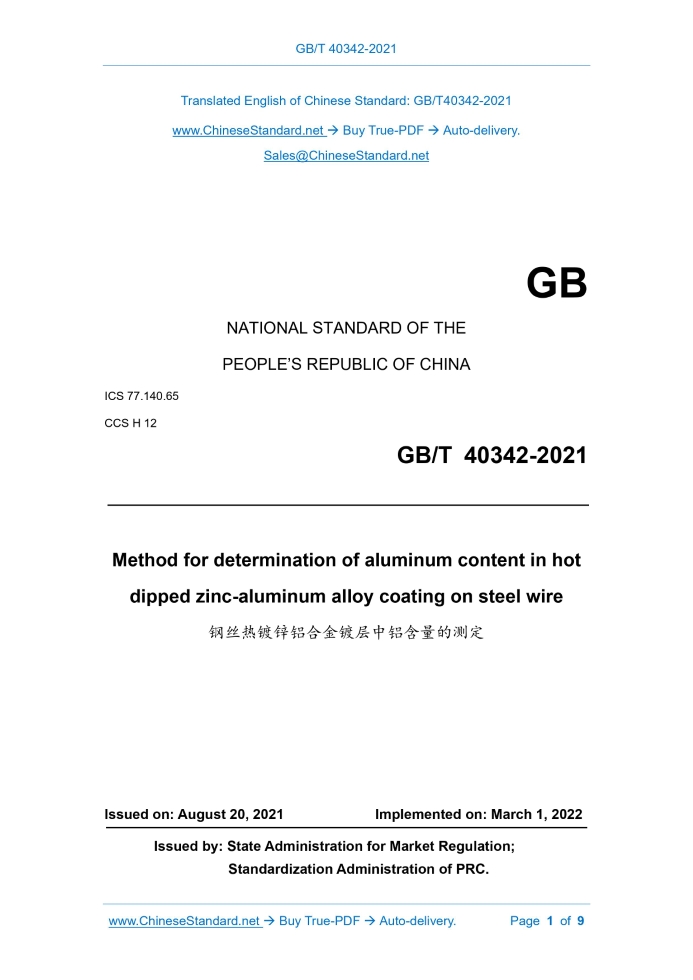
GB NATIONAL STANDARD OF THE PEOPLE’S REPUBLIC OF CHINA ICS 77.140.65 CCS H 12 Method for determination of aluminum content in hot dipped zinc-aluminum alloy coating on steel wire ISSUED ON: AUGUST 20, 2021 IMPLEMENTED ON: MARCH 1, 2022 Issued by: State Administration for Market Regulation; Standardization Administration of PRC.
Table of Contents
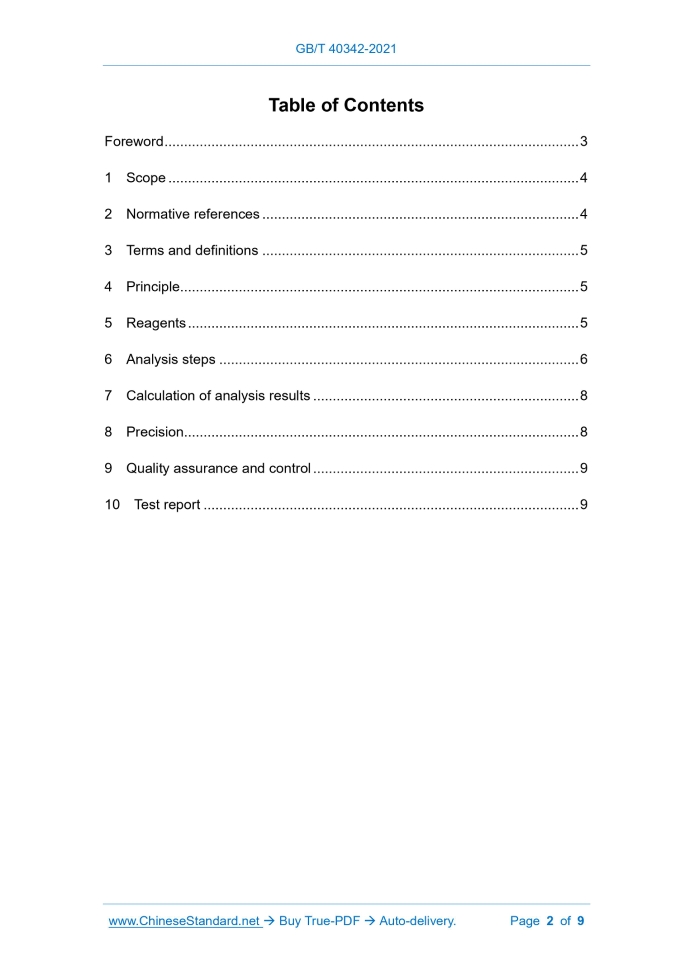
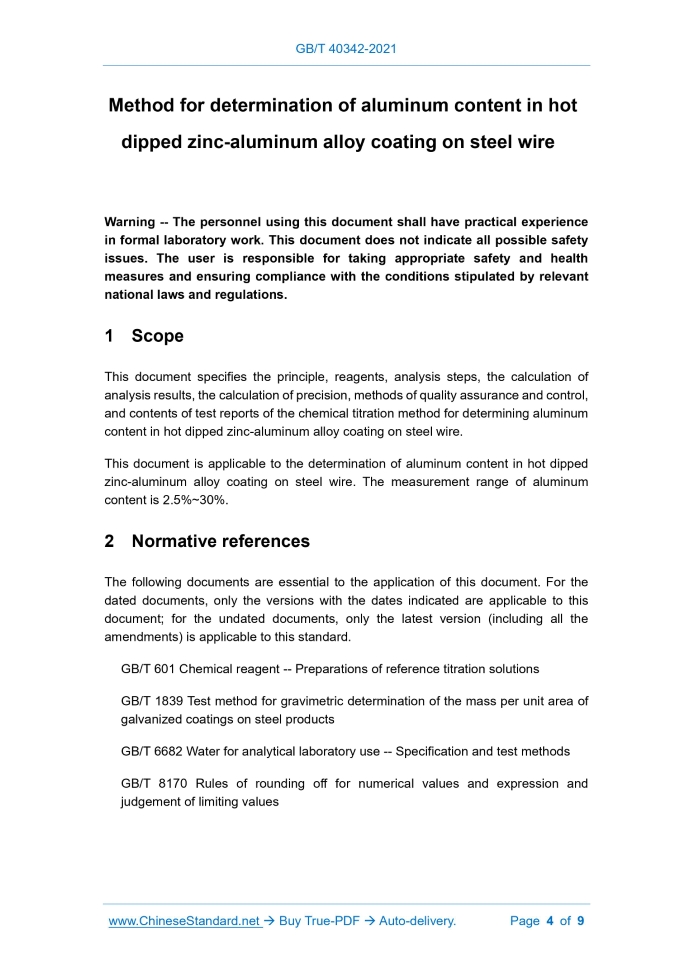
Foreword ... 3 1 Scope ... 4 2 Normative references ... 4 3 Terms and definitions ... 5 4 Principle... 5 5 Reagents ... 5 6 Analysis steps ... 6 7 Calculation of analysis results ... 8 8 Precision... 8 9 Quality assurance and control ... 9 10 Test report ... 9 Method for determination of aluminum content in hot dipped zinc-aluminum alloy coating on steel wire Warning -- The personnel using this document shall have practical experience in formal laboratory work. This document does not indicate all possible safety issues. The user is responsible for taking appropriate safety and health measures and ensuring compliance with the conditions stipulated by relevant national laws and regulations.1 Scope
This document specifies the principle, reagents, analysis steps, the calculation of analysis results, the calculation of precision, methods of quality assurance and control, and contents of test reports of the chemical titration method for determining aluminum content in hot dipped zinc-aluminum alloy coating on steel wire. This document is applicable to the determination of aluminum content in hot dipped zinc-aluminum alloy coating on steel wire. The measurement range of aluminum content is 2.5%~30%.2 Normative references
The following documents are essential to the application of this document. For the dated documents, only the versions with the dates indicated are applicable to this document; for the undated documents, only the latest version (including all the amendments) is applicable to this standard. GB/T 601 Chemical reagent -- Preparations of reference titration solutions GB/T 1839 Test method for gravimetric determination of the mass per unit area of galvanized coatings on steel products GB/T 6682 Water for analytical laboratory use -- Specification and test methods GB/T 8170 Rules of rounding off for numerical values and expression and judgement of limiting values3 Terms and definitions
There are no terms and definitions that need to be defined in this document.4 Principle
Add an excess of EDTA standard solution to the weakly acidic solution to form complexes with iron, zinc, copper and other elements. Then, in the presence of acetic acid, boil all aluminum to form a complex; use xylenol orange as an indicator; and use lead nitrate standard solution to back-titrate an excess of EDTA. Add fluoride to de- mask Al-EDTA; release the same amount of EDTA as aluminum; and titrate with lead nitrate standard titration solution; then, calculate the mass fraction of aluminum.5 Reagents
Unless otherwise specified, only use approved analytical reagents and above grade 3 distilled water that meets the requirements of GB/T 6682 or water of comparable purity. 5.1 Hydrochloric acid (1+1). 5.2 Ammonia (1+1). 5.3 Anhydrous potassium fluoride (KF, solid). 5.4 Deplating hydrochloric acid corrosion inhibitor: Weigh 7.5g of hexamethylenetetramine (C6H12N4) and dissolve it in 250 mL of hydrochloric acid (see 5.1); add 250 mL of water; mix well. 5.5 EDTA solution (c=0.05 mol/L): Weigh 20g of EDTA (Na2C10H14N2O8 • 2H2O) into a 500 mL beaker. After adding water to dissolve, transfer to a 1000mL volumetric flask; dilute to the mark with water; mix well. 5.6 Ammonium acetate solution (w=50%): Weigh 100g of ammonium acetate and dissolve in 100mL of water; mix well. 5.7 Acetic acid-sodium acetate buffer solution (pH=5.5): Weigh 200g of sodium acetate (CH3COONa • 3H2O); dissolve in water; and add 9mL of glacial acetic acid; then diluted with water to 1000mL. 5.8 Lead nitrate standard titration stock solution (c=0.05 mol/L): Weigh 17g of lead nitrate and dissolve it in 1000 mL of nitric acid solution (1+2000); shake well and set aside. Calibrate in accordance with the regulations of GB/T 601. 5.9 Lead nitrate standard titration solution (c=0.01 mol/L): dilute the lead nitrate7 Calculation of analysis results
Calculate the mass fraction of aluminum w Al according to formula (3): Where: w Al --- The mass fraction of aluminum; c --- The actual concentration of lead nitrate standard titration solution (see 5.9), in moles per liter (mol/L); V --- The volume of consumed lead nitrate standard titration solution (see 5.9) that is used for titration of released EDTA, the unit is milliliters (mL); M Al --- The molar mass of aluminum, 26.98g/mol; Δm --- The mass of the alloy after deducting the iron brought in when the sample is dissolved, in grams (g); 25/250 --- Dispensing rate. The result retains two decimal places and is rounded according to GB/T 8170.8 Precision
8.1 Repeatability The results of two independent tests under repeatability conditions shall be within the average range given below. The absolute difference between these two test results does not exceed the repeatability limit (r); and the probability of exceeding the repeatability limit (r) is not more than 5%. Calculate the repeatability limit (r) according to formula (4): Where: X --- The average of the two analysis results. ......Source: Above contents are excerpted from the full-copy PDF -- translated/reviewed by: www.ChineseStandard.net / Wayne Zheng et al.