GB/T 31970-2025 English PDF
Price & Delivery
US$305.00 · In stock · Download in 9 secondsGB/T 31970-2025: Performance requirements and bench test methods for air brake caliper assemblies of vehicles
Delivery: 9 seconds. True-PDF full-copy in English & invoice will be downloaded + auto-delivered via email. See step-by-step procedure
Status: Valid
GB/T 31970: Historical versions
| Standard ID | USD | BUY PDF | Delivery | Standard Title (Description) | Status |
| GB/T 31970-2025 | 305 | Add to Cart | Auto, 9 seconds. | Performance requirements and bench test methods for air brake caliper assemblies of vehicles | Valid |
| GB/T 31970-2015 | 90 | Add to Cart | Auto, 9 seconds. | Performance Requirements and Bench Test Methods for Air Brake Caliper Assemble of Automobile | Valid |
Click to Preview this PDF
Similar standards
GB/T 31970-2025: Performance requirements and bench test methods for air brake caliper assemblies of vehicles
---This is an excerpt. Full copy of true-PDF in English version (including equations, symbols, images, flow-chart, tables, and figures etc.), auto-downloaded/delivered in 9 seconds, can be purchased online: https://www.ChineseStandard.net/PDF.aspx/GBT31970-2025
GB NATIONAL STANDARD OF THE PEOPLE’S REPUBLIC OF CHINA ICS 43.040.40 CCS T 24 Replacing GB/T 31970-2015 Performance requirements and bench test methods for air brake caliper assemblies of vehicles Issued on: AUGUST 29, 2025 Implemented on: MARCH 01, 2026 Issued by. State Administration for Market Regulation; Standardization Administration of the People's Republic of China.
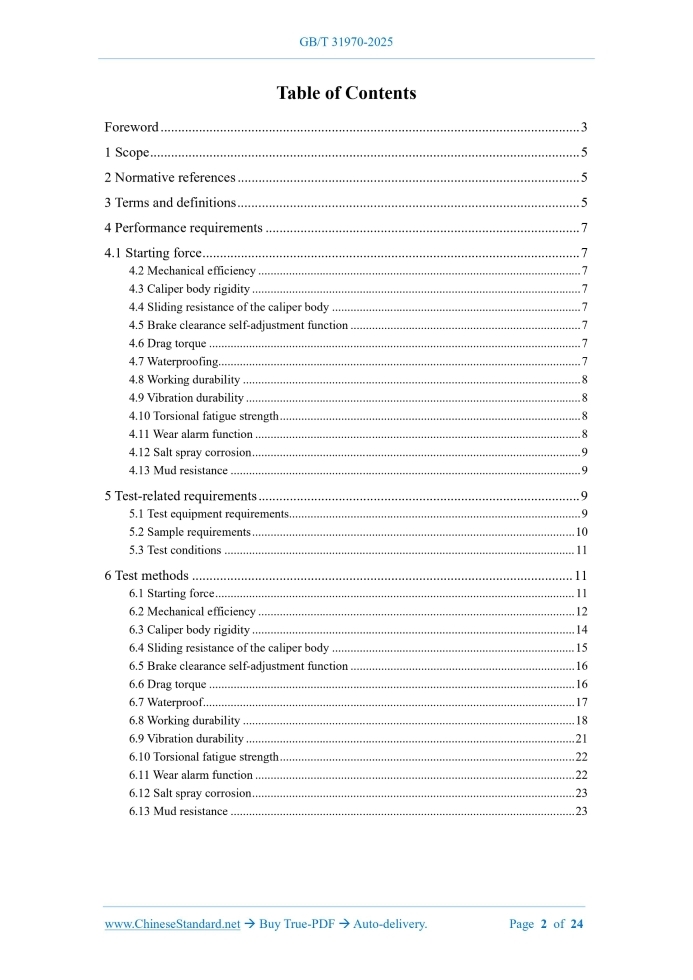
Table of Contents
Foreword... 3 1 Scope... 5 2 Normative references... 5 3 Terms and definitions... 5 4 Performance requirements... 7 4.1 Starting force... 7 4.2 Mechanical efficiency... 7 4.3 Caliper body rigidity... 7 4.4 Sliding resistance of the caliper body... 7 4.5 Brake clearance self-adjustment function... 7 4.6 Drag torque... 7 4.7 Waterproofing... 7 4.8 Working durability... 8 4.9 Vibration durability... 8 4.10 Torsional fatigue strength... 8 4.11 Wear alarm function... 8 4.12 Salt spray corrosion... 9 4.13 Mud resistance... 9 5 Test-related requirements... 9 5.1 Test equipment requirements... 9 5.2 Sample requirements... 10 5.3 Test conditions... 11 6 Test methods... 11 6.1 Starting force... 11 6.2 Mechanical efficiency... 12 6.3 Caliper body rigidity... 14 6.4 Sliding resistance of the caliper body... 15 6.5 Brake clearance self-adjustment function... 16 6.6 Drag torque... 16 6.7 Waterproof... 17 6.8 Working durability... 18 6.9 Vibration durability... 21 6.10 Torsional fatigue strength... 22 6.11 Wear alarm function... 22 6.12 Salt spray corrosion... 23 6.13 Mud resistance... 23 Performance requirements and bench test methods for air brake caliper assemblies of vehicles1 Scope
This document specifies the performance requirements, test-related requirements and describes the bench test methods for automotive pneumatic brake caliper assemblies. This document applies to floating pneumatic brake caliper assemblies (excluding brake chambers) whose working medium is compressed air.2 Normative references
The following referenced documents are indispensable for the application of this document. For dated references, only the edition cited applies. For undated references, the latest edition of the referenced document (including any amendments) applies. GB/T 5620, Road vehicles -- Vocabulary and definition for braking of automotive vehicles and their trailers GB/T 10125-2021, Corrosion tests in artificial atmospheres -- Salt spray tests QC/T 239, Specifications and bench test methods for commercial vehicle service brake QC/T 316, Automobile service brake fatigue strength bench test methods QC/T 556, Temperature measurement methods and thermocouple installation requirements for automobile brakes3 Terms and definitions
For the purposes of this document, the terms and definitions defined in GB/T 5620 as well as the followings apply. 3.1 clamp force The force acting on the axial end face of the brake disc between the two pad assemblies inside the caliper, when the brake caliper assembly is actuated by the control device Td When the brake caliper assembly is released, the remaining brake disc rotation resistance torque.4 Performance requirements
4.1 Starting force The starting force shall not exceed 100 N. 4.2 Mechanical efficiency The mechanical efficiency shall not be less than 92%. 4.3 Caliper body rigidity The total deformation of the caliper body along the center line of the push rod shall not be greater than 2 mm. 4.4 Sliding resistance of the caliper body The sliding resistance of the caliper body shall not be greater than 90 N. 4.5 Brake clearance self-adjustment function The total clearance between the pad assembly of the brake caliper assembly and the brake disc shall be maintained within the range of 0.6 mm ~ 1.2 mm. The difference in the brake clearance between the two pistons of a dual-piston brake caliper shall not exceed 0.2 mm. 4.6 Drag torque The drag torque shall not exceed 7 N·m. 4.7 Waterproofing There shall be no water stains on the surfaces of the internal components of the caliper, the guide pin holes, or the guide pin surfaces. 4.8 Working durability Conduct the test according to 6.8.During the test, the brake caliper assembly shall not be stuck or have any other abnormalities. The performance indicators after the test shall meet the following requirements. a) The caliper body and exposed non-metallic parts must be free of surface cracks or deformation that could affect function; b) The starting force must not exceed 110 N; c) The mechanical efficiency must not be less than 85%; d) The sliding resistance of the caliper body must not exceed 100 N; e) The brake clearance self-adjustment function must meet the requirements of 4.5. 4.9 Vibration durability When testing according to 6.9, the brake caliper assembly shall not have any damage, such as damage such as parts falling off or breakage that affects its function. 4.10 Torsional fatigue strength Carry out the test according to 6.10.During the test, the brake caliper assembly shall not show any signs of sticking or other phenomena. The performance indicators after the test shall meet the following requirements. a) The caliper body must be free of surface cracks or deformation that could affect its function; b) The pad assembly must be uniformly worn, free of penetrating cracks or extensive, severe damage; c) The caliper body's sliding resistance must not exceed 100 N; d) The brake clearance self-adjustment function must meet the requirements of 4.5. 4.11 Wear alarm function When the brake lining wear limit alarm is triggered, the minimum remaining thickness of the brake lining shall be 3 mm ± 1 mm. 4.12 Salt spray corrosion No corrosion products with a diameter greater than 2 mm shall be produced within any 100 cm2 area on the outer surface of the brake caliper body. The total corrosion area shall not exceed 5 cm2. 4.13 Mud resistance There shall be no mud accumulation in the sealed cavities of the caliper. The sliding resistance of the caliper shall not exceed 100 N. The brake clearance self-adjustment function shall meet the requirements of 4.5.5 Test-related requirements
5.1 Test equipment requirements 5.1.1 Test bench for basic brake caliper performance The rigidity of the simulated fixture used to measure clamp force in place of the brake disc and pad assembly must be no less than that of the actual vehicle's brake disc and pad assembly. The force transducer used for the caliper rigidity test must not deflect more than 0.1 mm under a 100 kN load. The simulated fixture must not affect the proper contact between the push disc and pad assembly. 5.1.2 Drag torque test bench The spindle speed on the test bench, where the brake disc is mounted, can be adjusted freely within the range of 0 r/min ~ 50 r/min. The system detection error of torque shall be within ±1.0% of the full scale. The resolution shall be no less than 0.1 N·m. The sampling frequency of speed and torque shall be no less than 50 Hz. 5.1.3 High and low temperature test chambers The error between the actual temperature of the test chamber and the set temperature shall be within ±2°C. The test chamber shall have a passage connecting the air pipe. It shall have sealing measures for heat insulation and moisture insulation. 5.1.4 Salt spray test chamber The salt spray test chamber shall meet the requirements of the neutral salt spray test in GB/T 10125-2021. 5.1.5 Brake inertia test bench 5.3 Test conditions 5.3.1 Unless otherwise specified, the test environment temperature is 23℃ ± 15℃. 5.3.2 During the test, the brake chamber selected shall be the brake chamber installed on the actual vehicle. For spring-loaded brake chambers, the energy storage spring shall be in a fully compressed state. 5.3.3 Before the drag torque and wear alarm function test, the end face runout measured 10 mm inward from the outer edge of the brake disc shall not exceed 0.2 mm.6 Test methods
6.1 Starting force 6.1.1 Install the sample on the caliper body bracket. Remove the liner assembly. Install the displacement sensor along the axis at the center of the push plate (see Figure 2). 6.1.2 Slowly apply load from the input end through the loading mechanism at a speed not exceeding 10 mm/min. When the displacement sensor value changes, retract the loading mechanism to unload until the force sensor value reaches zero. 6.1.3 Repeat step 6.1.2 twice, then reset the displacement sensor value to zero. 8 - Brake chamber; 9 - Pressure sensor; 10 - Electrically controlled directional valve; 11 - Electrically controlled proportional valve; 12 - Air source. Figure 4 -- Schematic diagram of clamp rigidity measurement 6.3.3 Install a micro displacement sensor or a suitable displacement meter to measure the total deformation of the sample caliper body in the direction of the push rod centerline. 6.3.4 Apply the brakes five times at the rated working pressure. The pressure holding time shall not be less than 5 seconds. The interval between two braking operations shall be 2 s ~ 3 s. 6.3.5 Clear the displacement sensor value to zero. 6.3.6 Slowly increase the air pressure at the brake chamber inlet from zero to the rated operating pressure. Maintain this pressure for 5 s. Record the total deformation of the sample along the centerline of the push rod. NOTE. For samples with two or more push rods, the total deformation along the centerline of each push rod can be measured simultaneously. The maximum value is taken as the total deformation of the caliper body along the centerline of the push rod for that sample. 6.4 Sliding resistance of the caliper body 6.4.1 Install the sample on the caliper bracket (see Figure 4) to simulate the actual vehicle state, without installing the brake chamber, brake disc, pad assembly and related parts such as compression spring and pressure plate. 6.4.2 Manually push and pull the caliper body forward and backward three times along the axial direction of the brake caliper guide pin, and finally stop at the initial position. 6.4.3 Place a push-pull force gauge at the center of the outer rear end of the pliers. Push the pliers 20 mm along the centerline of the push rod at a speed no greater than 10 mm/s. Record the maximum thrust. 6.4.4 Use a push-pull dynamometer equipped with a hook. Hook the inner side of the caliper. Pull the caliper 20 mm in the opposite direction along the centerline of the push rod at a speed no greater than 10 mm/s. Record the maximum pulling force. 6.4.5 Take the maximum value of 6.4.3 and 6.4.4 as the sliding resistance of the caliper body. NOTE. For fixed brake caliper assemblies, this item is not applicable. 6.5 Brake clearance self-adjustment function 6.5.1 Sample installation is the same as 6.3.1. 6.5.2 Use simulated brake disc I (its rigidity and thickness shall be as close as possible to those of the actual vehicle brake disc) to replace the brake disc. 6.5.3 Return the pad assembly of the sample. Adjust the total clearance between the friction surface of the pad assembly and the brake disc to 2.0 mm ~ 2.2 mm. 6.5.4 Perform 50 braking operations at 0.25 times the rated working pressure and a pressure increase/decrease rate of 1.5 MPa/s ± 0.3 MPa/s. The pressure hold time shall not be less than 5 s. The interval between braking operations shall be 2 s ~ 3 s. 6.5.5 After the last brake release, manually push the rear end of the caliper body to bring the outer pad assembly into contact with the brake disc. Select an appropriate feeler gauge and insert it into the gap between the inner pad assembly backplate and the push disc. Insert the feeler gauge to a depth that extends through the pad assembly height. Record the maximum thickness of the feeler gauge that can be inserted; this is the brake clearance. For dual-piston brake caliper assembly samples, measure the brake clearance at each piston. Calculate the difference in brake clearance between the two pistons. 6.5.6 Replace the sample with a simulated brake disc II made of the same material and 1.3 mm ~ 1.5 mm thinner than the simulated brake disc I. The positional relationships and dimensions of the other parts of the sample remain unchanged. 6.5.7 Repeat 6.5.4 and 6.5.5. 6.6 Drag torque 6.6.1 Install the sample on the drag torque test bench (see Figure 5) to simulate the actual vehicle state. 6.6.2 Clean the friction surfaces of the brake disc and pad assembly. ......Source: Above contents are excerpted from the full-copy PDF -- translated/reviewed by: www.ChineseStandard.net / Wayne Zheng et al.