GB/T 27403-2026 (GB/T 27403-2008) English PDF
Price & Delivery
US$515.00 · In stock · Download in 9 secondsGB/T 27403-2008: Criterion on quality control of laboratories -- Molecular biological testing of food
Delivery: 9 seconds. True-PDF full-copy in English & invoice will be downloaded + auto-delivered via email. See step-by-step procedure
Status: Valid
GB/T 27403: Historical versions
| Standard ID | USD | BUY PDF | Delivery | Standard Title (Description) | Status |
| GB/T 27403-2026 | 739 | Add to Cart | 6 days | Criterion on quality control of laboratories - Molecular biological testing of food | Valid |
| GB/T 27403-2008 | 515 | Add to Cart | Auto, 9 seconds. | Criterion on quality control of laboratories -- Molecular biological testing of food | Valid |
Click to Preview this PDF
Similar standards
GB/T 27403-2008: Criterion on quality control of laboratories -- Molecular biological testing of food
---This is an excerpt. Full copy of true-PDF in English version (including equations, symbols, images, flow-chart, tables, and figures etc.), auto-downloaded/delivered in 9 seconds, can be purchased online: https://www.ChineseStandard.net/PDF.aspx/GBT27403-2008
GB NATIONAL STANDARD OF THE PEOPLE’S REPUBLIC OF CHINA ICS 03.120.10 A 00 Criterion on quality control of laboratories -- Molecular biological testing of food Issued on: MAY 04, 2008 Implemented on: OCTOBER 01, 2008 Issued by. General Administration of Quality Supervision, Inspection and Quarantine of the People's Republic of China; Standardization Administration of the People's Republic of China.
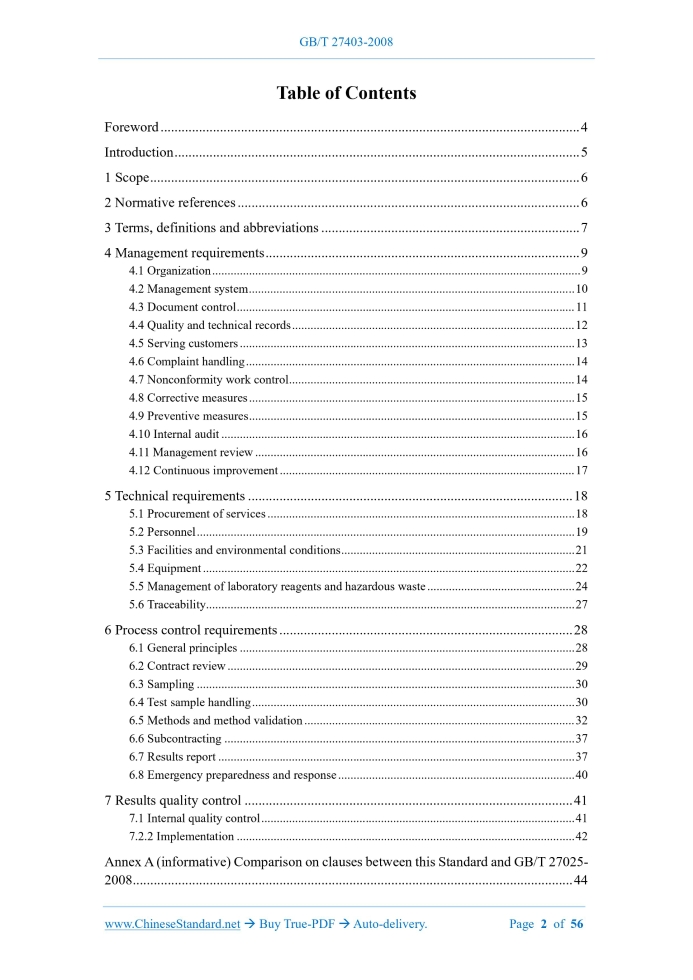
Table of Contents
Foreword... 4 Introduction... 5 1 Scope... 6 2 Normative references... 6 3 Terms, definitions and abbreviations... 7 4 Management requirements... 9 4.1 Organization... 9 4.2 Management system... 10 4.3 Document control... 11 4.4 Quality and technical records... 12 4.5 Serving customers... 13 4.6 Complaint handling... 14 4.7 Nonconformity work control... 14 4.8 Corrective measures... 15 4.9 Preventive measures... 15 4.10 Internal audit... 16 4.11 Management review... 16 4.12 Continuous improvement... 17 5 Technical requirements... 18 5.1 Procurement of services... 18 5.2 Personnel... 19 5.3 Facilities and environmental conditions... 21 5.4 Equipment... 22 5.5 Management of laboratory reagents and hazardous waste... 24 5.6 Traceability... 27 6 Process control requirements... 28 6.1 General principles... 28 6.2 Contract review... 29 6.3 Sampling... 30 6.4 Test sample handling... 30 6.5 Methods and method validation... 32 6.6 Subcontracting... 37 6.7 Results report... 37 6.8 Emergency preparedness and response... 40 7 Results quality control... 41 7.1 Internal quality control... 41 7.2.2 Implementation... 42 Annex A (informative) Comparison on clauses between this Standard and GB/T 27025- 2008... 44 Criterion on quality control of laboratories -- Molecular biological testing of food1 Scope
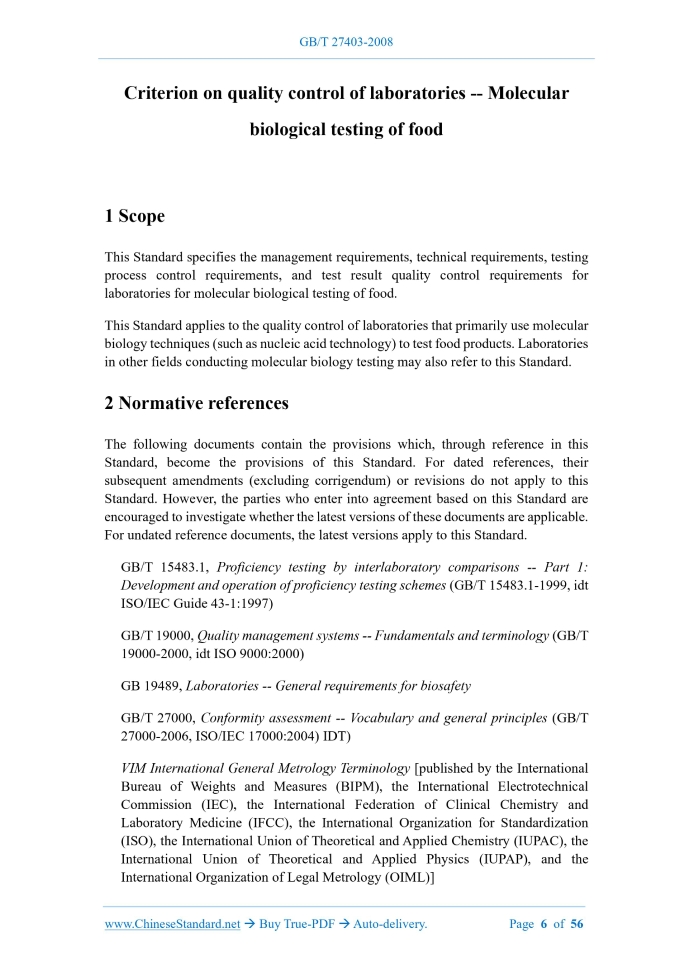
This Standard specifies the management requirements, technical requirements, testing process control requirements, and test result quality control requirements for laboratories for molecular biological testing of food. This Standard applies to the quality control of laboratories that primarily use molecular biology techniques (such as nucleic acid technology) to test food products. Laboratories in other fields conducting molecular biology testing may also refer to this Standard.2 Normative references
The following documents contain the provisions which, through reference in this Standard, become the provisions of this Standard. For dated references, their subsequent amendments (excluding corrigendum) or revisions do not apply to this Standard. However, the parties who enter into agreement based on this Standard are encouraged to investigate whether the latest versions of these documents are applicable. For undated reference documents, the latest versions apply to this Standard. GB/T 15483.1, Proficiency testing by interlaboratory comparisons -- Part 1. Development and operation of proficiency testing schemes (GB/T 15483.1-1999, idt ISO/IEC Guide 43-1.1997) GB/T 19000, Quality management systems -- Fundamentals and terminology (GB/T 19000-2000, idt ISO 9000.2000) GB 19489, Laboratories -- General requirements for biosafety GB/T 27000, Conformity assessment -- Vocabulary and general principles (GB/T 27000-2006, ISO/IEC 17000.2004) IDT) VIM International General Metrology Terminology [published by the International Bureau of Weights and Measures (BIPM), the International Electrotechnical Commission (IEC), the International Federation of Clinical Chemistry and Laboratory Medicine (IFCC), the International Organization for Standardization (ISO), the International Union of Theoretical and Applied Chemistry (IUPAC), the International Union of Theoretical and Applied Physics (IUPAP), and the International Organization of Legal Metrology (OIML)]3 Terms, definitions and abbreviations
3.1 Terms and definitions The terms and definitions defined in GB/T 19000, GB/T 27000 and VIM, as well as the following terms and definitions, apply to this Standard. NOTE. GB/T 19000 specifies general definitions related to quality. GB/T 27000 specifically specifies definitions related to certification and laboratory accreditation. If there are differences between the definitions given in GB/T 19000 and GB/T 27000 and VIM, the definitions in GB/T 27000 and VIM shall prevail. 3.1.1 molecular biological testing laboratories of food A laboratory that uses molecular biology techniques (such as nucleic acid technology) as its main means and food as its testing object. 3.1.2 top management of laboratory One person or group of people commanding and controlling the laboratory at the highest level. 3.1.3 management personnel of laboratory Personnel responsible for managing laboratory activities under the leadership of the laboratory's top manager. 3.1.4 laboratory competence The materials, environment, information resources, personnel, technology, and expertise required for the laboratory to conduct the corresponding tests. 3.1.5 sample One or more parts are taken from a whole and are intended to provide relevant information about the whole, usually serving as the basis for judging the whole. 3.1.6 testing report A document that provides test results and other relevant information regarding the test. 3.1.7 polymerase chain reaction; PCR This is a molecular biology experimental method for the in vitro enzymatic synthesis of specific DNA fragments. It mainly consists of a repeated thermal cycle of three steps. high-temperature denaturation, low-temperature annealing, and optimal-temperature extension. First, the template DNA is denatured into single strands at high temperature. Then, under the catalysis of DNA polymerase and at a suitable temperature, two primers4 Management requirements
4.1 Organization 4.1.1 Laboratories conducting molecular biological testing of food (hereinafter referred to as laboratories) or their affiliated organizations shall have a clear legal status. Laboratories are generally independent legal entities; laboratories that are not independent legal entities must be authorized by the legal entity. 4.1.2 Laboratory testing services shall meet the needs of clients and their organizations. 4.1.3 Laboratories shall comply with the relevant provisions of this Standard when conducting work in their fixed facilities or in external locations. 4.1.4 The top management of laboratory shall be responsible for the design, establishment, maintenance, and improvement of the organizational management system, including at least the following aspects. a) Staff the laboratory adequately. Provide all personnel with the necessary authority and resources to perform their duties; b) Establish policies and procedures to prevent institutions and individuals from becoming involved in any activities that could impair their judgment, technical expertise, honesty, or impartiality; c) Establish policies and procedures to ensure that clients' confidential information is protected; d) Clearly define the laboratory's organizational and management structure, as well as its relationship with other relevant institutions; e) Define the responsibilities, powers, and relationships among all personnel; f) Establish a technical management team to oversee technical operations (the head of the technical management team is also called the technical lead) and assign them corresponding responsibilities and authority. Appoint a quality lead, who shall be fully responsible for the operation of the quality system; g) Appoint a safety officer to be responsible for laboratory safety management, including the formulation, implementation and updating of laboratory safety measures (including biosafety measures), daily safety maintenance, and safety knowledge training; h) Personnel familiar with the purpose, procedures, operation, and result evaluation of testing shall provide appropriate training and supervision to other laboratory personnel based on their experience, ability, and responsibilities. The top manager shall directly appoint and manage quality supervisors; i) Appoint a proxy for key personnel. In some small laboratories, one person may assume multiple responsibilities. 4.1.5 Top management, technical leaders, quality managers, and other key quality personnel may authorize capable individuals to exercise their respective powers in specialized laboratories. 4.1.6 The top management of laboratory, technical director, quality director, and heads of various specialized laboratories shall have appointment documents. 4.2 Management system 4.2.1 Policies, processes, plans, procedures, guidelines, and operating procedures shall all be documented and communicated to all relevant personnel. It shall be ensured that relevant personnel are familiar with, understand, and implement them. 4.2.2 The management system shall include internal quality control and external quality review. 4.2.3 Top management shall organize the development of quality policies, objectives, and commitments, document them, and include them in the quality manual. Top management or the quality manager shall communicate the quality policy and objectives to all employees. The quality policy, objectives, and commitments shall be concise, clear, and easily accessible to relevant personnel. They shall also be made known to customers. They shall include the following. a) Scope of services provided by the laboratory; b) Commitment to service standards; c) Clarification of the laboratory's quality management level and technical objectives; d) Requirements for relevant personnel to be familiar with, understand, and implement quality documents;5 Technical requirements
5.1 Procurement of services 5.1.1 Laboratories shall establish policies and procedures for selecting and procuring services and supplies that affect the quality of testing. NOTE. Services include. calibration (verification) services; design, installation, and commissioning of facilities and environmental conditions. Supplies include. testing equipment, auxiliary equipment, reagents, consumables, etc. Equipment procurement is detailed in 5.4. 5.1.2 Laboratories shall periodically evaluate suppliers of essential supplies and services that significantly impact testing quality. Evaluations shall take into account changes in experimental needs and product quality. Laboratories shall maintain evaluation records and lists of qualified suppliers. Update these records promptly. 5.1.3 In procurement documents for items that affect the quality of test results, the laboratory shall describe the purchased items. The technical content of these procurement documents shall be reviewed and approved before issuance. NOTE. This description may include model, type, grade, concentration, specifications, quality requirements, and management system standards for the production of the purchased items. 5.1.4 The laboratory shall accept all purchased services and supplies that affect the quality of testing. They may only be put into normal use after being tested or otherwise demonstrated to comply with the relevant testing methods and requirements. The laboratory shall maintain records of all conformity checks conducted. NOTE 1.Reagents that affect the quality of molecular biology assays include (but are not limited to). a) Reagent kits (e.g., nucleic acid extraction kits, PCR premixed master reaction solutions, reverse transcription kits, etc.); b) Enzymes (e.g., thermostable DNA polymerases, restriction endonucleases, lysozymes, and proteinase K, etc.); c) Primers and probes; d) dNTPs. NOTE 2.When appropriate, the supplier’s declaration of conformity for its management system may also serve as verification documentation. 5.1.5 Laboratories shall provide appropriate storage locations and conditions based on the biological and safety characteristics of the supplies that affect the quality of testing, so as to ensure their quality during storage. 5.1.6 Laboratories shall register and label any purchased supplies that may affect the quality of testing. Labeling shall include the expiration date and opening date. 5.2 Personnel 5.2.1 The laboratory shall have sufficient human resources to meet the needs of molecular biological testing of food and operation management system. 5.2.2 The laboratory shall define the qualifications and job responsibilities of all personnel (management, technical, and support staff), and specify the objectives and performance evaluation standards for each position. A detailed description of the job content for each position shall be provided, documented, and updated regularly. 5.2.3 The laboratory shall ensure the competence of all personnel operating specialized equipment, performing molecular biology testing, evaluating results, and signing testing reports. Where laws and regulations require specific training and skills for certain positions, these requirements shall be met. Personnel performing specific tasks, such as PCR or microarray testing, shall be qualified based on their relevant education, training, experience, and/or demonstrable skills. When using employees who are undergoing training, appropriate supervision shall be provided. NOTE. Personnel providing opinions and interpretations on testing reports, in addition to possessing the relevant qualifications, training, experience, and sufficient knowledge of the tests conducted, must also have. a) Knowledge of the materials, composition, and production of the tested objects, such as the foreign genes introduced into different strains of transgenic crops; b) Knowledge of the general requirements as set forth in regulations and standards; c) Understanding the extent of the impact of abnormal situations occurring in the testing object and testing process. 5.2.4 The laboratory shall establish policies and procedures for personnel training. Training needs shall be identified and corresponding training plans developed. Circumstances such as pregnancy, immunodeficiency, and physical disability shall be appropriately considered. The plan shall be aligned with the laboratory's current and anticipated tasks. The effectiveness of training (including the trainees' ability to perform assigned tasks) shall be evaluated. If necessary, retraining and re-evaluation may be conducted. Personnel training shall include, but is not limited to, the following aspects (where applicable). a) General knowledge of laboratory safety, including fire safety knowledge and fire prevention procedures; b) Procedures for transporting and storing experimental samples; c) Professional theories and operational techniques involved in the experiment; d) Testing methods; e) Laboratory biosafety knowledge, including the hazard level and safety protection knowledge of the objects being tested, especially the safety procedures for handling biological materials, chemicals, and radioactive materials, as well as the selection and use of personal protective equipment; f) f) Correct evaluation on experimental results; g) Equipment maintenance and use; h) Response and handling of emergency situations in the laboratory, including the prevention and handling of leaks and spills of biological materials and biochemical reagents, procedures for handling personnel injuries, and personnel evacuation procedures; i) Waste disposal procedures; j) Internal and external quality control in the laboratory; k) Specialized training in quality management for laboratories for molecular biological testing of food; l) Staff ethical standards (such as impartiality, honesty, confidentiality, etc.). 5.2.5 Laboratories shall employ long-term or contracted staff. When employing contracted staff and other technical and key support personnel, laboratories shall ensure that these personnel are competent to perform molecular biology testing, are subject to supervision, and work in accordance with the requirements of the laboratory management system. 5.2.6 Laboratories shall provide relevant scientific and technological literature or access methods for technical personnel as much as possible so that staff can keep abreast of the latest domestic and international information on molecular biological testing of food and related technologies. 5.2.7 Laboratories shall authorize specialized personnel to conduct specific types of sampling, testing, issue testing reports, provide opinions and interpretations, and operate special types of equipment. 5.2.8 Where applicable, laboratories shall conduct regular medical examinations for their staff to ensure that their physical condition is suitable for the needs of molecular ......Source: Above contents are excerpted from the full-copy PDF -- translated/reviewed by: www.ChineseStandard.net / Wayne Zheng et al.