GB 5009.6-2025 English PDF
Price & Delivery
US$275.00 · In stock · Download in 9 secondsGB 5009.6-2025: National food safety standard - Determination of fat in foods
Delivery: 9 seconds. True-PDF full-copy in English & invoice will be downloaded + auto-delivered via email. See step-by-step procedure
Status: Valid
GB 5009.6: Historical versions
| Standard ID | USD | BUY PDF | Delivery | Standard Title (Description) | Status |
| GB 5009.6-2025 | 275 | Add to Cart | Auto, 9 seconds. | National food safety standard - Determination of fat in foods | Valid |
| GB 5009.6-2016 | 85 | Add to Cart | Auto, 9 seconds. | National food safety standard - Determination of fat in foods | Valid |
| GB/T 5009.6-2003 | 199 | Add to Cart | 2 days | Determination of fat in foods | Obsolete |
| GB/T 5009.6-1985 | 199 | Add to Cart | 2 days | Method for determination of fat in foods | Obsolete |
Click to Preview this PDF
Similar standards
GB 5009.6-2025: National food safety standard - Determination of fat in foods
---This is an excerpt. Full copy of true-PDF in English version (including equations, symbols, images, flow-chart, tables, and figures etc.), auto-downloaded/delivered in 9 seconds, can be purchased online: https://www.ChineseStandard.net/PDF.aspx/GB5009.6-2025GB NATIONAL STANDARD OF THE PEOPLE’S REPUBLIC OF CHINA National Food Safety Standards - Determination of Fat in Foods Issued on: SEPTEMBER 2, 2025 Implemented on: MARCH 2, 2026 Issued by. National Health Commission of the People’s Republic of China; State Administration for Market Regulation.
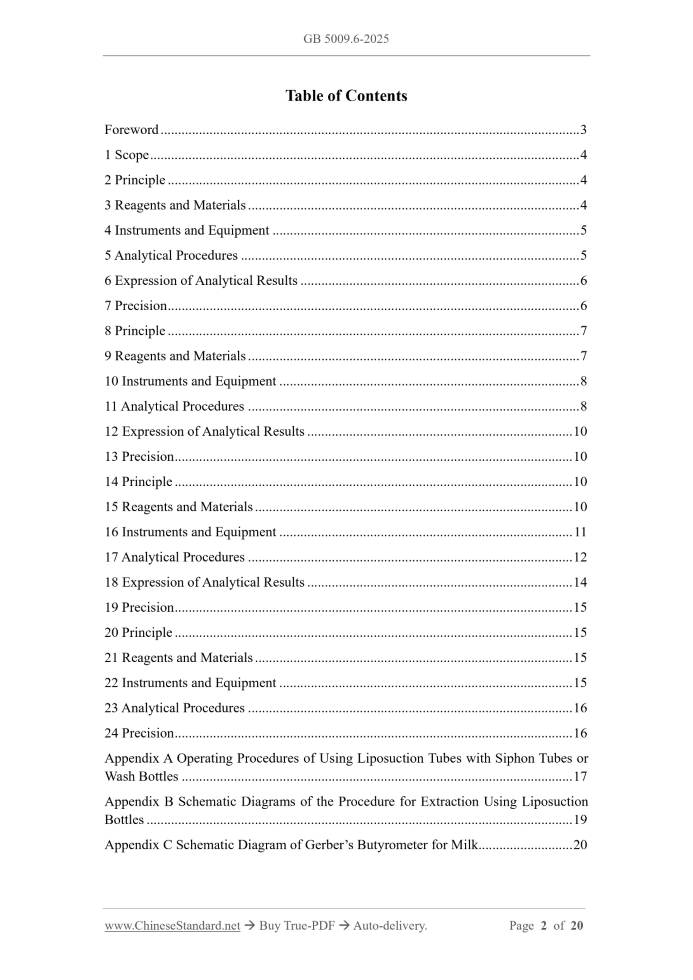
Table of Contents
Foreword... 3 1 Scope... 4 2 Principle... 4 3 Reagents and Materials... 4 4 Instruments and Equipment... 5 5 Analytical Procedures... 5 6 Expression of Analytical Results... 6 7 Precision... 6 8 Principle... 7 9 Reagents and Materials... 7 10 Instruments and Equipment... 8 11 Analytical Procedures... 8 12 Expression of Analytical Results... 10 13 Precision... 10 14 Principle... 10 15 Reagents and Materials... 10 16 Instruments and Equipment... 11 17 Analytical Procedures... 12 18 Expression of Analytical Results... 14 19 Precision... 15 20 Principle... 15 21 Reagents and Materials... 15 22 Instruments and Equipment... 15 23 Analytical Procedures... 16 24 Precision... 16 Appendix A Operating Procedures of Using Liposuction Tubes with Siphon Tubes or Wash Bottles... 17 Appendix B Schematic Diagrams of the Procedure for Extraction Using Liposuction Bottles... 19 Appendix C Schematic Diagram of Gerber’s Butyrometer for Milk... 20 National Food Safety Standard - Determination of Fat in Foods1 Scope
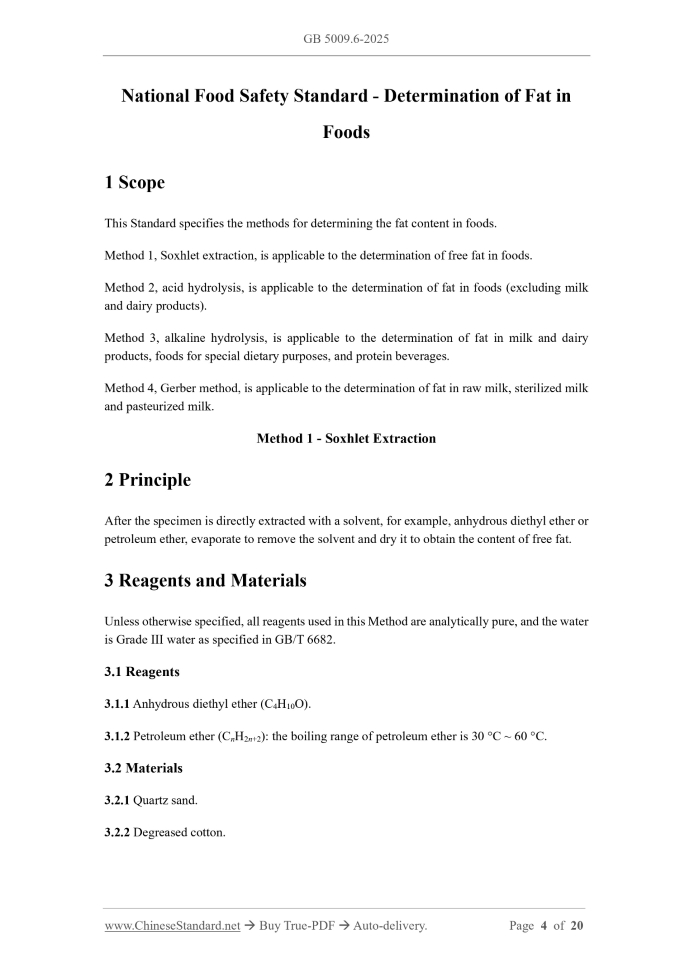
This Standard specifies the methods for determining the fat content in foods. Method 1, Soxhlet extraction, is applicable to the determination of free fat in foods. Method 2, acid hydrolysis, is applicable to the determination of fat in foods (excluding milk and dairy products). Method 3, alkaline hydrolysis, is applicable to the determination of fat in milk and dairy products, foods for special dietary purposes, and protein beverages. Method 4, Gerber method, is applicable to the determination of fat in raw milk, sterilized milk and pasteurized milk. Method 1 - Soxhlet Extraction2 Principle
After the specimen is directly extracted with a solvent, for example, anhydrous diethyl ether or petroleum ether, evaporate to remove the solvent and dry it to obtain the content of free fat.3 Reagents and Materials
Unless otherwise specified, all reagents used in this Method are analytically pure, and the water is Grade III water as specified in GB/T 6682. 3.1 Reagents 3.1.1 Anhydrous diethyl ether (C4H10O). 3.1.2 Petroleum ether (CnH2n+2). the boiling range of petroleum ether is 30 C ~ 60 C. 3.2 Materials 3.2.1 Quartz sand. 3.2.2 Degreased cotton.4 Instruments and Equipment
4.1 Homogenizer. 4.2 Tissue pulverizer or grinding machine. 4.3 Soxhlet extractor. 4.4 Constant-temperature water bath. 4.5 Analytical balance. with a division value of 0.001 g and 0.0001 g. 4.6 Electric blast drying oven. 4.7 Desiccator. contains effective desiccant, for example, silica gel. 4.8 Filtration paper cylinder. 4.9 Evaporating dish.5 Analytical Procedures
5.1 Specimen Preparation For particle-free and homogeneous liquid samples, shake well before use. For liquid samples with particles or non-homogeneous liquid samples, or semi-solid samples, use a homogenizer to homogenize them before use. For solid samples, use a tissue pulverizer or grinding machine to pulverize and homogenize before use. Frozen beverages can be appropriately heated to melt, and then, thoroughly stirred while hot before use. The prepared specimens shall be determined as soon as possible. NOTE. oil samples need to be dried at 105 C 2 C for 1 hour, then pulverized and passed through a 0.425 mm sieve mesh. 5.2 Specimen Preparation 5.2.1 Solid specimens. weigh-take 2 g ~ 5 g of homogeneous specimen (accurate to 0.001 g) and transfer it entirely into a filtration paper cylinder. 5.2.2 Liquid or semi-solid specimens. weigh-take 5 g ~ 10 g of homogeneous specimen (accurate to 0.001 g), place it in an evaporating dish, add approximately 20 g of quartz sand, evaporate to dryness in a boiling water bath, and dry in an electric blast drying oven at 100 C 5 C for 30 min. Remove, finely grind, and transfer it entirely into a filtration paper cylinder. Wipe the evaporating dish and the glass rod with the specimen adhering to it clean with degreased cotton soaked in diethyl ether and place the cotton inside the filtration paper cylinder. 5.3 Extraction Place the filtration paper cylinder into the extraction cylinder of a Soxhlet extractor and connect it to a receiving flask that has been dried to a constant weight (accurate to 0.0001 g). Add anhydrous diethyl ether or petroleum ether through the top of the extractor condenser tube, until the flask is two-thirds full. Heat in a 50 C ~ 60 C water bath, continuously reflux and extract the anhydrous diethyl ether or petroleum ether (6 times/h ~ 8 times/h), generally for 6 ~ 10 hours. At the end of extraction, use a ground glass rod to collect one drop of the extracting solution; the absence of oil spots on the ground glass rod indicates that extraction is complete. 5.4 Weighing Remove the receiving flask, recover the anhydrous diethyl ether or petroleum ether, and when 1 mL ~ 2 mL of solvent remains in the receiving flask, evaporate to dryness in a 60 C water bath, then, dry at 100 C 5 C for 1 hour. Cool to room temperature in a desiccator and weigh it (accurate to 0.0001 g). Repeat the above operation, until a constant weight is achieved (until the difference between two weighings does not exceed 2 mg), and take the smallest weighing result.6 Expression of Analytical Results
The fat content in the specimen is calculated in accordance with Formula (1). Where, X---the fat content in the specimen, expressed in (g/100 g); m1---the mass of the receiving flask and fat after reaching a constant weight, expressed in (g); m0---the mass of the receiving flask, expressed in (g); m2---the mass of the specimen, expressed in (g); 100---the conversion factor. The calculation result is expressed to two decimal places. NOTE. the formula for calculating the fat content in oils shall comply with the formulas specified in the relevant standards.7 Precision
The absolute difference between two independent determination results obtained under repeatability conditions must not exceed 10% of the arithmetic mean; for oil specimens, it shall not exceed 1%. Method 2 - Acid Hydrolysis8 Principle
Combined-state fat in foods is released using a strong acid. The released fat is easily soluble in organic solvents. After hydrolysis with hydrochloric acid, the specimen is extracted with anhydrous diethyl ether and petroleum ether. Removing the solvent yields the total content of free and combined-state fats.9 Reagents and Materials
Unless otherwise specified, all reagents used in this Method are analytically pure, and the water is Grade III water as specified in GB/T 6682. 9.1 Reagents 9.1.1 Hydrochloric acid (HCl). 9.1.2 Ethanol (C2H5OH). with a volume fraction of at least 95%. 9.1.3 Anhydrous diethyl ether (C4H10O). 9.1.4 Petroleum ether (CnH2n+2). the boiling range of petroleum ether is 30 C ~ 60 C. 9.1.5 Iodine (I2). 9.1.6 Potassium iodide (KI). 9.2 Reagent Preparation 9.2.1 Hydrochloric acid solution (2 mol/L). measure-take 50 mL of hydrochloric acid and add it to 250 mL of water, then, mix it well. 9.2.2 Iodine solution (0.05 mol/L). weigh-take 6.5 g of iodine and 25 g of potassium iodide, dissolve them in a small amount of water, and dilute to 1 L. 9.2.3 Diethyl ether-petroleum ether mixture (1 + 1). take equal volumes of anhydrous diethyl ether and petroleum ether, mix well, and reserve it for later use. 9.3 Materials 9.3.1 Blue litmus paper. 9.3.2 Degreased cotton. 9.3.3 Filter paper. medium speed.10 Instruments and Equipment
10.1 Homogenizer. 10.2 Tissue pulverizer or grinding machine. 10.3 Constant-temperature water bath. 10.4 Hot plate. capable of reaching a high temperature of 200 C. 10.5 Erlenmeyer flask. 10.6 Analytical balance. with a division value of 0.1 g and 0.001 g. 10.7 Electric blast drying oven. 10.8 Centrifuge.11 Analytical Procedures
11.1 Specimen Preparation For homogeneous liquid samples without particles, shake well before use. For liquid samples with particles or non-homogeneous liquid samples, or semi-solid samples, use a homogenizer to homogenize them before use. For solid samples, use a tissue pulverizer or grinding machine to pulverize and homogenize before use. Frozen beverages can be appropriately heated to melt, and then, thoroughly stirred while hot before use. The prepared specimens shall be determined as soon as possible. 11.2 Acid Hydrolysis of Specimens 11.2.1 Meat products Weigh-take 3 g ~ 5 g of homogeneous specimen (accurate to 0.001 g) and place it in an Erlenmeyer flask (250 mL). Add 50 mL of 2 mol/L hydrochloric acid solution and a few fine glass beads. Cover with a watch glass and heat on a hot plate, until it slightly boils. Maintain it for 1 hour, rotate and shake once every 10 minutes. Remove the Erlenmeyer flask, add 150 mL of hot water, mix well, and filter it. Wash the Erlenmeyer flask and watch glass with hot water and filter the hot water as well. Use hot water to wash the precipitate, until it becomes neutral (test with blue litmus paper; when neutral, the paper does not change color). Place the precipitate and filter paper on a large watch glass and dry in an electric blast drying oven at 100 C 5 C for 1 hour, then cool. 11.2.2 Starch-containing samples Based on the estimated total fat content, weigh-take 25 g ~ 50 g of homogeneous specimen ......Source: Above contents are excerpted from the full-copy PDF -- translated/reviewed by: www.ChineseStandard.net / Wayne Zheng et al.