GB 5009.288-2023 English PDF
Price & Delivery
US$140.00 · In stock · Download in 9 secondsGB 5009.288-2023: National food safety standard - Determination of carmine cochineal in foods
Delivery: 9 seconds. True-PDF full-copy in English & invoice will be downloaded + auto-delivered via email. See step-by-step procedure
Status: Valid
| Standard ID | USD | BUY PDF | Delivery | Standard Title (Description) | Status |
| GB 5009.288-2023 | 140 | Add to Cart | Auto, 9 seconds. | National food safety standard - Determination of carmine cochineal in foods | Valid |
Click to Preview this PDF
Similar standards
GB 5009.288-2023: National food safety standard - Determination of carmine cochineal in foods
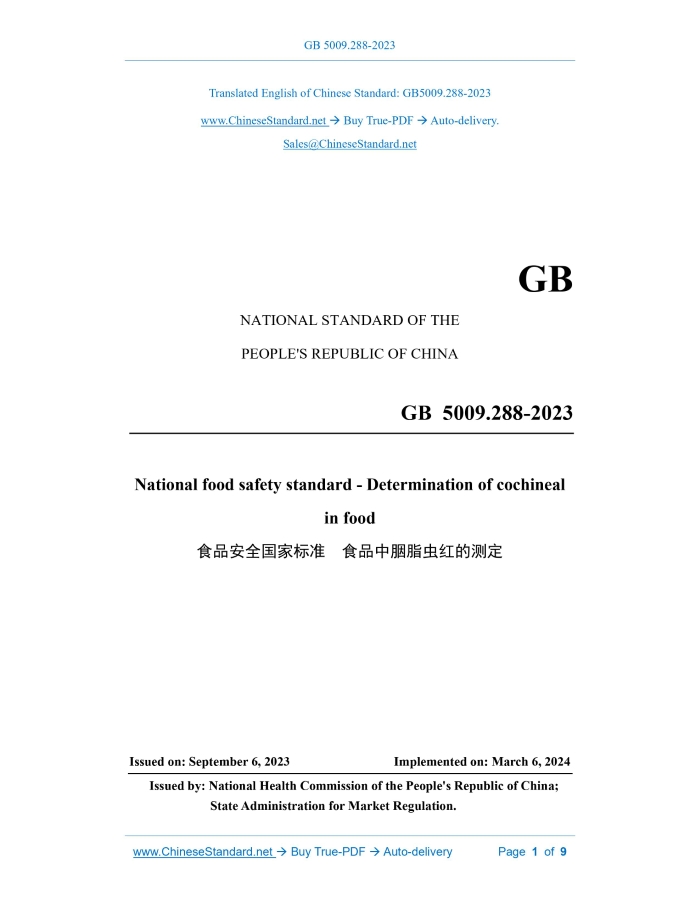
---This is an excerpt. Full copy of true-PDF in English version (including equations, symbols, images, flow-chart, tables, and figures etc.), auto-downloaded/delivered in 9 seconds, can be purchased online: https://www.ChineseStandard.net/PDF.aspx/GB5009.288-2023GB NATIONAL STANDARD OF THE PEOPLE'S REPUBLIC OF CHINA National food safety standard - Determination of cochineal in food ISSUED ON: SEPTEMBER 6, 2023 IMPLEMENTED ON: MARCH 6, 2024 Issued by: National Health Commission of the People's Republic of China; State Administration for Market Regulation.
Table of Contents
1 Scope ... 3 2 Principle ... 3 3 Reagents and materials ... 3 4 Instruments and equipment ... 4 5 Analysis steps ... 5 6 Expression of analysis results ... 7 7 Precision ... 8 8 Others ... 8 Appendix A Reference material liquid chromatogram ... 9 National food safety standard - Determination of cochineal in food1 Scope
This standard specifies the liquid chromatography method for the determination of cochineal in food. This standard applies to the determination of cochineal in food.2 Principle
Cochineal in the sample is extracted with a hydrochloric acid solution, purified with a solid-phase extraction column, separated by a reverse-phase C18 liquid chromatography column, detected with a UV-visible light detector, and quantified by an external standard method.3 Reagents and materials
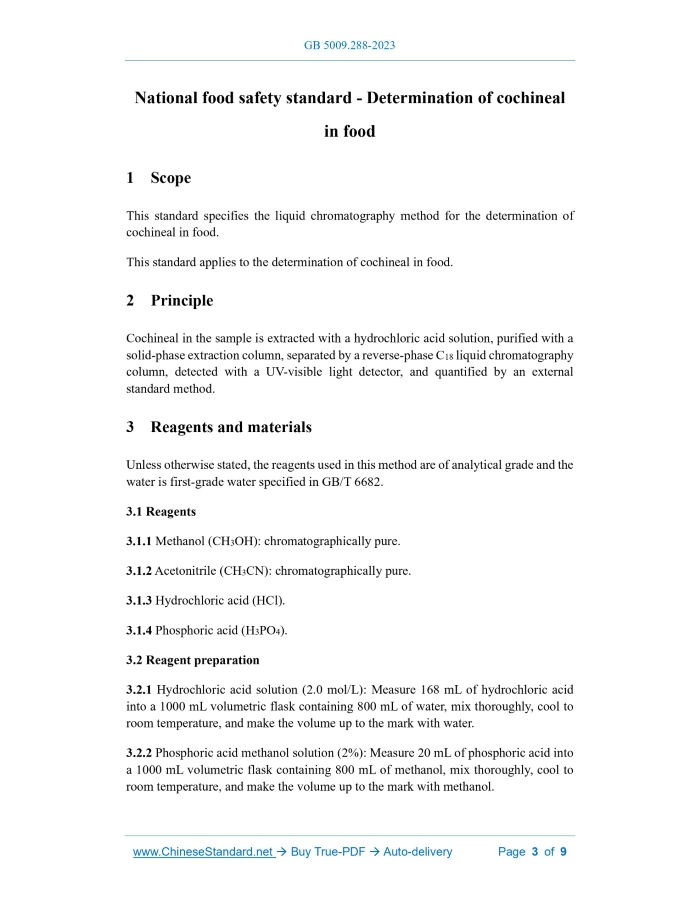
Unless otherwise stated, the reagents used in this method are of analytical grade and the water is first-grade water specified in GB/T 6682. 3.1 Reagents 3.1.1 Methanol (CH3OH): chromatographically pure. 3.1.2 Acetonitrile (CH3CN): chromatographically pure. 3.1.3 Hydrochloric acid (HCl). 3.1.4 Phosphoric acid (H3PO4). 3.2 Reagent preparation 3.2.1 Hydrochloric acid solution (2.0 mol/L): Measure 168 mL of hydrochloric acid into a 1000 mL volumetric flask containing 800 mL of water, mix thoroughly, cool to room temperature, and make the volume up to the mark with water. 3.2.2 Phosphoric acid methanol solution (2%): Measure 20 mL of phosphoric acid into a 1000 mL volumetric flask containing 800 mL of methanol, mix thoroughly, cool to room temperature, and make the volume up to the mark with methanol. 3.2.3 Phosphoric acid aqueous solution (0.1%): Pipette 1.0 mL of phosphoric acid into a 1000 mL volumetric flask containing 800 mL of water, mix thoroughly, cool to room temperature, and make the volume up to the mark with water. 3.2.4 Phosphoric acid acetonitrile solution (0.1%): Pipette 1.0 mL of phosphoric acid into a 1000 mL volumetric flask containing 800 mL of acetonitrile, mix thoroughly, cool to room temperature, and make the volume up to the mark with acetonitrile. 3.3 Standard product Carminic acid standard product (C22H20O13, CAS number: 1260-17-9): purity of ≥95.5%, or standard product with national authentication and a Reference Material Certificate. 3.4 Preparation of standard solution 3.4.1 Carminic acid standard stock solution (1.00 mg/mL): Accurately weigh 100.0 mg (accurate to 0.1 mg) of the standard product, dissolve with water, and make the volume up to the mark in a 100 mL volumetric flask, shake well, and store at 4 °C in a dark place; the period of validity is 3 months. 3.4.2 Carminic acid standard series working solution: Use a pipette (accurate to 0.01 mL) to accurately draw 0.5 mL of the standard stock solution (1.00 mg/mL) into a 100 mL volumetric flask; accurately draw the standard stock solution (1.00 mg/mL) 0.1 mL, 0.2 mL, 0.5 mL and 1.0 mL respectively in 10.0 mL volumetric flasks, make the volume up to the mark with phosphoric acid aqueous solution (0.1%), shake well, and prepare to carminic acid standard series working solutions with a mass concentration of 5.00 mg/L, 10.0 mg/L, 20.0 mg/L, 50.0 mg/L and 100 mg/L respectively. Prepare solutions fresh just before use. 3.5 Materials Solid-phase extraction column (150 mg/6 mL, mixed strong anion exchange reverse- phase column, the filler is a polystyrene/divinylbenzene copolymer containing hydrophilic groups and bonded with quaternary ammonium groups, or equivalent one).4 Instruments and equipment
4.1 High-performance liquid chromatograph: equipped with UV-visible light detector. 4.2 Balance: The sensitivity is 0.1 mg and 1 mg respectively. 4.3 Constant temperature water bath. 4.4 Vortex mixer. 4.5 Ultrasonic generator. 4.6 High-speed centrifuge. 4.7 Solid phase extraction device. 4.8 Nitrogen blower. 4.9 Crusher.5 Analysis steps
5.1 Sample preparation Liquid samples need to be shaken well for extraction; semi-solid samples and powdery samples with a uniform matrix need to be extracted directly; other samples need to be homogenized or crushed evenly for extraction. The prepared samples shall be stored at 0 ℃~5 ℃ and measured as soon as possible. 5.2 Sample extraction 5.2.1 Liquid and semi-solid samples (except milk-containing semi-solid samples) Weigh 2 g (accurate to 0.001 g) of the sample into a 50 mL centrifuge tube, add 40 mL of hydrochloric acid solution (2.0 mol/L), tighten the lid, shake well, place in a boiling water bath and heat for 30 min; take out and cool to room temperature, shake 5 min, ultrasonic for 5 min, centrifuge at 5000 r/min for 5 min, and transfer the supernatant to a 50.0 mL volumetric flask; make the volume up to the mark with water, filter with appropriate amount of absorbent cotton, and wait for purification. 5.2.2 Solid and milk-containing semi-solid samples (except modified milk powder) Weigh 2 g (accurate to 0.001 g) of the sample into a 50 mL centrifuge tube, add 40 mL of hydrochloric acid solution (2.0 mol/L), tighten the lid, shake well, place in a boiling water bath and heat for 30 min; take out and cool to room temperature, shake 5 min, ultrasonic for 5 min, centrifuge at 5000 r/min for 5 min, and transfer the supernatant to a 100 mL volumetric flask; add 40 mL of hydrochloric acid solution (2.0 mol/L) to the residue, repeat the extraction once at room temperature, combine the two extracts, and make the volume up to the mark with water; filter through an appropriate amount of absorbent cotton, and wait for purification. 5.2.3 Modified milk powder Weigh 2 g (accurate to 0.001 g) of sample into a 50 mL centrifuge tube, add 40 mL of hydrochloric acid solution (2.0 mol/L), tighten the lid, shake well, place in a boiling water bath and heat for 30 min; take out and cool to room temperature, shake 5 min, 2.00 -- the metered volume of the purified extract, in milliliters (mL); 1000 -- conversion factor; m -- the sampling quantity of the sample, in grams (g); 25.0 -- the volume of the extract, in milliliters (mL); The calculation result is rounded to 3 significant figures.7 Precision
The absolute difference between two independent determination results obtained under repeatability conditions shall not exceed 15% of the arithmetic mean.8 Others
The detection limit of this method is as follows: when the sample weight is 2 g, the detection limit of cochineal (by carminic acid) in liquid and semi-solid samples (except milk-containing semi-solid samples) is 0.006 g/kg, the detection limit of cochineal (by carminic acid) in solid and milk-containing semi-solid samples (except modified milk powder) is 0.01 g/kg, and the detection limit of cochineal (by carminic acid) in modified milk powder is 0.03 g/kg. The quantification limit of this method is as follows: when the sample weight is 2 g, the quantification limit of cochineal (by carminic acid) in liquid and semi-solid samples (except milk-containing semi-solid samples) is 0.02 g/kg, the quantification limit of cochineal (by carminic acid) in solid and milk-containing semi-solid samples (except modified milk powder) is 0.04 g/kg, and the quantification limit of cochineal (by carminic acid) in modified milk powder is 0.1 g/kg. ......Source: Above contents are excerpted from the full-copy PDF -- translated/reviewed by: www.ChineseStandard.net / Wayne Zheng et al.