GB 5009.183-2025 English PDF
Price & Delivery
US$110.00 · In stock · Download in 9 secondsGB 5009.183-2025: National food safety standard - Determination of urease in food
Delivery: 9 seconds. True-PDF full-copy in English & invoice will be downloaded + auto-delivered via email. See step-by-step procedure
Status: Valid
GB 5009.183: Historical versions
| Standard ID | USD | BUY PDF | Delivery | Standard Title (Description) | Status |
| GB 5009.183-2025 | 110 | Add to Cart | Auto, 9 seconds. | National food safety standard - Determination of urease in food | Valid |
| GB/T 5009.183-2003 | 139 | Add to Cart | 2 days | Qualitative analysis of urease in vegetable protein drinking | Valid |
Click to Preview this PDF
Similar standards
GB 5009.183-2025: National food safety standard - Determination of urease in food
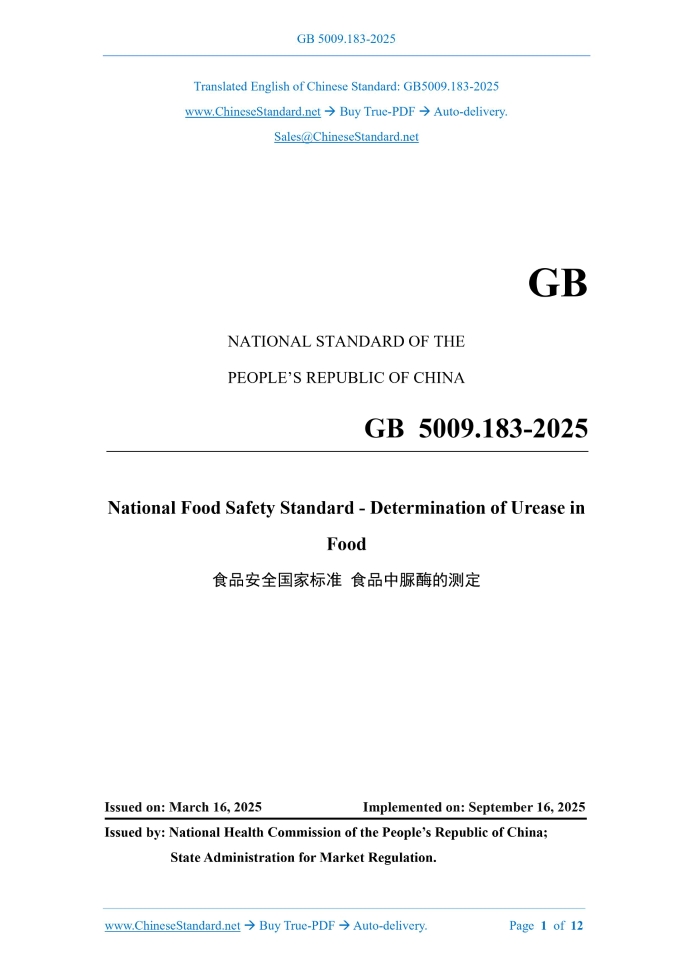
---This is an excerpt. Full copy of true-PDF in English version (including equations, symbols, images, flow-chart, tables, and figures etc.), auto-downloaded/delivered in 9 seconds, can be purchased online: https://www.ChineseStandard.net/PDF.aspx/GB5009.183-2025GB NATIONAL STANDARD OF THE PEOPLE’S REPUBLIC OF CHINA National Food Safety Standard - Determination of Urease in Food Issued on: MARCH 16, 2025 Implemented on: SEPTEMBER 16, 2025 Issued by. National Health Commission of the People’s Republic of China; State Administration for Market Regulation.
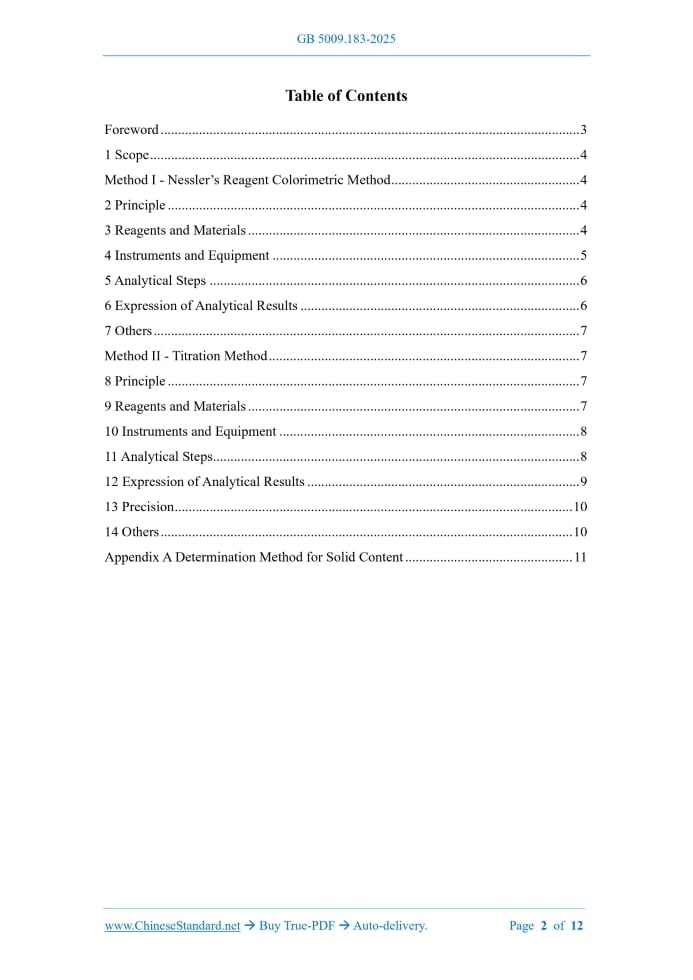
Table of Contents
Foreword... 3 1 Scope... 4 Method I - Nessler’s Reagent Colorimetric Method... 4 2 Principle... 4 3 Reagents and Materials... 4 4 Instruments and Equipment... 5 5 Analytical Steps... 6 6 Expression of Analytical Results... 6 7 Others... 7 Method II - Titration Method... 7 8 Principle... 7 9 Reagents and Materials... 7 10 Instruments and Equipment... 8 11 Analytical Steps... 8 12 Expression of Analytical Results... 9 13 Precision... 10 14 Others... 10 Appendix A Determination Method for Solid Content... 11 National Food Safety Standard - Determination of Urease in Food1 Scope
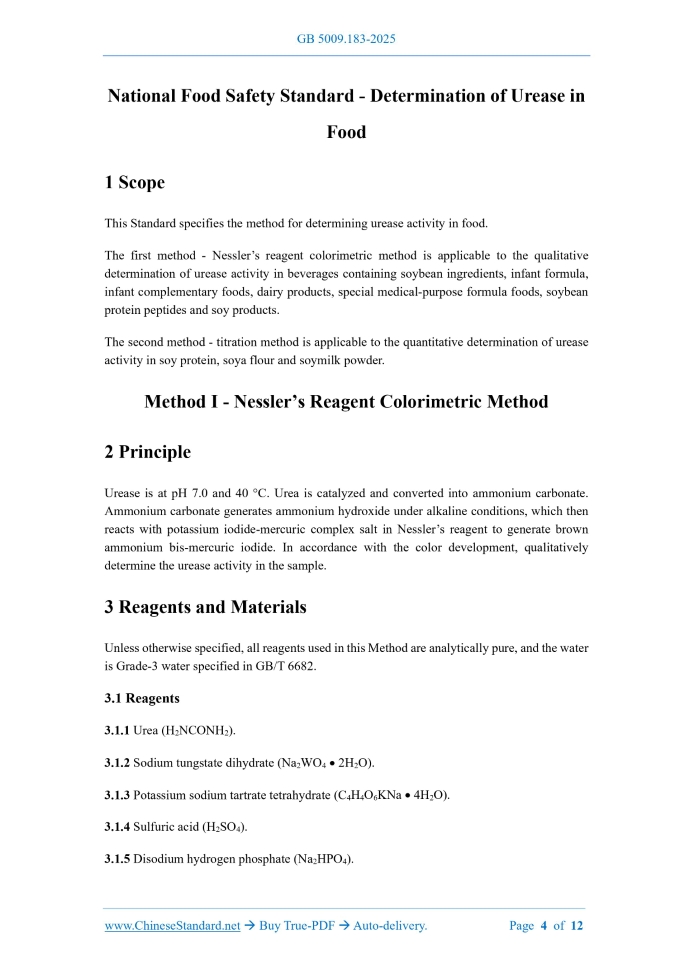
This Standard specifies the method for determining urease activity in food. The first method - Nessler’s reagent colorimetric method is applicable to the qualitative determination of urease activity in beverages containing soybean ingredients, infant formula, infant complementary foods, dairy products, special medical-purpose formula foods, soybean protein peptides and soy products. The second method - titration method is applicable to the quantitative determination of urease activity in soy protein, soya flour and soymilk powder. Method I - Nessler’s Reagent Colorimetric Method2 Principle
Urease is at pH 7.0 and 40 C. Urea is catalyzed and converted into ammonium carbonate. Ammonium carbonate generates ammonium hydroxide under alkaline conditions, which then reacts with potassium iodide-mercuric complex salt in Nessler’s reagent to generate brown ammonium bis-mercuric iodide. In accordance with the color development, qualitatively determine the urease activity in the sample.3 Reagents and Materials
Unless otherwise specified, all reagents used in this Method are analytically pure, and the water is Grade-3 water specified in GB/T 6682. 3.1 Reagents 3.1.1 Urea (H2NCONH2). 3.1.2 Sodium tungstate dihydrate (Na2WO4 2H2O). 3.1.3 Potassium sodium tartrate tetrahydrate (C4H4O6KNa 4H2O). 3.1.4 Sulfuric acid (H2SO4). 3.1.5 Disodium hydrogen phosphate (Na2HPO4). 3.1.6 Potassium dihydrogen phosphate (KH2PO4). 3.1.7 Red mercuric iodide (HgI2). 3.1.8 Potassium iodide (KI). 3.1.9 Sodium hydroxide (NaOH). 3.1.10 Graphitized carbon black (GCB) solid phase extraction column. 300 mg, 6 mL. 3.2 Preparation of Reagents 3.2.1 Urea solution (10 g/L). weigh-take 5 g of urea (accurate to 0.01 g), use water to dissolve it and dilute to 500 mL, mix it well, and store it in a brown reagent bottle. Store it in a refrigerator at 2 C ~ 8 C away from light. The shelf life is 2 weeks. 3.2.2 Sodium tungstate solution (89.0 g/L). weigh-take 50.0 g of sodium tungstate dihydrate, use water to dissolve it and dilute to 500 mL, and mix it well. 3.2.3 Potassium sodium tartrate solution (14.9 g/L). weigh-take 10.0 g of potassium sodium tartrate tetrahydrate, use water to dissolve it and dilute to 500 mL, and mix it well. 3.2.4 Sulfuric acid solution (5 + 95). measure-take 25 mL of sulfuric acid, and while stirring, slowly add it into 475 mL of water. After cooling, thoroughly mix it. 3.2.5 Buffer solution (pH 7.0). weigh-take 5.79 g of disodium hydrogen phosphate and use 200 mL of water to dissolve it. Weigh-take 3.53 g of potassium dihydrogen phosphate and use 200 mL of water to dissolve it. Transfer it into the above-mentioned solution, use water to dilute it to 1,000 mL, and mix it well. 3.2.6 Nessler’s reagent. weigh-take 14.4 g of sodium hydroxide, use 50 mL of water to thoroughly dissolve it, and cool it. Weigh-take 5.5 g of red mercuric iodide and 4.125 g of potassium iodide, dissolve them in 25 mL of water, and then, slowly transfer small amounts, and in several times, to the above-mentioned sodium hydroxide solution; during the addition process, constantly shake it. After the transfer is completed, add water to dilute to 100 mL, mix it well, and transfer it to a brown reagent bottle. After letting it stand, take the supernatant for use. Store it in a refrigerator at 2 C ~ 8 C, and it shall remain valid for 1 month. Or use a commercial Nessler’s reagent solution that meets the requirements.4 Instruments and Equipment
4.1 Electronic balance. the division value is respectively 0.01 g and 0.001 g. 4.2 Vortex oscillator. 4.3 Constant-temperature water bath. the temperature can be controlled at 40 C 1 C. 9.2 Preparation of Reagents 9.2.1 Urea buffer solution (pH 7.0 0.1). weigh-take 3.55 g of disodium hydrogen phosphate and 3.40 g of potassium dihydrogen phosphate, dissolve in water and dilute to 1,000 mL. Weigh-take 30 g of urea, dissolve it in the above-mentioned buffer solution, mix it well, and transfer it to a brown reagent bottle. Store it in a refrigerator at 2 C ~ 8 C away from light. The shelf life is 1 month. 9.2.2 Hydrochloric acid solution (0.1 mol/L). pipette 8.3 mL of hydrochloric acid, use water to dilute to 1,000 mL, and mix it well. 9.2.3 Sodium hydroxide standard solution (0.05 mol/L). in accordance with the method specified in GB/T 601, prepare 0.1 mol/L sodium hydroxide standard solution, and then, in accordance with the method specified in GB/T 601, dilute it to 0.05 mol/L. 9.2.4 Methyl red and bromocresol green mixed ethanol solution. weigh-take 0.1 g of methyl red, use 95% ethanol to dissolve it and dilute it to 100 mL, and mix it well. Then, weigh-take 0.5 g of bromocresol green, use 95% ethanol to dissolve it and dilute it to 100 mL, then, mix it well. Mix the two solutions in equal volumes and store in a brown bottle. The shelf life is 1 month.10 Instruments and Equipment
10.1 Electronic balance. the division value is respectively 0.01 g and 0.0001 g. 10.2 Acidity meter. with an accuracy of 0.02, equipped with magnetic stirrer and titration device. 10.3 Constant-temperature water bath. the temperature can be controlled at 30 C 0.5 C. 10.4 Pulverizer. the pulverizing shall not generate strong heat. 10.5 Timer. 10.6 Burette. 25 mL. 10.7 Beaker. 100 mL. 10.8 Single-mark pipette. 10 mL. 10.9 Thermometer. with a measuring range of 0 C ~ 100 C.11 Analytical Steps
11.1 Preparation of Specimens Use a pulverizer to pulverize and evenly mix the sample. NOTE. the temperature during sample pulverizing process must not exceed 70 C. 11.2 Specimen Analysis Weigh-take about 0.2 g of specimen (accurate to 0.001 g) into a glass test tube. At the same time interval, add 10.0 mL of urea buffer solution to each specimen. Immediately cover the test tube and vigorously shake it. Then, place the test tube in a constant-temperature water bath at 30 C 0.5 C and keep the timing for 30 min 10 s. After taking out the test tube, at the same time interval, add 10.0 mL of hydrochloric acid solution, after shaking, cool it to 20 C. Transfer all the contents of the test tube into a 100 mL beaker, use 20 mL of water to rinse the test tube several times, and use the sodium hydroxide standard solution to titrate it, until the acidity meter indicates pH 4.70.If you choose to use an indicator, then, transfer all the contents of the test tube into a 250 mL conical flask, add 8 ~ 10 drops of a mixed indicator of methyl red and bromocresol green, and use the sodium hydroxide standard solution to titrate it, until the solution turns blue-green and does not fade for 30 seconds. Take another test tube for a blank test and weigh-take the same mass of specimen. At the same time interval, add 10.0 mL of hydrochloric acid solution to each specimen. After shaking, add 10 mL of urea buffer solution. Immediately cover the test tube and vigorously shake it. Then, place the test tube in a constant-temperature water bath at 30 C 0.5 C and keep the timing for 30 min 10 s. After taking out the test tube, cool it to 20 C, and then, in accordance with the same steps, conduct the determination. NOTE. if the acidity meter indicates pH 4.70 before titration or the solution displays blue-green after adding the indicator, 0.05 g of specimen can be weighed for specimen analysis.12 Expression of Analytical Results
Urease activity is expressed as milligrams of nitrogen produced per gram of specimen per minute by catalyzing urea and is calculated in accordance with Formula (1). Where, X---the urease activity of the specimen, expressed in (U/g); c---the concentration of the sodium hydroxide standard titration solution, expressed in (mol/L); V0---the volume of the sodium hydroxide standard titration solution consumed by the blank, expressed in (mL); V---the volume of the sodium hydroxide standard titration solution consumed by the specimen, expressed in (mL); 30---the reaction time, expressed in (min); ......Source: Above contents are excerpted from the full-copy PDF -- translated/reviewed by: www.ChineseStandard.net / Wayne Zheng et al.