GB 21670-2025 English PDF
Price & Delivery
US$1295.00 · In stock · Download in 9 secondsGB 21670-2025: Technical requirements and testing methods for passenger car braking systems
Delivery: 9 seconds. True-PDF full-copy in English & invoice will be downloaded + auto-delivered via email. See step-by-step procedure
Status: Valid
GB 21670: Historical versions
| Standard ID | USD | BUY PDF | Delivery | Standard Title (Description) | Status |
| GB 21670-2025 | 1295 | Add to Cart | Auto, 9 seconds. | Technical requirements and testing methods for passenger car braking systems | Valid |
| GB 21670-2008 | 145 | Add to Cart | Auto, 9 seconds. | Technical requirements and testing methods for passenger car braking systems | Valid |
Click to Preview this PDF
Similar standards
GB 21670-2025: Technical requirements and testing methods for passenger car braking systems
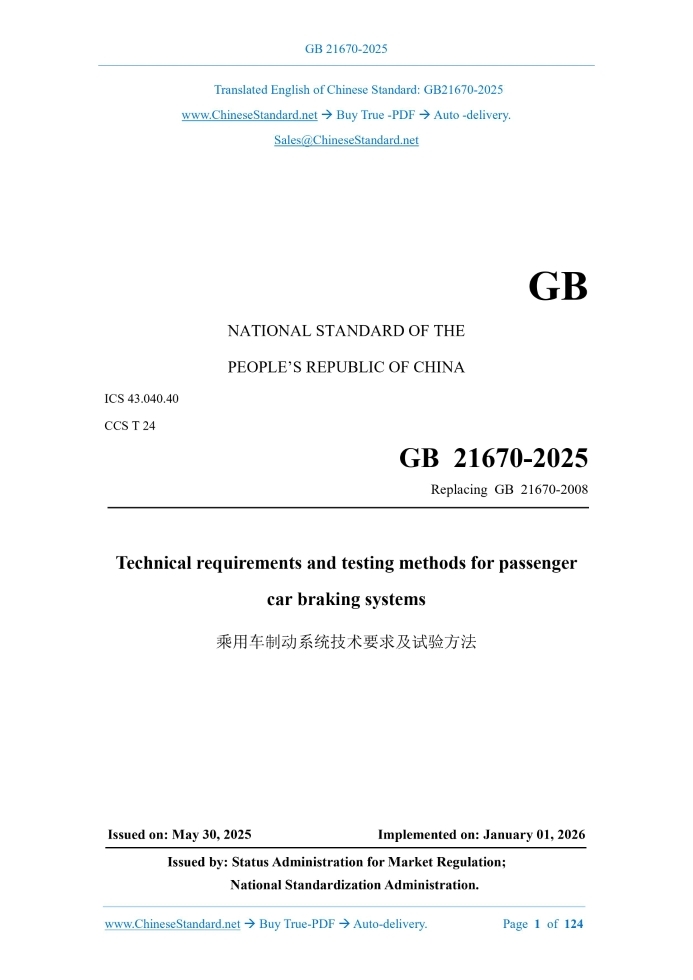
---This is an excerpt. Full copy of true-PDF in English version (including equations, symbols, images, flow-chart, tables, and figures etc.), auto-downloaded/delivered in 9 seconds, can be purchased online: https://www.ChineseStandard.net/PDF.aspx/GB21670-2025GB NATIONAL STANDARD OF THE PEOPLE’S REPUBLIC OF CHINA ICS 43.040.40 CCS T 24 Replacing GB 21670-2008 Technical requirements and testing methods for passenger car braking systems Issued on: MAY 30, 2025 Implemented on: JANUARY 01, 2026 Issued by. Status Administration for Market Regulation; National Standardization Administration.
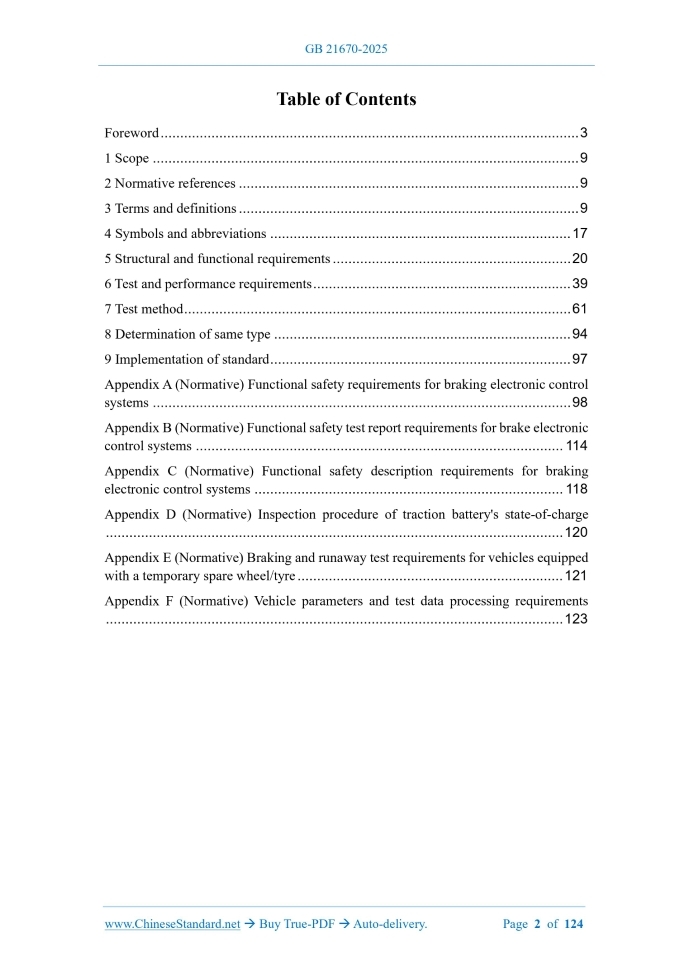
Table of Contents
Foreword... 3 1 Scope... 9 2 Normative references... 9 3 Terms and definitions... 9 4 Symbols and abbreviations... 17 5 Structural and functional requirements... 20 6 Test and performance requirements... 39 7 Test method... 61 8 Determination of same type... 94 9 Implementation of standard... 97 Appendix A (Normative) Functional safety requirements for braking electronic control systems... 98 Appendix B (Normative) Functional safety test report requirements for brake electronic control systems... 114 Appendix C (Normative) Functional safety description requirements for braking electronic control systems... 118 Appendix D (Normative) Inspection procedure of traction battery's state-of-charge ... 120 Appendix E (Normative) Braking and runaway test requirements for vehicles equipped with a temporary spare wheel/tyre... 121 Appendix F (Normative) Vehicle parameters and test data processing requirements ... 123 Technical requirements and testing methods for passenger car braking systems1 Scope
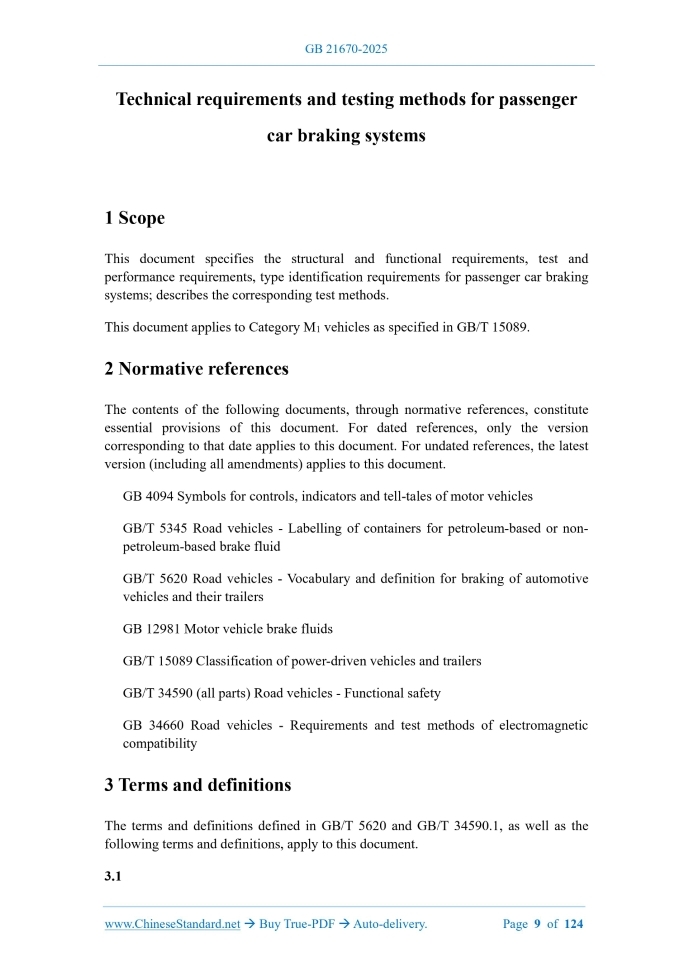
This document specifies the structural and functional requirements, test and performance requirements, type identification requirements for passenger car braking systems; describes the corresponding test methods. This document applies to Category M1 vehicles as specified in GB/T 15089.2 Normative references
The contents of the following documents, through normative references, constitute essential provisions of this document. For dated references, only the version corresponding to that date applies to this document. For undated references, the latest version (including all amendments) applies to this document. GB 4094 Symbols for controls, indicators and tell-tales of motor vehicles GB/T 5345 Road vehicles - Labelling of containers for petroleum-based or non- petroleum-based brake fluid GB/T 5620 Road vehicles - Vocabulary and definition for braking of automotive vehicles and their trailers GB 12981 Motor vehicle brake fluids GB/T 15089 Classification of power-driven vehicles and trailers GB/T 34590 (all parts) Road vehicles - Functional safety GB 34660 Road vehicles - Requirements and test methods of electromagnetic compatibility3 Terms and definitions
The terms and definitions defined in GB/T 5620 and GB/T 34590.1, as well as the following terms and definitions, apply to this document. 3.1 3.39 Electrical transmission braking system; ETBS A braking system in which the service braking force and its transmission are controlled solely by the driver and are supplied by an electrical storage device. 3.40 Brake demand value Braking demand value for a single wheel or axle using electrical actuation to generate braking force. 3.41 Effect of ageing Irreversible degradation of battery performance due to factors such as time, usage, environment. 3.42 Energy management system A system that monitors key variables affecting battery performance and state (e.g., voltage, temperature, internal resistance, aging effects, state-of-charge, power consumption, charge cycles, etc.) and infers whether the actual capacity of the electrical storage device meets the design requirements. Note. The energy management system is not necessarily part of the ETBS but is used by it.4 Symbols and abbreviations
4.1 Symbols The following symbols apply to this document. areduced. Value after deceleration demand value is reduced. aref. Deceleration demand value. B. Braking force. BEF. Brake efficiency factor. dm. Fully applied mean deceleration. vmax. Maximum design vehicle speed. vs. Rated initial braking velocity. v0.Vehicle initial velocity. v1.Initial vehicle speed at the start of braking. v2.Vehicle speed at the end of braking. z. Braking strength, z = J/g. zAL. Maximum braking strength of the vehicle when the anti-lock braking system is engaged. zm. Average braking strength. zMALS. Braking strength of a fully loaded vehicle. zmax. Maximum value of z. 4.2 Abbreviations The following abbreviations apply to this document. FMEA. Failure Mode and Effect Analysis FTA. Fault Tree Analysis MFDD. Mean Fully Developed Deceleration Pw. Power Warning5 Structural and functional requirements
5.1 Braking equipment 5.1.1 General requirements 5.1.1.1 The design, manufacture, installation of vehicle braking systems shall ensure normal operation, in case of exposure to driving vibrations; meanwhile meet the requirements of this document. 5.1.1.2 The design, manufacture, installation of braking systems shall ensure corrosion and aging resistance. 5.1.1.3 Brake linings shall not contain asbestos. 5.1.1.4 The effectiveness of braking systems shall not be adversely affected by magnetic or electric fields; it shall be verified in accordance with the vehicle electromagnetic radiation immunity test requirements in GB 34660. 5.1.1.5 Without degrading braking performance, the interruption of control transmission by a failure detection signal shall not exceed 10 ms. 5.1.2 Braking system functionality 5.1.2.1 Service braking Regardless of vehicle speed, load, or whether the vehicle is traveling uphill or downhill, the service braking system shall be able to control vehicle movement and safely, quickly, effectively decelerate or stop the vehicle. Braking action shall be graduated/modulatable. The driver shall be able to brake from the driving position without removing their hands from the steering wheel. 5.1.2.2 Emergency braking If the service braking system fails, the emergency braking system shall be able to stop the vehicle within an appropriate distance. The braking action shall be graduated/modulatable. The driver shall be able to brake from the driving position, without removing their hands from the steering wheel. This requirement assumes that no more than one part of the service braking system fails simultaneously. 5.1.2.3 Parking brake The operating components of the parking braking system shall be locked by a purely mechanical device, allowing the vehicle to be stopped on an uphill or downhill, even when the driver is not present. The driver shall be able to brake from the driving position. 5.1.3 Functional safety requirements for electronic braking control systems The functional safety requirements for electronic braking systems shall comply with Appendix A. The functional safety test report for electronic braking systems shall comply with Appendix B. The functional safety description requirements for electronic braking systems shall comply with Appendix C. This article applies to electronic brake control systems, which have the functions such as anti-lock braking, electrical regenerative braking, parking brakes with electronic transmission, service brakes with electronic transmission, service brakes with electric transmission. 5.2 Braking system characteristics 5.2.1 The entire braking system equipped on a vehicle shall meet the vehicle requirements for the service braking system, emergency braking system, parking braking system. 5.2.2 If the service braking system, emergency braking system, parking braking system require only one accumulator. j) Components such as the brake pedal and its bracket, the brake master cylinder and its piston, the control valve, the connector between the brake pedal and the brake master cylinder or control valve, the wheel cylinder and its piston, the brake lever cam assembly shall be considered as components, that are not susceptible to failure, if they are sufficiently large, easily accessible and maintainable, have at least the same safety features as other important vehicle components (such as steering connections). Failure of these components would result in the vehicle failing to achieve the specified emergency braking performance. They shall be made of metal or materials with equivalent performance to metal; meanwhile it shall not exhibit noticeable deformation during normal operation of the braking system. 5.2.3 In the event of a partial failure of the hydraulic transmission system, a red alarm signal shall be illuminated, to indicate this to the driver no later than when the differential pressure between the normal and failed portions of the braking system measured at the master cylinder outlet exceeds 1.55 MPa. Alternatively, an alarm system that illuminates the red signal, when the fluid level in the reservoir falls below the manufacturer's specified level, is permitted. The alarm signal shall remain illuminated, as long as the failure persists and the ignition (starter) switch is in the "ON" ("RUN") position. The alarm signal shall be clearly visible even in daylight. The driver shall be able to easily check the proper operation of the alarm signal, from the driving position. Failure of an alarm device component shall not result in a complete loss of braking system effectiveness. The driver shall also be informed of the application of the parking brake, which may be indicated by the same alarm signal. 5.2.4 When utilizing energy sources other than the driver's physical strength, it is not necessary to have more than one energy source (hydraulic pump, air compressor, etc.) or electrical supply. However, the operation of the energy source drive device or electrical supply shall ensure safety within the practical range of use and meet the following requirements. a) In the event of failure of any part of the transmission system, energy shall continue to be supplied to the unaffected parts, to ensure that the vehicle is stopped with the specified emergency braking performance. This requirement shall be achieved by means of a device that is easily activated, when the vehicle is stationary or automatically. b) The energy storage device located downstream of the device shall ensure that, in the event of a failure of the energy supply, after 4 full actuations of the service brake control device under the conditions specified in 6.4.1.2, the vehicle can still be stopped with the specified emergency braking performance, when the 5-th braking operation is performed. c) For hydraulic braking system with stored energy, compliance with the requirements of 6.4.1.3 is considered to be in compliance with the above provisions. d) For ETBS, if the specified emergency braking performance is still achieved when performing the 9-th braking, after the service brake control device is fully actuated 8 times after any transmission failure occurs, it considers complying with the above provisions. Each full actuation shall comply with the requirements of 6.6.1.2.3 b). 5.2.5 When the automatic device is not in use, the requirements of 5.2.2 ~ 5.2.4 shall be met. Note. This automatic device is typically in standby mode and only activates if the braking system fails; therefore, its failure is generally ignored. 5.2.6 The service braking system shall apply to all wheels of the vehicle and distribute the braking force appropriately among the axles. 5.2.7 For vehicles equipped with a category B electric regenerative braking system, if it is necessary to appropriately delay the braking input of other braking energy sources to enable the electric regenerative braking system to function alone, the following two conditions shall be met. - If the requirements of 6.1.3.2 or 6.5.2.3 (including when the electric motor is engaged) are met, inherent variations in the output torque of the electric regenerative braking system (such as those caused by changes in the state-of- charge of the traction battery) may be automatically compensated for by appropriate phase relationship changes; - Taking into account the actual tire/road adhesion conditions, all wheels of the vehicle shall be automatically braked when necessary to ensure that the braking strength expected by the driver is achieved. 5.2.8 The braking force of the service braking system shall be distributed symmetrically between the wheels on the same axle, as relative to the vehicle's longitudinal centerline. Compensation and functions (such as anti-lock braking) that may result in an unbalanced distribution of braking force shall be stated. Under all load conditions, when the electronic transmission device's compensation for a braking system failure or performance degradation exceeds the following limits, the driver shall be informed by a yellow warning signal as specified in 5.2.21 a). a) The difference in brake pressure or brake demand value on the left and right sides of any axle. 1) When the vehicle deceleration is greater than or equal to 2 m/s2, the difference shall be 25% of the higher of the two values at the actual deceleration; 2) When the vehicle deceleration is less than 2 m/s2, the difference shall be 25% of the higher of the two values at 2 m/s2. b) Compensation value for a single axle. 1) When the vehicle deceleration is greater than or equal to 2 m/s2, it shall take 50% of the nominal value at the actual deceleration; 2) When the vehicle deceleration is less than 2 m/s2, it shall take 50% of the nominal value at 2 m/s2. This compensation is permitted, only when braking is initiated at a speed greater than 10 km/h. 5.2.9 Braking shall not be applied against the driver's intent, in the event of a failure of the electronically controlled transmission device. 5.2.10 The braking force of the service braking system, emergency braking system, parking braking system shall act on braking surfaces connected to the wheels via connectors of sufficient strength. When the braking force of axle (or axles) is provided by both a friction braking system and a category B electric regenerative braking system, the electric regenerative braking system may be disconnected, if the friction braking system can maintain and provide the compensation described in 5.2.7.During the short period of disconnection, incomplete compensation is permitted; however, it shall reach at least 75% of the full compensation value within 1 second. However, in all cases, a permanently connected friction braking source shall ensure that the service and emergency braking systems continue to operate with the specified effectiveness. Disengagement of the parking braking system's braking surfaces may only be controlled, by the driver from their driving position through a system that is not affected by leakage. This requirement does not apply to the remote control parking (RCP) function. 5.2.11 Brake wear shall be easily compensated for by manual or automatic adjustment devices. Furthermore, the transmission and brake components and controls shall have a certain reserve travel, that can be appropriately compensated when necessary, to ensure that effective braking is achieved when the brakes heat up or the brake linings wear to a certain extent, without the need for immediate clearance adjustment. Adjustment and inspection of service brake wear shall meet the following requirements. - Service brake wear shall be automatically adjusted. The automatic wear adjustment device shall ensure that the brakes continue to brake effectively after heating and cooling, and in particular, ensure that the vehicle can be driven normally after the test specified in 6.1.5 (Type I test). ......Source: Above contents are excerpted from the full-copy PDF -- translated/reviewed by: www.ChineseStandard.net / Wayne Zheng et al.