YBB 6006-2012 PDF English
Price & Delivery
US$135.00 · In stock · Download in 9 secondsYBB 6006-2012: The Test Method for Residue of Solvent in Packaging Material
Delivery: 9 seconds. True-PDF full-copy in English & invoice will be downloaded + auto-delivered via email. See step-by-step procedure
| Standard ID | USD | BUY PDF | Delivery | Standard Title (Description) | Status |
| YBB 6006-2012 | 135 | Add to Cart | Auto, 9 seconds. | The Test Method for Residue of Solvent in Packaging Material |
Click to Preview this PDF
Similar standards
YBB 6006-2012: The Test Method for Residue of Solvent in Packaging Material
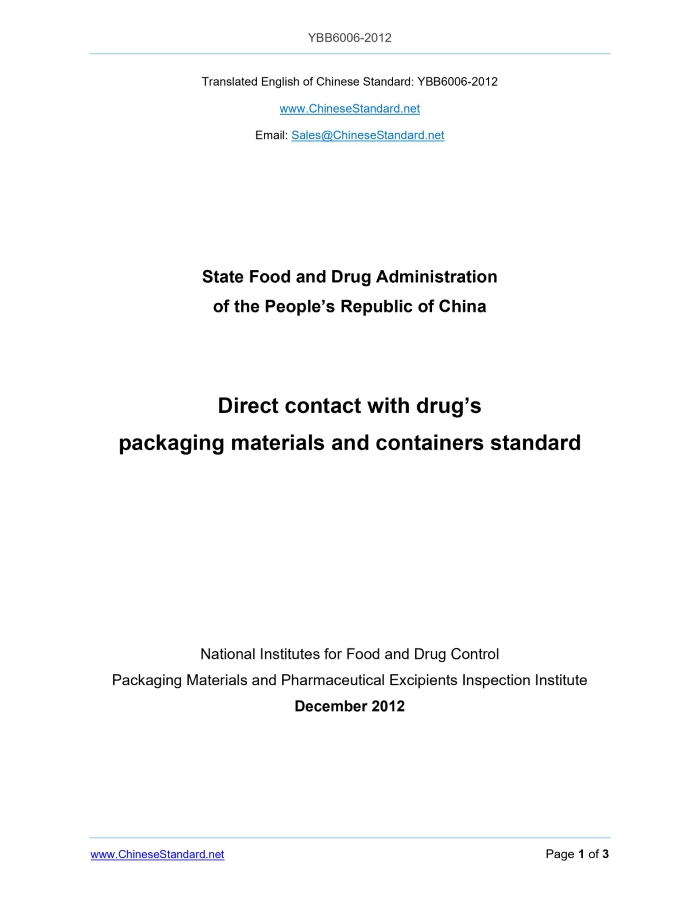
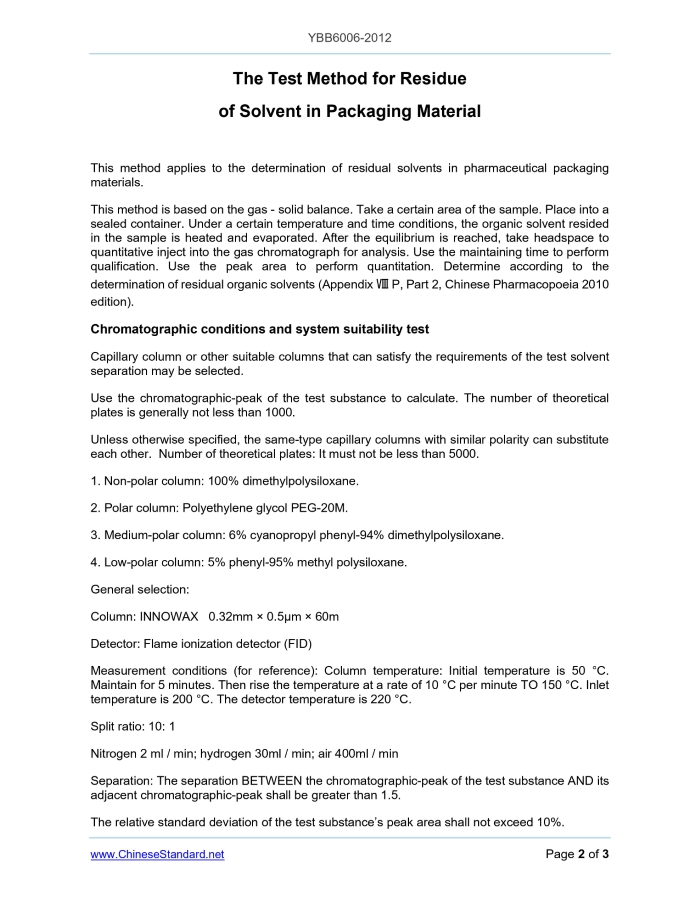
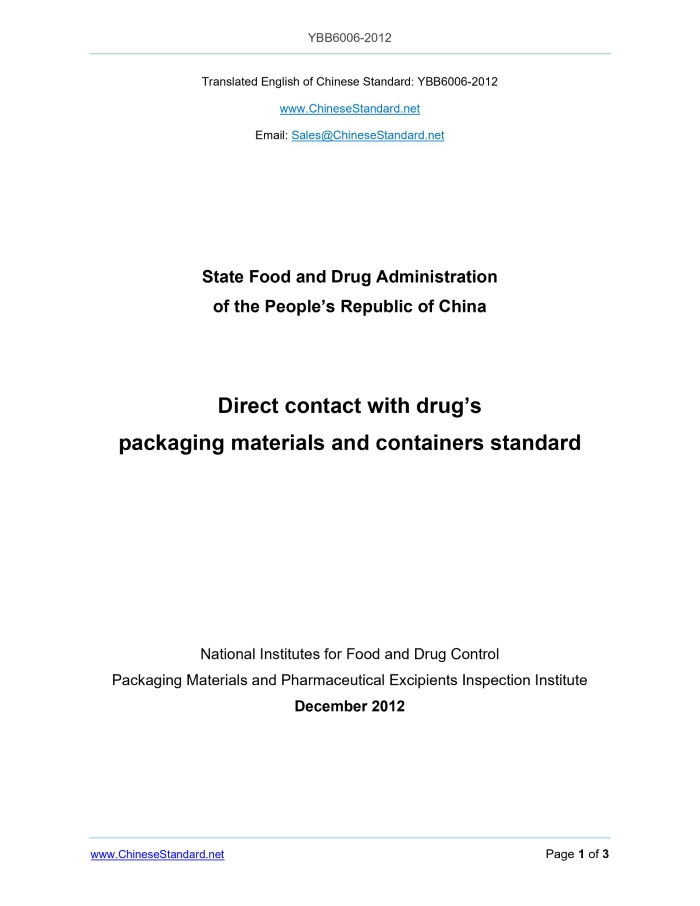
---This is an excerpt. Full copy of true-PDF in English version (including equations, symbols, images, flow-chart, tables, and figures etc.), auto-downloaded/delivered in 9 seconds, can be purchased online: https://www.ChineseStandard.net/PDF.aspx/YBB6006-2012State Food and Drug Administration of the People’s Republic of China Direct contact with drug’s packaging materials and containers standard National Institutes for Food and Drug Control Packaging Materials and Pharmaceutical Excipients Inspection Institute December 2012 The Test Method for Residue of Solvent in Packaging Material This method applies to the determination of residual solvents in pharmaceutical packaging materials. This method is based on the gas - solid balance. Take a certain area of the sample. Place into a sealed container. Under a certain temperature and time conditions, the organic solvent resided in the sample is heated and evaporated. After the equilibrium is reached, take headspace to quantitative inject into the gas chromatograph for analysis. Use the maintaining time to perform qualification. Use the peak area to perform quantitation. Determine according to the determination of residual organic solvents (Appendix Ⅷ P, Part 2, Chinese Pharmacopoeia 2010 edition). Chromatographic conditions and system suitability test Capillary column or other suitable columns that can satisfy the requirements of the test solvent separation may be selected. Use the chromatographic-peak of the test substance to calculate. The number of theoretical plates is generally not less than 1000. Unless otherwise specified, the same-type capillary columns with similar polarity can substitute each other. Number of theoretical plates. It must not be less than 5000. 1.Non-polar column. 100% dimethylpolysiloxane. 2.Polar column. Polyethylene glycol PEG-20M. 3.Medium-polar column. 6% cyanopropyl phenyl-94% dimethylpolysiloxane. 4.Low-polar column. 5% phenyl-95% methyl polysiloxane. General selection. Column. INNOWAX 0.32mm × 0.5μm × 60m Detector. Flame ionization detector (FID) Measurement conditions (for reference). Column temperature. Initial temperature is 50 °C. Maintain for 5 minutes. Then rise the temperature at a rate of 10 °C per minute TO 150 °C. Inlet temperature is 200 °C. The detector temperature is 220 °C. Split ratio. 10.1 Nitrogen 2 ml / min; hydrogen 30ml / min; air 400ml / min Separation. The separation BETWEEN the chromatographic-peak of the test substance AND its adjacent chromatographic-peak shall be greater than 1.5. The relative standard deviation of the test substance’s peak area shall not exceed 10%. ......
Source: Above contents are excerpted from the full-copy PDF -- translated/reviewed by: www.ChineseStandard.net / Wayne Zheng et al.