GB/T 31547-2023 PDF English
Price & Delivery
US$170.00 · In stock · Download in 9 secondsGB/T 31547-2023: Electric bicycle inner tubes
Delivery: 9 seconds. True-PDF full-copy in English & invoice will be downloaded + auto-delivered via email. See step-by-step procedure
Status: Valid
GB/T 31547: Historical versions
| Standard ID | USD | BUY PDF | Delivery | Standard Title (Description) | Status |
| GB/T 31547-2023 | 170 | Add to Cart | Auto, 9 seconds. | Electric bicycle inner tubes | Valid |
| GB/T 31547-2015 | 105 | Add to Cart | Auto, 9 seconds. | Electric bicycle inner tubes | Obsolete |
Click to Preview this PDF
Similar standards
GB/T 31547-2023: Electric bicycle inner tubes
---This is an excerpt. Full copy of true-PDF in English version (including equations, symbols, images, flow-chart, tables, and figures etc.), auto-downloaded/delivered in 9 seconds, can be purchased online: https://www.ChineseStandard.net/PDF.aspx/GBT31547-2023GB NATIONAL STANDARD OF THE PEOPLE’S REPUBLIC OF CHINA ICS 83.160.10 CCS G 41 Replacing GB/T 31547-2015 Electric Bicycle Inner Tubes ISSUED ON: DECEMBER 28, 2023 IMPLEMENTED ON: JULY 1, 2024 Issued by: State Administration for Market Regulation; Standardization Administration of the People’s Republic of China.
Table of Contents
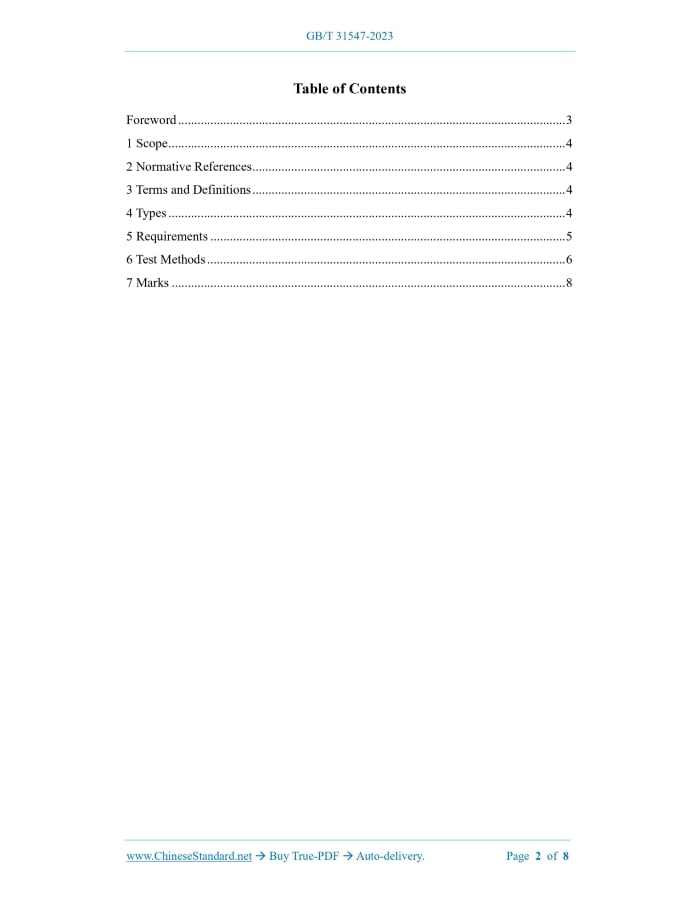
Foreword ... 3 1 Scope ... 4 2 Normative References ... 4 3 Terms and Definitions ... 4 4 Types ... 4 5 Requirements ... 5 6 Test Methods ... 6 7 Marks ... 8Foreword
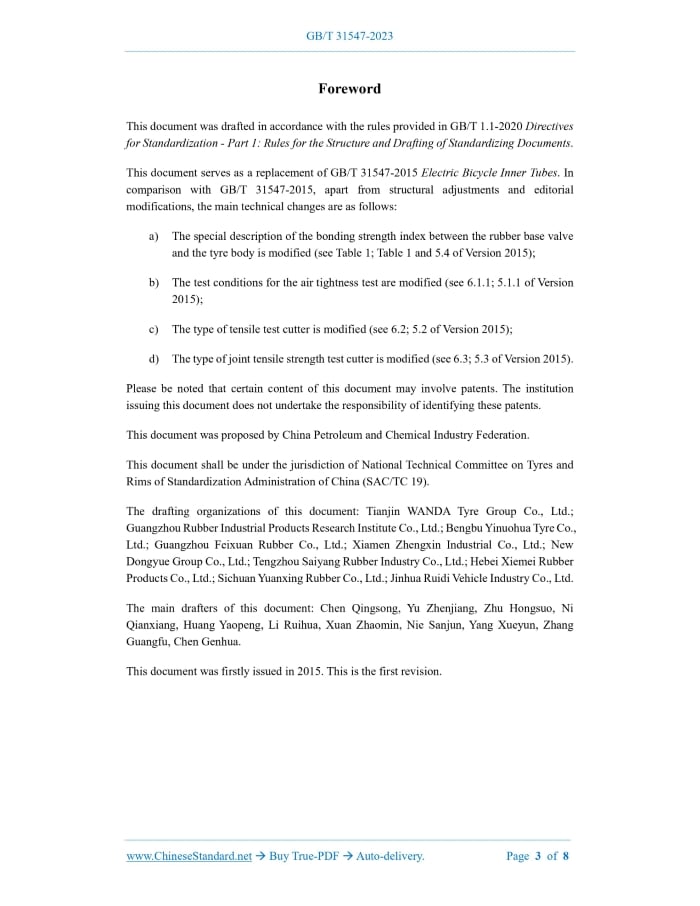
This document was drafted in accordance with the rules provided in GB/T 1.1-2020 Directives for Standardization - Part 1: Rules for the Structure and Drafting of Standardizing Documents. This document serves as a replacement of GB/T 31547-2015 Electric Bicycle Inner Tubes. In comparison with GB/T 31547-2015, apart from structural adjustments and editorial modifications, the main technical changes are as follows: a) The special description of the bonding strength index between the rubber base valve and the tyre body is modified (see Table 1; Table 1 and 5.4 of Version 2015); b) The test conditions for the air tightness test are modified (see 6.1.1; 5.1.1 of Version 2015); c) The type of tensile test cutter is modified (see 6.2; 5.2 of Version 2015); d) The type of joint tensile strength test cutter is modified (see 6.3; 5.3 of Version 2015). Please be noted that certain content of this document may involve patents. The institution issuing this document does not undertake the responsibility of identifying these patents. This document was proposed by China Petroleum and Chemical Industry Federation. This document shall be under the jurisdiction of National Technical Committee on Tyres and Rims of Standardization Administration of China (SAC/TC 19). The drafting organizations of this document: Tianjin WANDA Tyre Group Co., Ltd.; Guangzhou Rubber Industrial Products Research Institute Co., Ltd.; Bengbu Yinuohua Tyre Co., Ltd.; Guangzhou Feixuan Rubber Co., Ltd.; Xiamen Zhengxin Industrial Co., Ltd.; New Dongyue Group Co., Ltd.; Tengzhou Saiyang Rubber Industry Co., Ltd.; Hebei Xiemei Rubber Products Co., Ltd.; Sichuan Yuanxing Rubber Co., Ltd.; Jinhua Ruidi Vehicle Industry Co., Ltd. The main drafters of this document: Chen Qingsong, Yu Zhenjiang, Zhu Hongsuo, Ni Qianxiang, Huang Yaopeng, Li Ruihua, Xuan Zhaomin, Nie Sanjun, Yang Xueyun, Zhang Guangfu, Chen Genhua. This document was firstly issued in 2015. This is the first revision. Electric Bicycle Inner Tubes1 Scope
This document specifies the types and requirements of electric bicycle inner tubes, describes the corresponding test methods, and specifies the content of marks. This document is applicable to model vulcanized inner tubes for the assembly of electric bicycle tyres.2 Normative References
The contents of the following documents constitute indispensable clauses of this document through the normative references in the text. In terms of references with a specified date, only versions with a specified date are applicable to this document. In terms of references without a specified date, the latest version (including all the modifications) is applicable to this document. GB/T 528 Rubber, Vulcanized or Thermoplastic - Determination of Tensile Stress-strain Properties GB/T 1796.1 Tyre Valves - Part 1: Tube Clamp-in Valves GB/T 1796.2 Tyre Valves - Part 2: Rubber Base Valves GB/T 31546 Electric Bicycle Tyres GB/T 31548 Series of Electric Bicycle Tyres GB/T 31549 Performance Testing Method for Electric Bicycle Tyres3 Terms and Definitions
This document does not have terms or definitions that need to be defined.4 Types
In accordance with the materials used in manufacture, inner tubes are classified into two types: ---Natural rubber inner tubes and inner tubes based on natural rubber are Type A; ---Butyl rubber inner tubes and inner tubes based on butyl rubber are Type B.6 Test Methods
6.1 Air Tightness Test 6.1.1 Inflate the inner tube, until the cross-sectional circumference of the inner tube directly opposite the valve is 130% of the double flat-folded cross-sectional width of the inner tube, and let it stand at room temperature for 12 hours. 6.1.2 Check whether there is any gas leakage. If there is no obvious gas leakage, it is deemed as a qualified product. 6.1.3 If there is obvious gas leakage, it shall be re-inflated in accordance with the same conditions described above and immersed in water for 1 minute. If more than one bubble emerges, it is deemed as a disqualified product. However, after repair, it is allowed to test the valve part again in accordance with the method described above. 6.2 Tensile Test The tensile test is carried out in accordance with the stipulations of GB/T 528. When using a Type 2 cutter to determine the elongation at break, respectively take one specimen (as shown in Figure 1) along the circumferential direction of the tyre body at the center of the crown, the center of the base, the center of the upper mold and the center of the lower mold in the same non-joint section of the inner tube to respectively determine the elongation at break. The values are recorded as x1, x2, x3 and x4 in the order from large to small. The test results, which have the maximum value x1 and the minimum value x4 removed, shall be calculated in accordance with Formula (1): Where, TE---the elongation at break, expressed in (%); x2, x3---the determined value of specimen elongation at break used for calculation, expressed in (%). ......Source: Above contents are excerpted from the full-copy PDF -- translated/reviewed by: www.ChineseStandard.net / Wayne Zheng et al.