GB/T 37629-2019 English PDF
Price & Delivery
US$90.00 · In stock · Download in 9 secondsGB/T 37629-2019: Textiles - Quantitative chemical analysis - Mixtures of acrylic with certain other fibres (method using formic acid and zinc chloride)
Delivery: 9 seconds. True-PDF full-copy in English & invoice will be downloaded + auto-delivered via email. See step-by-step procedure
Status: Valid
| Standard ID | USD | BUY PDF | Delivery | Standard Title (Description) | Status |
| GB/T 37629-2019 | 90 | Add to Cart | Auto, 9 seconds. | Textiles - Quantitative chemical analysis - Mixtures of acrylic with certain other fibres (method using formic acid and zinc chloride) | Valid |
Click to Preview this PDF
Similar standards
GB/T 37629-2019: Textiles - Quantitative chemical analysis - Mixtures of acrylic with certain other fibres (method using formic acid and zinc chloride)
---This is an excerpt. Full copy of true-PDF in English version (including equations, symbols, images, flow-chart, tables, and figures etc.), auto-downloaded/delivered in 9 seconds, can be purchased online: https://www.ChineseStandard.net/PDF.aspx/GBT37629-2019
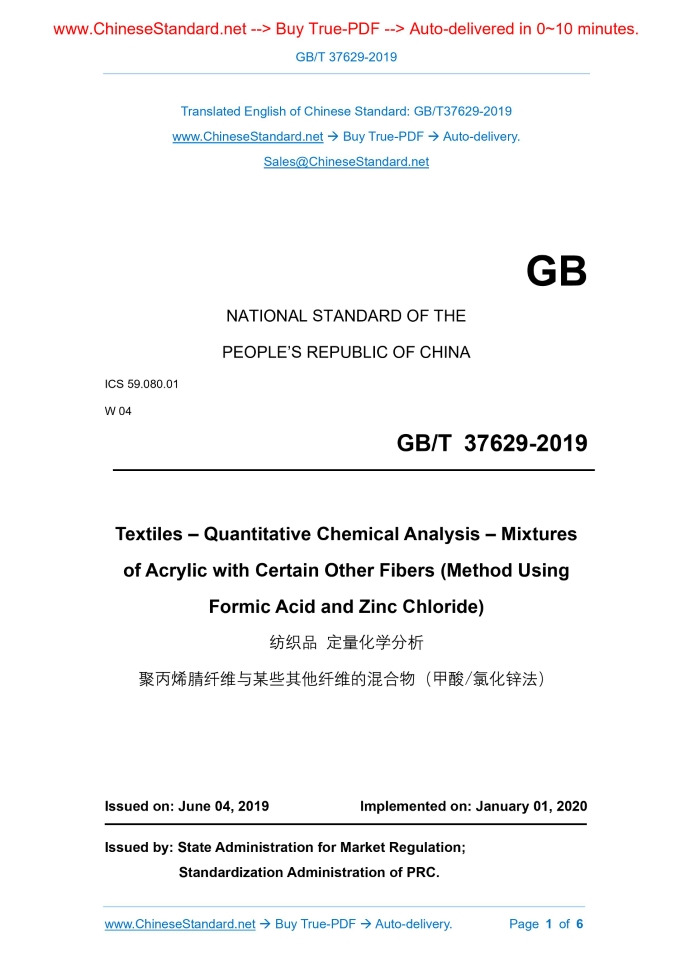
NATIONAL STANDARD OF THE PEOPLE’S REPUBLIC OF CHINA ICS 59.080.01 W 04 Textiles – Quantitative Chemical Analysis – Mixtures of Acrylic with Certain Other Fibers (Method Using Formic Acid and Zinc Chloride) ISSUED ON: JUNE 04, 2019 IMPLEMENTED ON: JANUARY 01, 2020 Issued by: State Administration for Market Regulation; Standardization Administration of PRC.
Table of Contents
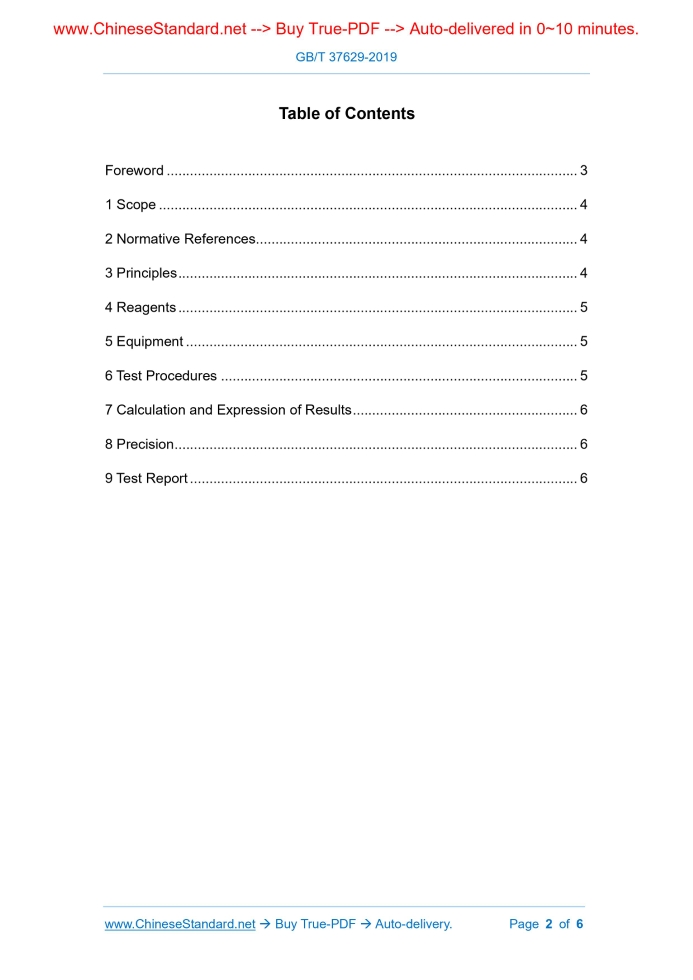
Foreword ... 3 1 Scope ... 4 2 Normative References ... 4 3 Principles ... 4 4 Reagents ... 5 5 Equipment ... 5 6 Test Procedures ... 5 7 Calculation and Expression of Results ... 6 8 Precision ... 6 9 Test Report ... 6Foreword
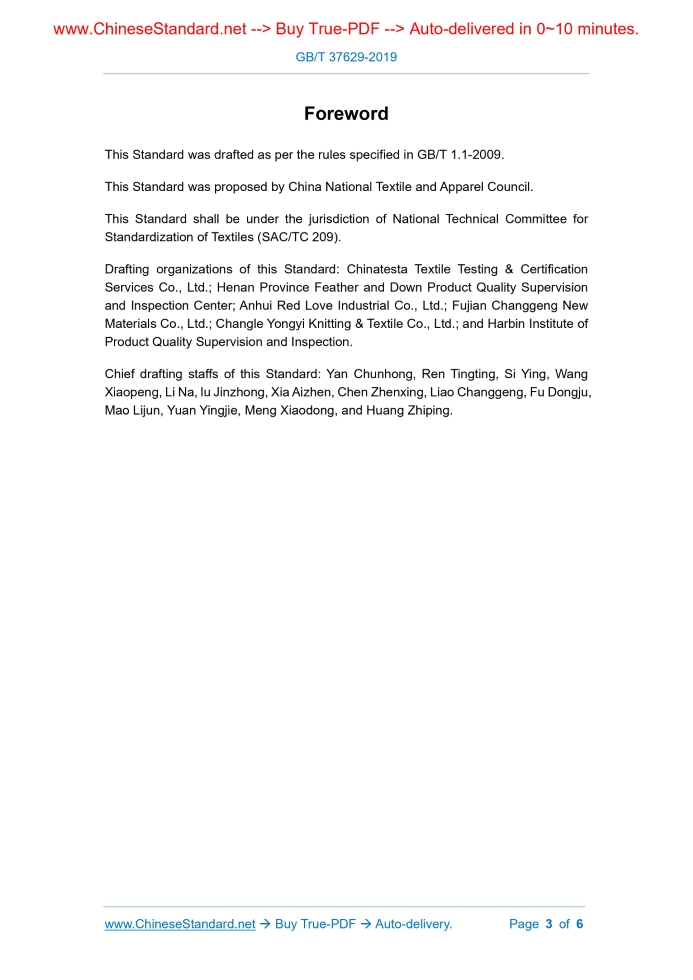
This Standard was drafted as per the rules specified in GB/T 1.1-2009. This Standard was proposed by China National Textile and Apparel Council. This Standard shall be under the jurisdiction of National Technical Committee for Standardization of Textiles (SAC/TC 209). Drafting organizations of this Standard: Chinatesta Textile Testing & Certification Services Co., Ltd.; Henan Province Feather and Down Product Quality Supervision and Inspection Center; Anhui Red Love Industrial Co., Ltd.; Fujian Changgeng New Materials Co., Ltd.; Changle Yongyi Knitting & Textile Co., Ltd.; and Harbin Institute of Product Quality Supervision and Inspection. Chief drafting staffs of this Standard: Yan Chunhong, Ren Tingting, Si Ying, Wang Xiaopeng, Li Na, lu Jinzhong, Xia Aizhen, Chen Zhenxing, Liao Changgeng, Fu Dongju, Mao Lijun, Yuan Yingjie, Meng Xiaodong, and Huang Zhiping. Textiles – Quantitative Chemical Analysis – Mixtures of Acrylic with Certain Other Fibers (Method Using Formic Acid and Zinc Chloride) WARNING: Personnel using this Standard shall have hands-on working experience in formal laboratory. This Standard does not address all possible safety issues; the users are responsible for taking appropriate safety and health measures and ensuing compliance with the relevant national regulations.1 Scope
This Standard specifies the method for determining the fiber content in the mixtures of polyacrylonitrile fiber with certain other fibers after removing the non-fibrous materials by the formic acid/zinc chloride method. This Standard is applicable to the binary mixtures of polyacrylonitrile fiber with wool, other animal fur fibers, cotton, linen, ramie and polyester fibers.2 Normative References
The following documents are essential to the application of this document. For the dated documents, only the versions with the dates indicated are applicable to this document; for the undated documents, only the latest version (including all the amendments) are applicable to this document. GB/T 2910.1 Textiles - Quantitative Chemical Analysis - Part 1: General Principles of Testing3 Principles
Use the formic acid/zinc chloride solution to dissolve and remove the polyacrylonitrile fiber from the mixture with known dry mass; collect the residue; clean, dry, and weigh it; calculate the percentage of the corrected mass accounting for the dry mass of the mixtures. Then calculate the mass percentage of the polyacrylonitrile fiber from the difference. ......Source: Above contents are excerpted from the full-copy PDF -- translated/reviewed by: www.ChineseStandard.net / Wayne Zheng et al.